
Set up segregated streams and record them in your site waste management plan: that single step unlocks higher recycling rates and keeps your project compliant. Regulators expect separated storage for concrete, timber, metal and hazardous materials, with asbestos and silica handled under their own strict procedures. Audits, receival dockets and transfer records are what prove the system actually worked.
TL;DR:
- Proper segregation requires storage of concrete, timber, metal, hazardous, and organic waste in designated, clearly labeled containers to ensure compliance and facilitate recycling.
- Site layout must incorporate accessible storage areas with consistent color coding, signage, and routine inspections to prevent contamination and misuse.
- Handling hazardous waste like asbestos, silica, and chemicals demands strict containment, licensed disposal, and specialized procedures to mitigate health and environmental risks.
- When space is limited, approved co-mingling arrangements and documented transfer protocols can maintain cost-effective waste management without legal breaches.
- Regular monitoring, auditing, and recording of waste transfer documentation are essential to prove waste reaches authorized processing sites and remains compliant.
Table of Contents
- What a site waste management plan must include about segregation
- Core segregation streams and labelling best practice
- On-site storage, placement and safe handling
- Hazardous and priority wastes: asbestos, silica, oils and chemicals
- If your site is tight on space: permitted co-mingling and temporary solutions
- Monitoring, audits and proving waste reached a lawful destination
- Practical checklist and toolbox talk for the team
- Field-tested operational tips from Sydney Sweep and Scrub
- Training and responsibilities of site personnel for effective waste segregation
- Procedures for handling contaminated or mixed waste
- Integration of waste segregation practices with overall site safety and environmental policies
- Communication strategies to ensure compliance by all site workers
- Guidance on procurement and use of suitable containers and equipment for segregation
- How Sydney Sweep and Scrub can support your segregation regime
- FAQ
- Sources
What a site waste management plan must include about segregation
A waste management plan (WMP) is a regulatory requirement for many development applications, and it needs to do more than list waste types. Assessors expect it to estimate quantities, show exactly where segregated storage sits on your site drawings, and name the receival sites that will take each stream. Waste management plans work best when they’re considered from the start of a project rather than bolted on once work begins, because storage and access needs shape early site layout decisions.
Your WMP should cover:
- Estimated waste quantities by material type, based on the scope of works
- Site drawings marking segregated storage areas, vehicle access routes and bin locations
- A list of nominated receival sites with their environmental protection licence (EPL) or development consent details
- A schedule of rates covering transport, recycling or disposal costs and a contingency allowance for unexpected waste volumes
- Evidence requirements: who collects dockets, who files them, and how often they’re reviewed
Leaving any of these out tends to invite follow-up questions from assessors or council officers later, when it’s harder to fix.
Core segregation streams and labelling best practice
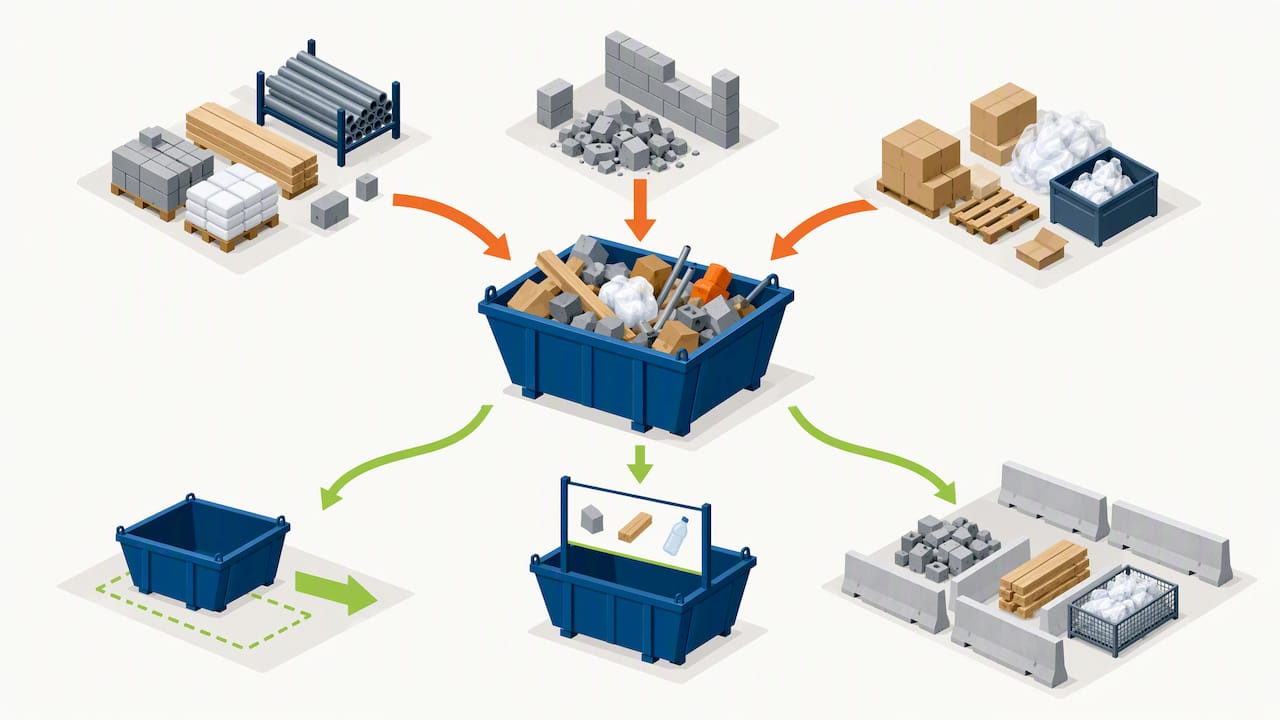
Most sites need the same core streams, even if volumes vary by project type. Concrete and brick, timber, metal, cardboard and paper, mixed recycling, general waste and, where your contractor collects it, organics, all need their own bin or stockpile. Hazardous and priority waste always sits apart from everything else.
Clear labelling stops operatives guessing:
- Concrete/brick bin: broken masonry, tiles, pavers only, no timber or metal fixings attached
- Timber bin: untreated offcuts and pallets; treated timber goes to a separate hazardous stream
- Metal bin: off-cuts, reinforcing steel, banding, fixings
- Cardboard/paper: flattened packaging, free of food contamination
- General waste: anything that genuinely doesn’t fit another stream, not a catch-all for convenience
Use consistent colour coding across the site, the same colours on bins, signage and site inductions, so a new subcontractor can read the system in seconds.
Pro Tip: Photograph each bin or stockpile when it’s set up and again when it’s emptied. It takes seconds and gives you a date-stamped record if a load is ever queried.
On-site storage, placement and safe handling
Storage areas only work if they’re practical to use every day. Position them for easy vehicle access so collection trucks aren’t reversing through live work zones, and keep walking routes clear so operatives aren’t tempted to dump a load somewhere closer.
- Space stockpiles apart to stop runoff or wind-blown material cross-contaminating a clean stream
- Keep lids and covers on bins at all times, not just overnight
- Maintain clear sightlines to signage so labelling actually gets read
- Keep access paths to each bin clear of parked plant or stored materials
- Run a daily check of storage areas as part of the site walk, not as a separate task someone forgets
Bin areas that are hard to reach get misused first. A five-minute daily check catches problems while they’re still small.
Hazardous and priority wastes: asbestos, silica, oils and chemicals
Hazardous materials don’t get the same treatment as general building waste. Asbestos must be contained, clearly labelled and removed only by a licensed removalist, with disposal restricted to authorised receival sites. Contaminated clothing and PPE need their own handling procedure, not a quick shake-off at the end of a shift.
Silica dust requires its own control plan under the model code for respirable crystalline silica, which sets out restricted work areas, respiratory protective equipment, and cleanup and maintenance logs as standard administrative controls. Our guide on silica dust as a site hazard covers the practical side of keeping exposure down during cutting and grinding tasks.
Other priority wastes need the same discipline:
- Oils and solvents: sealed drums, bunded storage, authorised collection
- Treated timber: never mixed with general timber waste
- E-waste: secure, separate collection through an authorised receiver
When in doubt on any of these, stop the task and call a specialist rather than guess.
If your site is tight on space: permitted co-mingling and temporary solutions
Not every site has room for a full set of separate bins. Where space is genuinely limited, agree permitted co-mingling arrangements directly with your waste contractor and record the agreement in your WMP rather than improvising on the day, a practice supported in project WMP guidance for constrained sites.
- Use temporary stockpiles with scheduled transfers to proper skips for sorting off-site
- Photograph each transfer and retain the receival docket as proof of due diligence
- Review the arrangement as the site layout changes through the project
Monitoring, audits and proving waste reached a lawful destination
Segregation only counts if you can prove it worked. NSW EPA guidance on construction and demolition waste makes clear that the site management team carries ultimate responsibility for ensuring waste reaches a lawful destination, regardless of what a contractor tells you verbally.
Build a routine around:
- Daily checks on contamination rate, signage condition and stockpile integrity
- Retained weighbridge tickets, EPL or receival consent documents, and consignment numbers from tracking systems such as WasteLocate
- Periodic audits that feed directly into corrective actions, not just a filing cabinet
- Linking audit results to payment milestones so contractors have a real incentive to keep streams clean
Procurement teams should record transporter details and receival site approvals before work starts, not chase them down after a load has already left site, following proactive maintenance scheduling for landlords principles to integrate waste servicing with contract schedules.
Practical checklist and toolbox talk for the team
A short daily and weekly routine keeps the system running without extra admin.
- Daily: check bin labels are legible, confirm lids are closed, isolate any hazardous waste found out of place, and photograph bin areas
- Weekly: file receival dockets, review audited loads, check signage condition, and confirm contractor evidence has come through
Pro Tip: Run a two-minute toolbox talk each morning: right bin, right material; lids closed, always; hazardous waste stops work, call a supervisor; photograph anything unusual; ask if unsure.
Five rules, repeated often, do more for contamination rates than a thick procedure document nobody reads twice.
Field-tested operational tips from Sydney Sweep and Scrub
We treat segregation as a daily operational task, not a one-off setup. Start and end-of-day checks catch contamination before it compounds, and scheduled mechanical sweeping keeps bin areas accessible so operatives aren’t stepping over debris to reach the right bin. Our tips on safely sweeping a construction site outline how regular sweeps reduce the loose material that ends up in the wrong stream. Photographed transfer evidence and a brief daily log give site managers a paper trail that supports audits without adding real workload.
Training and responsibilities of site personnel for effective waste segregation
Segregation fails most often because nobody on site actually knows the rules, not because the system is poorly designed. Every operative needs a short induction covering which stream takes which material, where hazardous waste gets isolated, and who to call when something doesn’t fit the usual categories.
Responsibilities need to be assigned by name, not left as a general expectation:
- Site manager: owns the WMP, signs off on storage layout changes, reviews audit results
- Supervisors: enforce correct bin use during daily walks, flag contamination immediately
- Subcontractors: responsible for their own waste streams, briefed at induction and at any scope change
- A designated waste coordinator on larger sites: manages dockets, liaises with the contractor, and tracks transfer evidence
Refresher training matters as much as the initial induction. New subcontractors arrive throughout a project, and a system that made sense to the original crew can quietly break down once new faces don’t know the colour coding or where the hazardous waste cage sits. Building a five-minute segregation briefing into every subcontractor’s first day on site closes that gap without slowing anyone down.
Clear accountability also makes audits meaningful. When a bin turns up contaminated, knowing which trade was working nearby and who supervised that area turns a vague problem into a specific conversation and a corrective action, rather than a shrug and a hope it doesn’t happen again.
Procedures for handling contaminated or mixed waste
Contamination happens on almost every site at some point, usually from a rushed moment rather than carelessness. The response matters more than preventing it entirely. When a bin or stockpile is found mixed, the first step is to isolate it rather than top it up further, because adding clean material to a contaminated load only increases what needs re-sorting.
A workable procedure looks like this:
- Stop additions to the affected bin or stockpile immediately
- Assess whether the material can be hand-sorted on site or needs transfer to a mixed-waste skip for off-site processing
- Record the contamination event, including likely cause, so recurring problems get addressed at the source
- Treat any contamination involving hazardous material (asbestos fragments, chemical residue) as a stop-work trigger for that area until a specialist assessment clears it
Mixed loads that can’t be practically re-sorted on site should go to a facility licensed to process mixed construction and demolition waste rather than general landfill, preserving at least some recovery value. This is also where the co-mingling agreement discussed earlier in your WMP becomes useful: if mixing was pre-approved and documented, you’re working within a lawful, recorded arrangement rather than scrambling to justify an unplanned departure from the plan.
Recording contamination events over time gives you a pattern. If the same bin keeps getting mixed, the problem is usually the bin’s location, its signage or the trade working nearest it, not the operatives themselves.
Integration of waste segregation practices with overall site safety and environmental policies
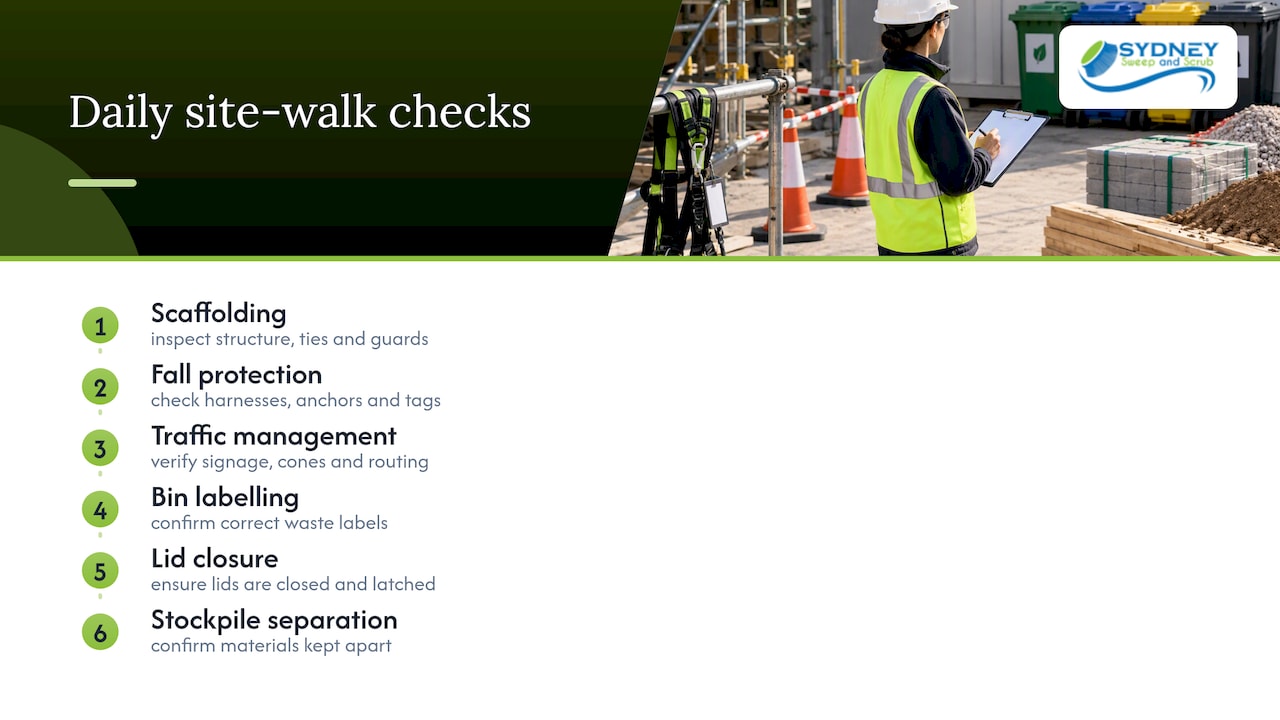
Waste segregation works best when it’s not treated as a standalone system sitting apart from everything else happening on site. The same daily walk that checks scaffolding, fall protection and traffic management can just as easily check bin labelling, lid closure and stockpile separation, because it’s the same supervisor, the same route and the same few minutes added to an existing routine.
Folding segregation into your broader site safety and environmental policy also means it gets reviewed at the same frequency as everything else that matters: toolbox talks, safety inductions and incident reviews. A hazardous waste spill or an asbestos containment breach is a safety incident as much as an environmental one, and treating it that way, with the same reporting line and the same urgency, keeps the response consistent.
Environmental policies that reference your WMP directly, rather than treating it as a separate compliance document, also make audits simpler. When an assessor or council officer reviews your site, they’re more reassured by a system where safety, environmental management and waste handling visibly connect than by three disconnected binders that happen to sit in the same site office.
This integration pays off practically too. Sites that fold waste checks into existing safety walks tend to catch problems earlier, simply because someone is already looking in the right direction every day rather than waiting for a scheduled audit to notice a stockpile has been contaminated for a week.
Communication strategies to ensure compliance by all site workers
A segregation system only works if every worker on site, including last-minute subcontractors, actually understands it. Site inductions are the obvious starting point, but a single mention in an induction pack rarely sticks once someone is three weeks into a busy project.
Repetition across multiple channels works better than one detailed briefing:
- Toolbox talks that repeat the same short rules rather than introducing new ones each time
- Clear, consistent signage at every bin, using the same colours and wording across the whole site
- A visible point of contact (supervisor or waste coordinator) that workers can ask without feeling like they’re raising a problem
- Short visual reminders, such as laminated photos of correctly sorted bins, placed where decisions actually happen
Language barriers matter on sites with diverse crews. Signage that relies on colour coding and simple pictograms, rather than dense text, communicates faster and more reliably than a written procedure that assumes everyone reads English fluently.
Consistency across supervisors matters as much as the message itself. If one supervisor enforces segregation strictly and another lets it slide, workers quickly learn which standard actually applies, and it’s rarely the stricter one. Keeping the same expectations across every shift and every supervisor is what turns a documented policy into an actual site habit.
Guidance on procurement and use of suitable containers and equipment for segregation
The right containers make correct sorting the easy option rather than the effortful one. Bin size and type should match the waste volume and material, not just whatever happens to be available from the hire company that week.
A few procurement principles help:
- Size storage to the quantities estimated in your WMP, not to whatever fits conveniently near the site office
- Use skips with clear, durable signage rather than relying on paint or chalk that wears off within weeks
- Choose bins with secure lids for anything prone to wind-blown contamination, particularly cardboard and light packaging
- Keep a dedicated, clearly separate container for hazardous materials, never a shared skip “for now”
Model design guidance recommends allocating storage space sized to the quantity generated and using standard signage so anyone using the system, including visitors and new starters, understands it without explanation.
Equipment needs reviewing as the project moves through its phases. A demolition stage generates very different volumes and materials than a fit-out stage, and containers sized for one phase often sit half-empty or overflowing once the work shifts. Reviewing container allocation at each major project milestone, rather than setting it once at the start, keeps the system matched to what’s actually happening on site.
How Sydney Sweep and Scrub can support your segregation regime
A segregation system is only as good as the site around it, which is why we treat waste support as part of our everyday cleaning work. We offer rubbish removal, mechanical sweeping and scheduled bin-area servicing that keep storage zones accessible and free of the loose debris that causes contamination.
When you request a quote, ask us about:
- Service frequency that matches your site’s waste generation pace
- Disposal evidence you can file against your WMP
- Invoicing that references the receival sites your waste actually reaches
Our service overview page covers rubbish removal, mechanical sweeping and bin-area cleaning together, and you can request a quote directly through our carpark cleaning and related service pages.
FAQ
What are the five types of waste segregation?
Definitions vary by jurisdiction and project, but a common breakdown separates construction waste into concrete and masonry, timber, metal, cardboard and paper, and general waste, with hazardous materials kept entirely apart. Many sites add a mixed recycling or organics stream depending on what their contractor collects.
How long can waste be stored on site?
Storage duration depends on your site’s waste management plan, container capacity and the type of material, with hazardous waste generally requiring faster, more tightly controlled turnaround than general streams. Check your WMP requirements and your waste contractor’s collection schedule rather than assuming a fixed timeframe applies everywhere.
What are the guidelines for waste segregation?
Guidelines typically require clear labelling, separate storage for each material stream, daily inspection of storage areas, and documented evidence that waste reached an authorised receiver. NSW EPA standards also call for mis-sorted loads to be recorded so recurring contamination gets addressed.
What are the four types of segregation?
A simplified four-category model often groups waste into recyclable, non-recyclable (general), hazardous and organic, though construction sites usually break this down further into specific material streams like concrete, timber and metal for practical sorting. The exact categories your site uses should match what’s recorded in your WMP.
Sources
- Waste management plans — City of Melbourne
- Construction waste management plan — Major Projects example
- Managing asbestos — Asbestos Victoria
- Managing risks of respirable crystalline silica — Safe Work Australia
- NSW EPA — construction and demolition waste