
A compliant compactor pad clean captures and lawfully disposes of all wash water, removes solids before any wet work begins, and uses containment to stop discharge to stormwater. Dry debris comes out first, drains are checked before a hose touches the pad, and liquid waste either goes to sewer under a trade waste approval or leaves site with a licensed transporter.
TL;DR:
- Proper compactor pad cleaning requires confirming sewer connection status and ensuring wastewater is either pre-treated or transported by a licensed waste carrier.
- The cleaning process must follow a strict sequence of dry debris removal, containment setup, liquid capture, scrubbing with appropriate chemicals, and documentation of waste disposal.
- Discharging wash water into stormwater drains is illegal; wastewater must be directed to sewer under approval or offsite disposal with receipts kept for compliance proof.
- Use low-aerosol methods and PPE such as gloves, eye protection, and splash suits to prevent biological hazards spread in bin area cleaning.
- A detailed written brief outlining method, waste disposal, and safety controls protects site owners from liability if pollution occurs during cleaning.
Table of Contents
- Quick pre-booking checklist for managers
- Step-by-step cleaning workflow for a compactor pad
- Trade waste, bunding and lawful wastewater disposal
- WHS, biological hazards and PPE on a compactor pad
- How often should a compactor pad be cleaned
- Choosing a contractor: what to put in the brief
- Sydney Sweep and Scrub: capabilities that map to this job
- Book a compactor pad audit and quote
- FAQ
- Sources
Quick pre-booking checklist for managers
Before you book a contractor, gather the information that determines whether the job can be done lawfully and safely. A rushed booking without these checks is how sites end up with wastewater in the wrong drain.
- Confirm whether a bunded wash bay exists and trace which drains on the pad connect to sewer versus stormwater.
- Ask the contractor how they capture wastewater (catch mats, wet vacs, filtration) and who their licensed liquid waste disposal partner is.
- Request details on the disinfectant they use, its required contact time, and whether their method limits aerosol generation.
- Lock in a schedule around weather and site activity, and confirm a spill kit will be on site during the clean.
A contractor who cannot answer these questions clearly is not ready to work on a compactor pad, regardless of price.
Step-by-step cleaning workflow for a compactor pad
A proper clean follows a fixed sequence. Skipping a step, especially the dry removal stage, is the most common cause of contaminated wastewater reaching a stormwater drain.
- Dry sweep and remove loose debris first, segregating any hazardous solids before wet work starts.
- Set up temporary bunding, drain covers, catch mats and a wet vac or filtration unit to stop any liquid leaving the pad.
- Collect the wastewater for offsite removal, or direct it to sewer only where pre-treatment and a trade waste approval are already in place.
- Mechanically scrub with a detergent suited to trade waste conditions, then apply a disinfectant formulated to work in the presence of organic matter, observing its full contact time.
- Photograph the captured waste, keep the transporter’s collection receipt, and re-inspect nearby drains and stormwater lines before leaving site.
Pro Tip: Ask your contractor to supply before and after photos of bunding and captured waste with every invoice. It is the fastest way to prove compliance if a council or EPA officer ever asks.
This order matters because disinfectants generally need a clean surface to work properly, and workplace guidance from WorkSafe QLD notes that disinfectants can fail when organic matter is not removed first. Scrubbing before disinfecting is not a cosmetic preference. It is what makes the chemical step work at all.
Trade waste, bunding and lawful wastewater disposal
Every compactor pad clean produces wastewater, and that water has exactly two lawful destinations: an approved sewer connection or a licensed transport and disposal service. There is no lawful third option, and that is the single idea every brief should be built around.
EPA NSW’s drain is just for rain guidance is blunt about this: stormwater drains carry rain to waterways, not wash water, and the guidance recommends dry cleaning of spills where possible plus bunding sized for the largest container on site, plus an extra 10%.
Wastewater from a compactor pad clean has no lawful default outlet. Every job needs a confirmed destination before the first bucket of water hits the concrete.
- Never assume a pad drain connects to sewer. Trace it before scheduling wet work.
- Discharging to sewer requires a trade waste approval and working pre-treatment, such as a grease arrestor or oily water separator, serviced on schedule.
- Without an approved sewer connection, wastewater must be captured and removed by a licensed liquid waste transporter, with disposal receipts kept on file.
- Secondary containment, drain covers and a logged inspection history belong in a site’s environmental management plan.
Toowoomba Regional Council’s liquid trade waste guidance confirms that trade waste discharge requires a formal application and ongoing servicing of pre-treatment devices by licensed operators, not a one-off installation.
WHS, biological hazards and PPE on a compactor pad
Bin and compactor areas routinely hold organic and faecal matter, which makes this a biological hazard job, not just a dirty-surface job. The method matters as much as the chemical.
- Favour low-aerosol methods over high-pressure jetting wherever the task allows it.
- Supply gloves, eye protection, respiratory protection where aerosol risk exists, and splash suits, with a clear plan for laundering or disposing of contaminated PPE.
- Clean before disinfecting, and give the disinfectant its full stated contact time rather than wiping it off early.
- Build spill response training, incident logging, and access to handwashing and first-aid facilities into the site’s environmental management plan.
WorkSafe QLD’s biological hazard guidance specifically warns that aerosolising methods can spread biological hazards further than the pad itself, which is why method selection belongs in the brief alongside the chemicals used.
Pro Tip: Keep a spare set of PPE on the truck. A contractor who has to stop and source fresh gloves mid-job is one who did not plan the visit properly.
How often should a compactor pad be cleaned
Frequency depends on footfall, bin turnover, spillage risk and any standing regulatory obligation on the site. A loading dock compactor serving a busy food court needs attention far more often than a low-traffic office bin store.
- Heavy-use sites with daily bin activity and food waste generally need monthly cleaning to control odour and pathogen build-up.
- Moderate-use sites can often run on a quarterly schedule, adjusted after inspection.
- Ask for itemised quotes covering containment and setup, wastewater transport and disposal fees, chemicals, labour and any trade waste application costs.
Costs climb once wastewater has to be collected and transported offsite rather than discharged to an approved sewer connection, and hot water systems or mechanical scrubbers add further to the price. A mobile bin cleaning guidance document from EPA SA lists catchment mats, wet vacs and recirculation systems as the standard capture equipment behind these costs, and notes that operators should work to applicable pressure-washing standards such as AS/NZS 4233.1.
Choosing a contractor: what to put in the brief
A written brief protects you if anything goes wrong after the job, and it forces the contractor to show their method before they turn up.
- Require a method statement that names the capture equipment, the disposal chain and the WHS controls in use.
- Ask for proof of a licensed liquid waste transporter and a sample disposal receipt or manifest.
- Set acceptance criteria in writing: no discharge to stormwater, photographic proof of captured waste, and a signed completion checklist.
- Confirm insurance, WHS policies, staff training records and references before the first booking.
Site managers remain responsible for pollution from their own premises even when a contractor does the physical work, according to EPA SA guidance on illegal dumping penalties, which is exactly why a documented chain of custody for liquid waste matters more than the price on the quote.
Sydney Sweep and Scrub: capabilities that map to this job
We build our process around the containment and disposal requirements above rather than around speed alone. Our operations are set up to support lawful wastewater handling, and we provide checklists and tailored scheduling so compliance does not depend on memory. You can see how we approach bin area cleaning in more detail.
Book a compactor pad audit and quote
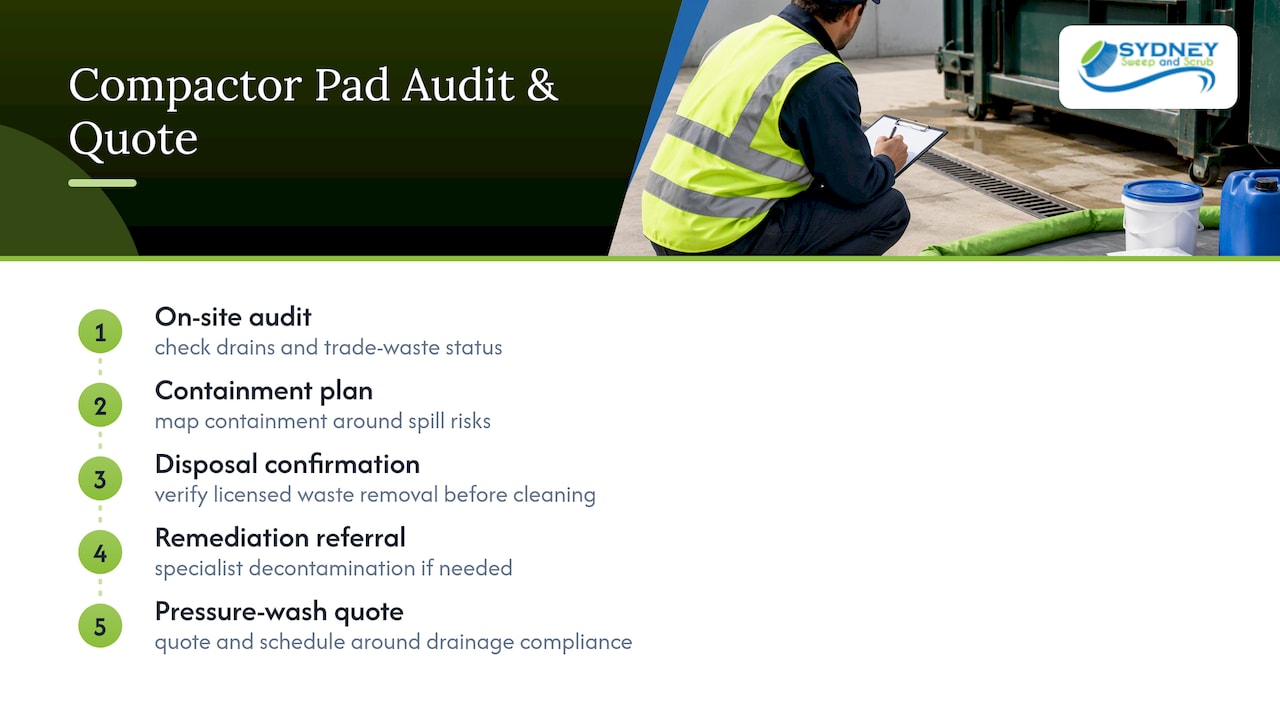
We offer an on-site audit that checks drain connections and trade waste status, maps out a containment plan and confirms licensed waste disposal arrangements before any cleaning starts. For deeper remediation needs, specialists such as Grime Scene Services cover decontamination work outside our scope. For your compactor pad, get a pressure washing quote and we will plan the job around your site’s drainage and compliance needs.
FAQ
Can I just hose down a compactor pad into the stormwater drain?
No. Stormwater drains carry rainwater to waterways, and EPA NSW guidance treats any wash water entering one as a pollution incident. Wash water needs to go to an approved sewer connection with pre-treatment or be captured for licensed offsite disposal.
Do I need a trade waste approval to clean a compactor pad?
You need one only if the wastewater will discharge to sewer, and even then it depends on having working pre-treatment such as a grease arrestor, as outlined by Toowoomba Regional Council. Where no sewer connection or approval exists, wastewater must be captured and removed by a licensed transporter instead.
What PPE does a compactor pad cleaning crew need?
Crews typically need gloves, eye protection, splash suits and respiratory protection where aerosol risk is present, because bin areas carry biological hazards from organic and faecal matter. WorkSafe QLD also recommends low-aerosol cleaning methods to limit how far those hazards spread.
How do I know if my site has a bunded wash bay?
Check whether the pad area has raised edges or kerbing designed to contain spills, and trace where the drains within that area connect before any wash-down. If there is no bunding or confirmed sewer connection, treat the job as requiring full liquid capture and offsite disposal.
Who is responsible if wash water reaches stormwater during a clean?
The site owner or operator typically carries the liability even when a contractor performed the work, as EPA SA’s guidance on illegal dumping makes clear. That is why requesting a documented chain of custody, including disposal receipts and photos, matters before you book any contractor.
Sources
- The drain is just for rain | EPA NSW
- Infection risks from work with sewage | WorkSafe QLD
- Stormwater management for mobile waste bin cleaners | EPA SA
- Liquid trade waste guidance | Toowoomba Regional Council