
Most construction site washdowns in Australia run on a quote-based model rather than a fixed price list, because the final figure depends on site area, contamination type and the access and traffic controls each job needs. Industry pricing calculators put rough cleans at roughly $1.80 to $3.20 per square metre and final or builders’ cleans at $4.00 to $7.50 per square metre, as a directional benchmark, Safe Work Australia’s guidance on dust and water jetting also shapes the scope, which is why a reputable contractor like Sydney Sweep and Scrub will inspect before confirming a price.
TL;DR:
- Site size, contamination type, and access conditions can significantly influence washdown costs, often pushing quotes above the basic per-square-metre range.
- Factors like silica dust, out-of-hours work, and wastewater handling require specialized methods that increase the final price compared to initial estimates.
- Accurate quotes depend on detailed site information, including surface types, contaminants, traffic control needs, and water supply arrangements.
- Contractors should specify their cleaning methods, safety controls, and equipment used to avoid underquoting jobs with silica or safety risks.
- Sydney Sweep and Scrub offers inspections-based pricing for pressure washing, sweeping, and waste removal services tailored to construction site conditions.
Table of Contents
- Indicative cost bands and what they mean
- What changes the price: eight job factors that move a quote
- Compliance and safety that affect scope and cost
- How to get an accurate quote: a 10-point checklist
- Worked example: estimating a ballpark cost
- How to choose a provider and what claims to verify
- Why hire Sydney Sweep and Scrub for construction site washdown
- Sources
- FAQ
Indicative cost bands and what they mean
Per-square-metre bands give you a starting point, not a final number. A touch-up clean between trades, limited to light dust and minor debris, usually sits at the low end of the market. A rough clean after demolition or earthworks, dealing with mud, concrete dust and general site grime, tends to land in the $1.80 to $3.20 per square metre range quoted by industry pricing calculators. A final or builders’ clean ahead of handover, which often includes detailed surface work and waste removal, typically runs $4.00 to $7.50 per square metre according to the same source.
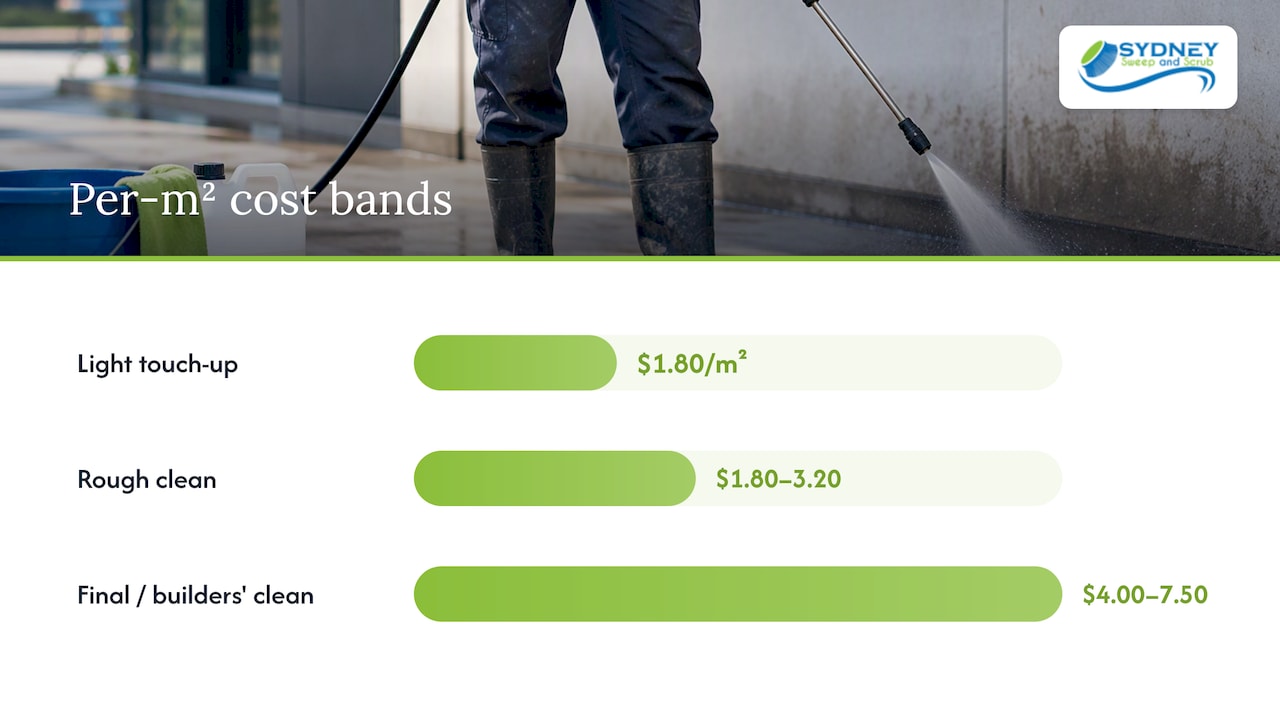
Capital city jobs tend to sit higher in these bands because of labour rates, traffic management requirements and tighter access in dense precincts. At the low end, you will usually find smaller sites with easy water access, minimal contamination and no silica controls required. At the high end, expect larger areas, heavier contamination, specialised plant such as H-class vacuums, and work scheduled outside standard hours to avoid disrupting other trades.
These bands are a planning tool. A site walk will confirm whether your job tracks near the bottom, middle or top of the range, and the OneBookPlus calculator itself recommends treating published figures as directional rather than fixed.
What changes the price: eight job factors that move a quote
A washdown quote moves on a handful of practical variables, and knowing them before you call a contractor makes the conversation faster and the quotes easier to compare.
- Surface type and area: concrete slabs, compacted earth and sealed car parks each respond differently to pressure and chemical treatment.
- Contamination type: mud and general dust clean up faster and cheaper than concrete residue, oil or paint overspray.
- Dust and silica load: sites with cut concrete, brick or stone dust may need wet suppression and specific vacuum classes rather than standard pressure washing.
- Access and gradients: tight laneways, multi-level car parks or sloped sites slow the work and add plant handling time.
- Traffic management: exclusion zones, signage and spotters add a line item, especially on live construction sites.
- Out-of-hours work: cleaning scheduled around other trades or council noise restrictions usually carries a premium.
- Water supply and wastewater handling: sites without mains water access may need tankers, and wastewater capture adds equipment and time.
- Plant mobilisation, travel and waste removal: distance from the contractor’s base and the volume of debris to cart away both affect the final figure.
Each of these factors can shift a quote from the bottom of a published band to well above it, which is why contractors rarely commit to a number before seeing the site.
Compliance and safety that affect scope and cost
Work health and safety requirements are not a formality bolted onto a washdown, they often decide the method used and therefore the price. Safe Work Australia’s guidance on silica states that dry sweeping and compressed air are not recommended for settled dust that may contain crystalline silica, and that control methods should follow the hierarchy of controls, including water suppression and wet cleaning. That single requirement can rule out a quick dry sweep and push the job towards a wet method or M- or H-class vacuuming instead.
High-pressure water jetting carries its own planning obligations. Safe Work Australia’s guide to managing high-pressure water jetting states that work must start with a site inspection and a documented plan covering hazards, controls and emergency procedures, not just a quote for the clean itself.
On larger or multi-trade sites, a safe work method statement (SWMS) is likely, and the principal contractor will usually want the washdown coordinated with other site controls. Expect added cost where the scope includes exclusion zones, PPE and respiratory protective equipment or low-pressure wet methods chosen specifically to manage dust rather than speed.
How to get an accurate quote: a 10-point checklist
Comparable quotes start with giving every contractor the same information. Work through this list before you call around.
- Share site plans, total area and the layout of access points.
- Describe the surface types involved (concrete, asphalt, compacted earth).
- List likely contaminants: mud, concrete residue, oil, paint or dust.
- Flag whether cut concrete, brick or stone work has occurred on site, which raises silica risk.
- State preferred time windows, including any out-of-hours constraints.
- Ask the contractor to specify their proposed cleaning method for dust-prone areas.
- Request confirmation of SWMS coverage and PPE or RPE provisions.
- Confirm who manages exclusion zones and traffic control, you or the contractor.
- Ask whether the contractor supplies water or requires you to arrange tankers.
- Request line-item pricing: labour, plant, travel, traffic control, wastewater handling, waste disposal and any out-of-hours premium.
Pro Tip: Send the same checklist, word for word, to every contractor you approach. It stops vague quotes and makes the line items genuinely comparable.
A contractor who cannot answer the method and PPE questions in points six and seven is likely underquoting a job that has silica risk, a gap worth catching before you sign.
Worked example: estimating a ballpark cost
Say a 1,500 square metre site needs a final clean after the concrete pour, with moderate dust and limited access through one gate. Starting from the $4.00 to $7.50 per square metre band for final cleans, a mid-range estimate of $5.50 per square metre gives a base figure of $8,250.
This figure covers labour and plant only. Traffic control, tanker water and waste disposal are typically quoted as separate line items, and a site walk remains the only way to confirm the final number.
How to choose a provider and what claims to verify
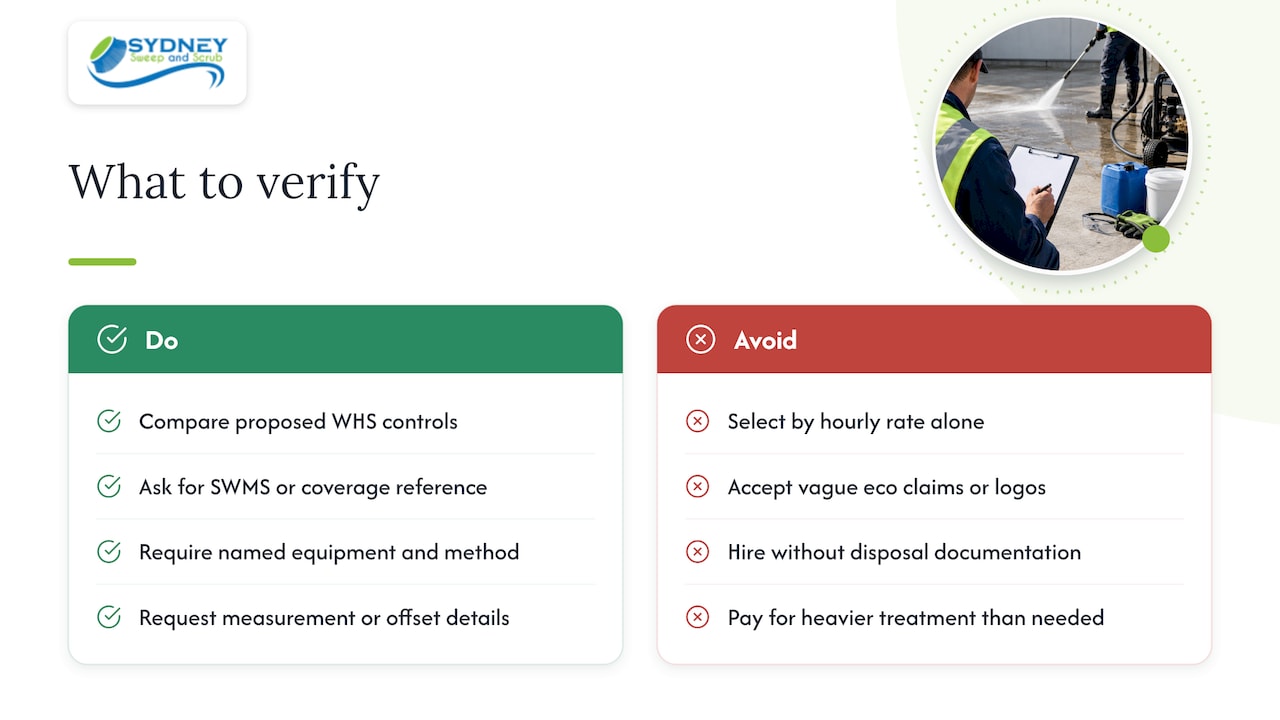
Price alone is a poor filter once WHS requirements are in the mix. Compare providers on the controls they propose, whether they reference SWMS coverage, and whether they name the equipment they will use (low-pressure wet systems, H or M-class vacuums, hot water units) rather than just citing an hourly rate. A provider who can describe their method in one sentence is usually one who has actually planned the job.
Eco or sustainability claims deserve the same scrutiny. A credible water-saving or carbon-neutral claim should come with a description of the process used, some form of measurement, and, where relevant, a named offsetting partner, not just a logo on a website. Choosing the right cleaning method for the surface and contamination also protects you from paying for a heavier treatment than the job needs.
Booking ease, on-site supervision and documented waste handling matter more than they sound. A contractor who tracks what leaves the site and how it was disposed of is less likely to hand you a surprise cost later, and a straightforward online booking process is often a sign of a well-run operation rather than a cosmetic feature.
Why hire Sydney Sweep and Scrub for construction site washdown
If you are managing a site in Sydney and want a contractor who can scope the job properly rather than guess at a number over the phone, Sydney Sweep and Scrub covers the full range of tasks a construction washdown usually needs.
- Pressure washing and hot water cleaning for concrete residue, mud and general site grime.
- Mechanical sweeping and scrubbing for larger paved or sealed areas.
- Rubbish removal to clear debris as part of the same booking.
- Cutting-edge equipment paired with eco-friendly, carbon-neutral operations, so sustainability reporting is part of the service rather than an afterthought.
Booking is handled online, and pricing is set after a site inspection so you get a quote built around your actual access, contamination and timing needs rather than a generic rate. If you want a SWMS-aware quote for your next site clean, start with the pressure washing service page and request an inspection.
Sources
These are the primary references behind the compliance and pricing points in this guide.
FAQ
How much does a construction site washdown cost in Australia?
There is no fixed national price, but industry pricing calculators suggest rough cleans run roughly $1.80 to $3.20 per square metre and final or builders’ cleans roughly $4.00 to $7.50 per square metre. The final figure depends on contamination, access and whether silica controls are needed, so most contractors quote after a site inspection.
Why won’t contractors give a fixed price over the phone?
Site conditions such as surface area, contamination type, access and traffic management all change the scope and labour involved. Safe Work Australia’s guidance on high-pressure water jetting also requires job planning and a site inspection before work begins, which is part of why quotes follow a site walk rather than a phone call.
Does silica dust affect washdown pricing?
Yes. Safe Work Australia’s silica guidance advises against dry sweeping or compressed air for settled dust that may contain crystalline silica, favouring wet suppression or M- or H-class vacuuming instead. These methods take more time and specialised equipment than a standard pressure clean, which typically raises the cost.
What should I ask a contractor to include in a washdown quote?
Ask for line-item pricing covering labour, plant, travel, traffic control, wastewater handling, waste disposal and any out-of-hours premium. You should also confirm the proposed cleaning method, SWMS coverage and PPE or RPE provisions, especially on sites with concrete cutting or demolition work.
Does Sydney Sweep and Scrub offer construction site washdown services?
Yes, a specialist cleaning company provides pressure washing, hot water cleaning, mechanical sweeping and scrubbing, and rubbish removal for construction sites in the Sydney area. Pricing follows a site inspection, and you can request a quote through the pressure washing service page.