
Warehouse spill response cleaning is the routine cleanup of everyday, non-hazardous leaks, oil drips and debris using mechanical sweepers, scrubbers, pressure washing and absorbents. The immediate priority is simple: isolate and contain the spill first, then remove the bulk contamination yourself or call a professional if the spill is large, oily or keeps coming back. Contaminated floors are a serious slip hazard, and most commercial cleaning contractors offer both scheduled and on-demand response to cover it.
TL;DR:
- Proper spill containment involves immediate area isolation and use of absorbents to prevent contamination spread and reduce slip hazards.
- Regular deep scrubbing every quarter or twice yearly is necessary to remove detergent residues and maintain slip resistance, especially in high-traffic areas.
- Dry absorbents and squeegees are ideal for quick oil leaks, while pressure washing requires capturing wastewater to prevent environmental breaches.
- Staff training should emphasize a clear, automatic response process, including responsible roles, documentation, and PPE use for routine spills.
- Contractors must provide detailed method statements, wastewater handling procedures, and proof of training and insurance before being trusted with spill response.
Table of Contents
- Why prompt spill response matters for safety and compliance
- Immediate response checklist when you find a spill
- Professional cleaning methods matched to the spill and floor
- Setting a realistic cleaning schedule for your warehouse
- Choosing and verifying a contractor for spill response cleaning
- Proper PPE for staff handling everyday spills
- Disposing of contaminated absorbents and cleanup materials
- Emergency procedures when a spill is hazardous
- Building spill response training into everyday operations
- Environmental considerations and what to report
- Sydney Sweep and Scrub: services built for spill response
- Sources
- FAQ
Why prompt spill response matters for safety and compliance
A wet or oily patch on a warehouse floor is not a cosmetic problem. Walking on a contaminated floor increases the odds of a slip by close to 14 times, according to WorkSafe Queensland’s guidance on contaminants.
A contaminated floor can raise slip risk by close to 14 times compared with a dry one, according to WorkSafe Queensland. That single figure explains why spill response cannot wait for the next scheduled clean.
Beyond the injury risk, an uncontrolled spill costs a facility in ways that are easy to underestimate: forklift traffic can spread contamination across a whole aisle, stock sitting near a leak can be damaged, and an area cordoned off for cleanup means lost throughput for the shift. There are environmental limits too. Wash-down water carrying oil or chemicals must never be allowed to run into stormwater drains, as EPA NSW’s guidance on spills and wash-down wastewater makes clear, which means any cleaning method that relies on hosing has to be paired with proper capture.
When a warehouse floor is routinely greasy, dusty or littered with pallet debris, it is rarely bad luck. It usually points to a missing system: no defined spill response, no one assigned to check high-risk zones, and no schedule for the deep clean that keeps residue from building up.
Immediate response checklist when you find a spill
The first few minutes after a spill is spotted decide whether it becomes a five-minute fix or a lost shift. Follow the same sequence every time.
- Isolate the area. Put out cones, wet floor signs or physical barriers before anything else, so no one walks through the contamination while you assess it.
- Contain the spread. Ring the spill with absorbent socks, a boom or a drip tray to stop it travelling toward drains, aisles or stock.
- Remove the bulk liquid. Apply a dry absorbent, let it soak in, then sweep it up. Avoid hosing the area toward a floor drain, since that can push contaminants straight into stormwater.
- Escalate when it’s beyond a quick wipe. A large spill, a persistent oil stain, or a leak that keeps recurring from the same pallet or machine is a sign to bring in an on-demand professional cleaner rather than repeating a patch job.
- Record it. Note the time, location, substance and who responded, then notify your WHS contact so the recurring-leak pattern gets tracked rather than ignored.
Pro Tip: Keep a spill kit (absorbent granules, socks, gloves, disposal bags) within sight of high-traffic zones like loading docks, not locked away in a store room.
Professional cleaning methods matched to the spill and floor
Not every spill calls for the same tool. Matching the method to the contaminant and the floor surface is what actually restores safe footing, rather than just moving the mess around.
- Mechanical sweeping and vacuuming clears dry debris, dust and grit, and is the standard first pass before any wet cleaning so liquids don’t turn dust into mud.
- Mechanical scrubbing uses rotating pads and detergent to lift ground-in grease and residue that sweeping alone can’t shift, and it is the method that genuinely restores slip resistance when done properly.
- Pressure washing, hot or cold, cuts through stubborn oil stains and baked-on grime, but the wastewater has to be captured or directed to an approved wash bay rather than left to run toward a drain.
- Dry absorbents and squeegees are the right call for an immediate oil or fuel leak, because they contain the liquid without adding more water to the problem.
The risk with any wet method is leftover detergent film. WorkSafe Queensland’s cleaning guidance warns that detergent residue left on a floor can quietly reduce slip resistance even after the visible spill is gone, which is why periodic deep scrubbing matters as much as the daily wipe-down. Choosing the wrong method for the floor, such as pressure washing a sealed timber surface, can also do more harm than the original spill. More detail on matching method to residue type is covered in this guide to removing grease and oil in a warehouse.
Setting a realistic cleaning schedule for your warehouse
A one-off deep clean fixes today’s spill. It does nothing for next week’s. The cadence that actually holds a floor safe has three layers.
- Daily or per-shift spot checks, with a named person responsible for walking high-risk zones such as loading docks, forklift lanes and racking aisles.
- Weekly to fortnightly mechanical sweeping and scrubbing for warehouses with moderate forklift or pedestrian traffic, to stop dust and light residue building into a slip hazard.
- Quarterly or twice-yearly deep mechanical scrubs, which strip out the detergent residue that routine cleaning leaves behind and reset the floor’s slip resistance.
Traffic and season change the maths. A dock exposed to rain, or a warehouse running extra forklift shifts through a busy season, needs tighter intervals than a low-traffic storage area. SafeWork Australia’s slips, trips and falls prevention guide points to a coordinated system, spot response plus scheduled deep cleans plus documentation, as the combination that actually reduces incidents, rather than any single clean on its own.
Keep a simple log: date, area, method used and photos before and after. That record does double duty, feeding into your WHS risk assessment and giving you proof of due diligence if an incident ever gets reviewed. Practical scheduling checklists are covered further in best practices for warehouse floor maintenance.
Choosing and verifying a contractor for spill response cleaning
Anyone can advertise “warehouse cleaning”. Fewer contractors can show you exactly how they’ll handle your floor and your wastewater, and that’s the gap worth checking before you sign anything.
- Ask for a method statement. It should name the equipment and technique for each floor type and contaminant on your site, not a generic list of services.
- Confirm wastewater handling. Get a direct answer on how they prevent wash-down water from reaching stormwater drains, whether through a funded wash bay, a capture system or an approved sewer connection, in line with EPA NSW’s guidance on spills and drains.
- Check training, insurance and references. Ask for proof of safety training, current insurance, and photos or checklists from comparable jobs.
- Lock down the contract terms. Response times for on-demand call-outs, what happens if staining reappears, and whether the scope covers scheduled maintenance, one-off jobs, or both.
- Require ongoing documentation. A cleaning frequency log and a record of materials used let you track whether slip resistance is actually holding up over time, not just on the day of the clean.
Pro Tip: A contractor who can’t describe their wastewater capture method in one sentence probably doesn’t have one. For a closer look at why mechanical scrubbing specifically warrants a professional rather than a mop and bucket, see why you should get a professional to scrub your warehouse floor.
Proper PPE for staff handling everyday spills
Even a routine, non-hazardous spill deserves basic protective gear, because oils, cleaning chemicals and wet floors all carry their own risks to skin, eyes and footing. Chemical-resistant gloves stop grease and cleaning agents from irritating skin during cleanup and disposal. Closed, slip-resistant footwear matters more than usual on a floor that’s actively wet or oily underfoot.
Safety glasses are worth wearing when handling absorbent granules or any splashing liquid, since grit or droplets can reach the eyes during scooping and sweeping. For anything beyond a light residue, a disposable apron or coveralls keeps contamination off clothing that would otherwise carry it around the rest of the site.
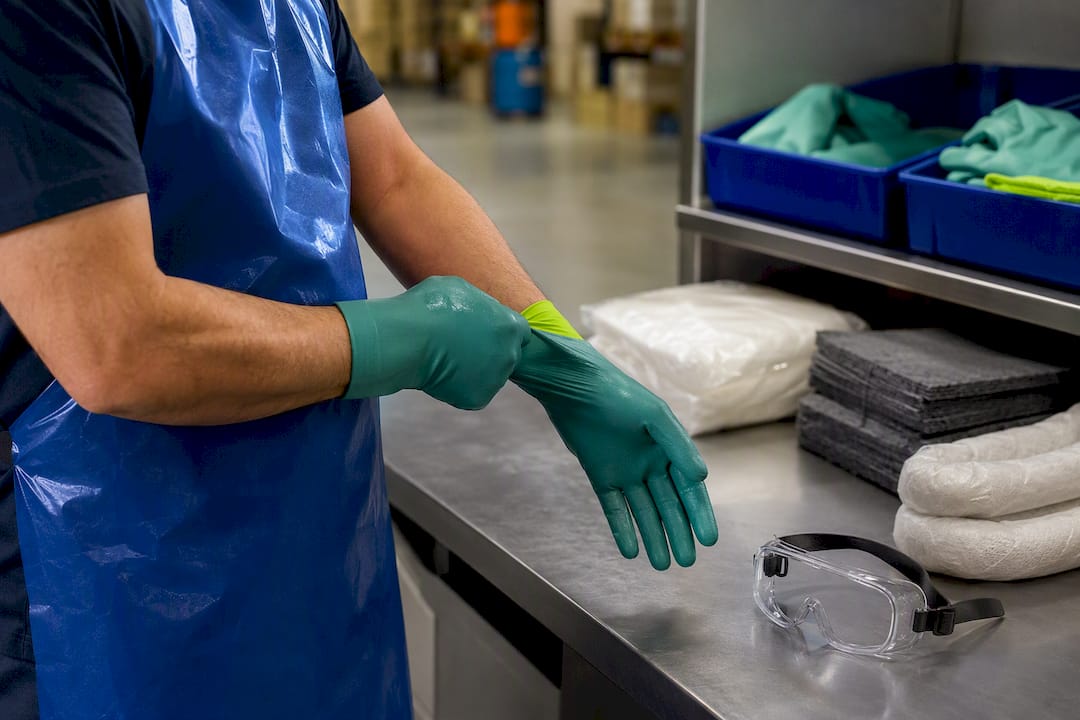
PPE needs to match the substance, not just the size of the spill. A small amount of hydraulic oil still calls for gloves and eye protection, even if the cleanup itself takes two minutes. Keep a basic PPE set in the same spill kit as your absorbents and barriers, so no one has to walk across the site to find gloves while a hazard sits unattended. Once gloves and other PPE have been used on a spill, treat them as contaminated: they go in with the used absorbents, not back into general use.
Disposing of contaminated absorbents and cleanup materials
Used absorbents, soiled rags and any packaging that touched the spill are contaminated waste, not general rubbish, and they need to be bagged and labelled as such straight after cleanup. Mixing them into a normal waste stream risks spreading residue further and can breach your site’s waste handling obligations.
Store contaminated materials in a sealed, labelled container away from drains and stormwater points until they’re collected. For oil-based residues in particular, check whether your waste contractor accepts them directly or whether they need to go through a separate collection stream. A professional cleaning contractor should be able to tell you exactly how they bag, store and dispose of what they collect from your site, and that detail belongs in the method statement discussed earlier.
Where debris removal is a regular part of your spill response, a dedicated waste removal service can handle it alongside the cleanup rather than leaving bagged material sitting on site, as outlined in this overview of commercial waste and cleanup services. Getting this step wrong doesn’t just create a housekeeping problem: it can turn a contained, non-hazardous spill into a compliance issue if contaminated waste ends up somewhere it shouldn’t.
Emergency procedures when a spill is hazardous
Most warehouse spills, oil drips, pallet leaks, coolant seepage, fall well inside the non-hazardous range this guide covers. But it’s worth knowing the line: if the substance is a hazardous chemical, has an unfamiliar smell, is producing fumes, or is leaking from a labelled dangerous goods container, that is a different situation and calls for your site’s formal emergency response procedure rather than a routine cleanup.
In that scenario, the first move is still isolation, evacuate the immediate area and stop anyone from walking through it, but the next step is escalation rather than cleanup. Notify your emergency coordinator or WHS contact immediately, check the substance’s safety data sheet if one is on file, and follow your site’s hazardous materials plan rather than attempting to absorb and sweep it as you would an oil spill.
Every warehouse handling any hazardous stock should have this escalation path documented and known to staff before a spill happens, so no one has to guess in the moment whether a leak is routine or serious. Knowing that boundary, and training staff to recognise it, is what keeps a genuinely hazardous incident from being treated like an everyday oil drip.
Building spill response training into everyday operations
A spill kit and a checklist only work if the person who finds the spill knows what to do with them. Training doesn’t need to be elaborate: it needs to cover the isolate, contain, remove, escalate, record sequence until it’s automatic for anyone on the floor.
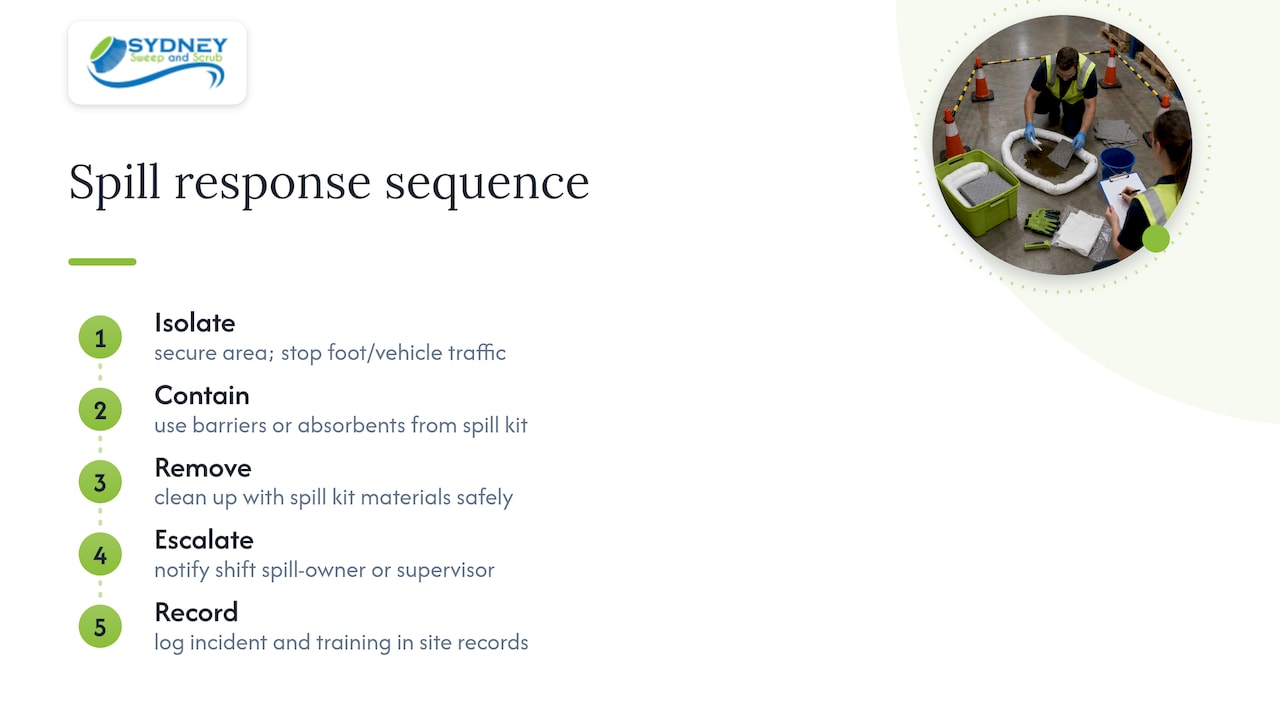
New starters should walk through the site’s spill kit locations and reporting process in their first week, not months later. Refresher sessions, even brief ones, keep the procedure current when equipment locations change or new stock introduces new contaminants. SafeWork Australia’s prevention guide treats this kind of coordinated system, clear responsibilities, spill kits placed where they’re needed, and staff who know the steps, as a genuine control against slip and fall incidents, not just paperwork.
Assign a specific person or role to own spill response on each shift, rather than leaving it as everyone’s job and therefore no one’s. Pair that with the documentation habit covered earlier in this guide: every logged spill and every training session is evidence that your site is managing the risk systemically, not just reacting to it.
Environmental considerations and what to report
Even a routine, non-hazardous warehouse spill has an environmental dimension the moment cleanup water is involved. EPA NSW is explicit that oils, paints and contaminated wash-down water must never reach a stormwater drain, and that bunded wash bays, capture systems or an approved sewer connection are the correct alternatives.
For everyday spills, the practical takeaway is to favour dry absorbents over hosing wherever possible, since dry methods contain the contaminant instead of turning it into wastewater that then needs managing. Where wet cleaning is unavoidable, confirm the water is captured and treated or discharged only through an approved trade waste arrangement.
Reporting obligations scale with severity: a small, contained oil drip that’s cleaned up promptly and disposed of correctly typically doesn’t trigger formal environmental reporting. A spill that reaches a stormwater drain, waterway or the ground outside a bunded area is a different matter and should be reported through your site’s environmental incident process. Facilities with trade waste agreements or environmental licences should also check whether their agreement sets its own notification thresholds for wash-down water, since those can be stricter than the general rule.
Sydney Sweep and Scrub: services built for spill response
Some professional cleaning companies cover the full spill response chain for warehouses: mechanical sweeping to clear debris, mechanical scrubbing to lift ground-in residue, pressure washing for stubborn oil stains, and rubbish removal to clear contaminated absorbents once the job is done. Jobs run on a schedule for routine maintenance or on demand when a spill needs an immediate response.
- Advanced sweeping, scrubbing and pressure washing equipment suited to different floor types and contaminants.
- Eco-friendly operations, with optional waste offset initiatives for clients who want to factor sustainability into their cleaning contract.
- Pricing and an online booking system that makes scheduling a routine clean or requesting an urgent one straightforward.
- Cleaning procedures, trained staff and proof-of-work records so you can verify exactly what was done and when.
If your warehouse needs a scheduled maintenance plan or a same-week response to a recurring leak, you can request a quote through the warehouse cleaning page and get a site assessment organised from there.
Sources
FAQ
What counts as warehouse spill response cleaning?
It’s the routine cleanup of everyday, non-hazardous leaks such as oil drips, pallet leaks and dust, using mechanical sweepers, scrubbers, pressure washing and absorbents. It’s distinct from emergency hazardous chemical response, which follows a separate escalation procedure.
How quickly should a spill be cleaned up?
As soon as it’s spotted: isolate the area, contain the spread with absorbents or a drip tray, then remove the bulk liquid before it spreads or dries into a harder stain. Contaminated floors carry a sharply higher slip risk, according to WorkSafe Queensland, which is why delay is the main thing to avoid.
Can I hose a spill into the floor drain?
No. Wash-down water carrying oil or other contaminants must not enter a stormwater drain, according to EPA NSW, and should instead go through a bunded wash bay, a capture system or an approved sewer connection.
How often should a warehouse floor get a deep mechanical scrub?
Most moderate-traffic warehouses do well with weekly to fortnightly sweeping and scrubbing, plus a deeper mechanical scrub every quarter or twice a year to remove detergent residue. Docks, wet weather and heavier forklift use all justify tightening that schedule.
What should I ask a cleaning contractor before hiring them for spill response?
Ask for a method statement covering equipment and technique per floor type and contaminant, and confirm exactly how they handle wash-down wastewater so it doesn’t reach stormwater. Some cleaning contractors can supply documented procedures, trained staff and proof-of-work records as part of that verification.