
If you find dumped rubbish, call 000 only when there is a fire, a chemical spill or visible asbestos putting people at risk. For everything else, report it through RIDonline or your state EPA or your local council, and take photos of the waste, the location and any vehicle involved before anyone touches it.
TL;DR:
- Reporting should include exact location, time-stamped photos, vehicle details, and witness contact information to improve chances of a successful investigation.
- Enforcement actions vary by jurisdiction and can include fines, clean-up notices, or court prosecutions, especially for hazardous or repeat offenders.
- Landowners and councils are responsible for clean-up if the offender cannot be identified, but hazardous waste like asbestos requires specialized removal.
- Preventative measures such as CCTV, signage, improved lighting, and accessible disposal options can reduce repeat dumping hotspots.
- Professional clean-up crews are recommended for large, hazardous, or urgent dumping sites to ensure safety, compliance, and efficient restoration.
Table of Contents
- What counts as illegal dumping and common examples
- How to report illegal dumping and what evidence to collect
- Responsibility, enforcement powers and likely penalties
- Safe clean-up steps for landowners and councils
- Funding, rebates and official support routes for councils and land managers
- Practical prevention measures for hotspots and repeat dumping
- When to call in a professional clean-up crew
- Getting your site clean and back in use
- Sources
- FAQ
What counts as illegal dumping and common examples
Illegal dumping is depositing waste on land or in public spaces without the permission of the landowner or the required approvals, and it covers far more than a single old mattress on the nature strip. Most councils allow a set number of bulky item kerbside collections each year, arranged by booking, and anything left outside that arrangement, or left by someone other than the resident who booked it, can be classed as illegal dumping.
The scale ranges from a few bags of household rubbish to loads of construction material tipped in bushland. Common examples include:
- Bulky household items such as furniture or whitegoods left on kerbs without a booked collection
- Builders’ waste, bricks or plasterboard dumped on vacant land or in reserves
- Tyres, mattresses and appliances abandoned in bushland, waterways or car parks
- Green waste and garden clippings dumped over fences into public reserves
- Commercial or trade waste placed in public bins to avoid disposal fees
Dumping clusters around industrial estates, bushland tracks, laneways and the edges of car parks, often where access is easy and passing traffic is low. When the offender cannot be identified, the clean-up cost usually falls to the landowner, whether that is a council, a private land manager or, in some cases, a homeowner whose property line borders public land.
How to report illegal dumping and what evidence to collect
A report with strong evidence is far more likely to lead to an outcome than a bare description of “someone dumped stuff here.” EPA Victoria notes that community reports and shared information are vital to investigations and have helped secure successful prosecutions, and in New South Wales, RIDonline forwards reports to the relevant council or agency so investigators can act before the evidence is cleared away.
Work through this checklist before you contact anyone:
- Note the exact location, including the street address or GPS coordinates.
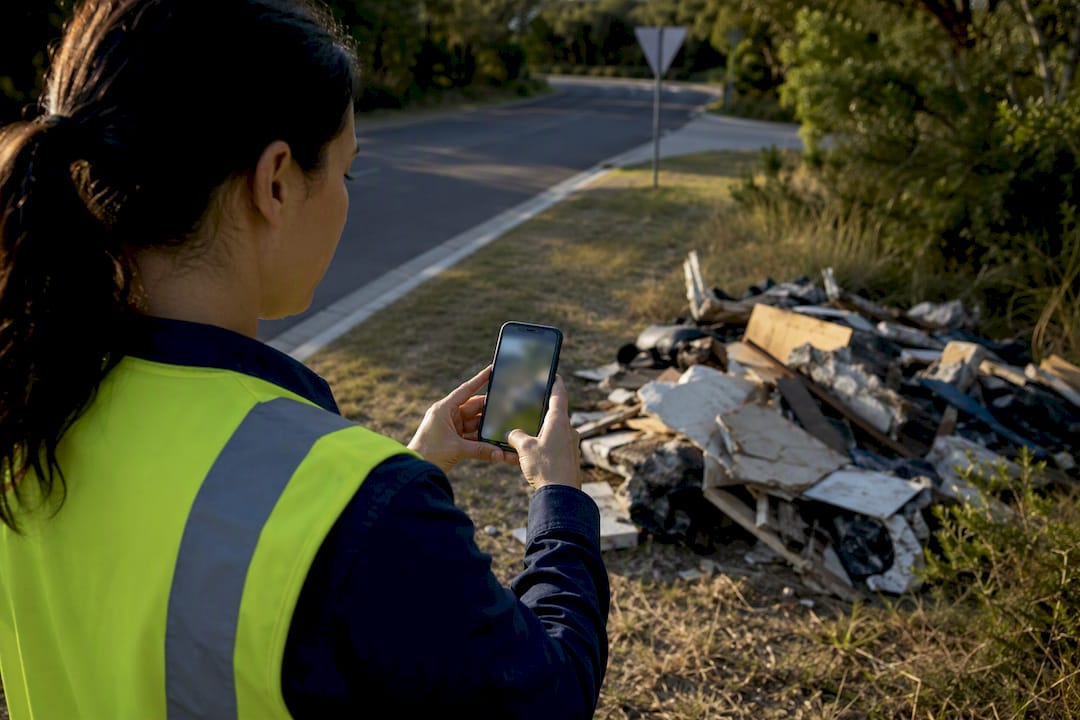
- Take time-stamped photos and, where possible, a short video of the waste and its surrounds.
- Record the vehicle registration, make and colour if a vehicle is involved or was seen leaving.
- Note the date and time you found the waste, and roughly how long it may have been there.
- Collect any witness names and contact details if someone saw the dumping happen.
- Check for paperwork in the waste itself, such as invoices, tip receipts or addressed mail, which can identify the source.
- Submit the report through RIDonline, your state EPA’s reporting tool, or your council’s online form, attaching photos and vehicle details in the fields provided.
- Keep a copy or reference number of your submission so you can follow up if nothing happens within a reasonable time.
Practical guidance from EPA Victoria points out that evidence such as CCTV footage and vehicle registration details often makes the difference between a closed file and a successful outcome, and investigators tend to prioritise reports that include a registration plate and clear time-stamped photos.
Pro Tip: Photograph the waste from several angles and include a landmark or street sign in at least one shot, so investigators can confirm the exact location without needing to visit in person.
Responsibility, enforcement powers and likely penalties
When the person responsible can be identified, the person who deposited the waste is usually liable, and transporters and businesses that arranged for waste to be moved can also be held responsible if they knew or should have known it would be dumped illegally. When no one can be identified, responsibility for clean-up generally sits with the landowner, which is why councils and land managers end up footing so many bills for other people’s rubbish.
Enforcement options vary by jurisdiction but typically include:
- On-the-spot fines issued to individuals or businesses caught dumping
- Clean-up notices requiring a landowner or responsible party to remove waste within a set timeframe
- Prosecution through the courts for serious or repeat offences
- Higher penalties where asbestos or significant environmental harm is involved
NSW EPA guidance lists these enforcement powers and penalty ranges, including elevated penalties for asbestos and large-scale dumping offences.
Councils, EPA staff and police often share enforcement roles depending on the scale and location of the dumping, with local government usually handling routine household-scale waste and EPA teams stepping in for larger volumes or hazardous material.
Case files and prosecutions referenced in state guidance show enforcement is applied selectively, targeting repeat offenders and larger commercial dumping over one-off household infractions.
Safe clean-up steps for landowners and councils
Before any waste is touched, assess the risk. Look for signs of chemical containers, unusual odours, fibrous grey sheeting or anything that might be asbestos, and treat these as reasons to stop and call for help rather than continue clearing the site yourself.
- Document the site first with photos and notes before anything is moved or disturbed.
- Secure the area if it is safe to do so, using tape or temporary fencing to keep people and pets away.
- Never disturb material you suspect is asbestos or another hazardous substance.
- For routine, non-hazardous waste, arrange a licensed waste carrier and keep the weighbridge receipt as proof of correct disposal.
- Keep disposal records for every load, including the date, volume and destination facility.
Routine waste, such as furniture, green waste or general rubbish, can usually be cleared by council crews or a licensed contractor once the site has been documented and secured. Getting a weighbridge receipt for each load matters more than it sounds: it is the paper trail that supports insurance claims, rebate applications and any later enforcement action.
Hazardous waste and suspected asbestos are a different matter entirely. Council and EPA guidance is consistent on this point: do not touch it. Contact a licensed asbestos removalist and your council or EPA for directions on next steps. Where asbestos is confirmed, council guidance explains that material must usually be wetted down, double-bagged in approved heavy-duty bags, sealed and labelled, then delivered to a licensed asbestos receiving facility. Skipping this process increases both health risk and the size of any penalty if the removal is later found to be non-compliant.
Pro Tip: If you are a strata manager or landowner making an insurance claim for clean-up costs, keep every photo, weighbridge receipt and correspondence with council in one file from day one, since insurers and rebate programs both ask for this documentation.
Funding, rebates and official support routes for councils and land managers
Clean-up costs add up quickly, especially for councils dealing with repeat hotspots, so it is worth knowing what financial support exists before assuming the bill has to be absorbed locally.
- The Illegal Dumping Clean-Up Rebate provides funding support for local government authorities and other land managers to cover eligible clean-up costs.
- RID squads and similar taskforce arrangements offer investigative and enforcement assistance to councils dealing with organised or repeat dumping, on top of direct clean-up funding.
- Programs typically expect applicants to provide evidence such as photos, disposal receipts and cost breakdowns before reimbursing eligible expenses.
Queensland’s Local Government Illegal Dumping Partnerships Program illustrates the scale of the problem where funded enforcement exists: participating councils investigated thousands of reports and removed a very large volume of illegally dumped waste under the program. That volume shows why cost recovery pathways matter as much as prevention.
Common exclusions in rebate schemes include waste from a landowner’s own activities, costs already covered by another grant, and clean-ups lacking proper documentation. Councils applying for support should keep a running file of every incident, its clean-up cost and the paperwork behind it, since incomplete records are the most common reason applications stall.
Practical prevention measures for hotspots and repeat dumping
Stopping repeat dumping is almost always cheaper than cleaning it up again and again. The 2025 NSW Illegal Dumping Research Report found that councils most commonly rely on surveillance, signage, fines and community education, but rate education and improved service access as the most effective tools for household and green waste specifically.
- Install CCTV, lockable bin enclosures and fencing at known hotspots to reduce easy access.
- Add clear signage and improve lighting in areas prone to repeat dumping.
- Offer accessible bulky item collection and simple booking systems, since cost and access barriers are a recognised driver of dumping.
- Run local education campaigns and use hotspot data to target patrols where dumping actually happens.
Reducing friction in lawful disposal options, alongside consistent enforcement, tends to bring dumping rates down faster than penalties alone.
When to call in a professional clean-up crew
Large volumes, contaminated sites or time-sensitive situations, such as a car park that needs to reopen the next day, are where a professional crew earns its keep rather than a weekend of volunteer labour. Professional clean-up crews handle this kind of job for property managers, councils and site operators across warehouses, car parks, construction sites and public spaces.
- Mechanical sweeping and scrubbing for large paved areas covered in dumped debris or residue
- Pressure washing and hot water cleaning to remove staining left behind after waste is cleared
- Rubbish removal and coordinated disposal, with documentation to support insurance or rebate claims
- Support for bin enclosure and communal waste areas prone to repeat dumping at apartment and strata properties
Before hiring any contractor, ask for their ABN, relevant licences, a written quote, disposal receipts for the waste they remove, and proof of insurance. A contractor who cannot produce these on request is not one to trust with a hazardous or large-scale job.
Getting your site clean and back in use
Once the reporting and evidence gathering is done, the practical problem remains: someone has to physically clear the site. Professional clean-up crews work with property managers, councils, strata operators and construction sites to handle this kind of job, from a single dumped load in a car park to a contaminated warehouse floor that needs to be operational again fast.
Some cleaning businesses run eco-friendly, carbon-neutral operations, allowing clients dealing with dumped waste to address the clean-up and sustainability goals in the same job. Booking is often handled online, with competitive pricing and quotes tailored to the job rather than a generic call-out rate. For a car park, warehouse or public space affected by dumping, the services overview covers mechanical sweeping, scrubbing, pressure washing and rubbish removal, and a quote can be arranged directly through Sydney Sweep and Scrub.
This article is general information, not a substitute for advice from a qualified lawyer. Consult a qualified legal professional about your own circumstances before acting on anything here.
Sources
- Report illegal waste dumping | EPA Victoria
- Illegal Dumping Clean-Up Rebate – Environment Victoria
- Report illegal dumping | NSW EPA (RIDonline)
FAQ
What are some examples of illegal dumping?
Common examples include bulky household items left out without a booked council collection, construction waste tipped in bushland or vacant land, tyres and whitegoods abandoned in reserves, and trade waste placed in public bins to avoid disposal fees. Dumping ranges from a single item to large loads of commercial or building waste.
What can you do if someone dumps rubbish on your property?
Document the waste with photos and notes before moving anything, then report it to your council or state EPA through their online reporting tool. If the waste looks hazardous, such as suspected asbestos, do not touch it and contact a licensed removalist or your council for directions instead.
What are the penalties for illegal dumping in New South Wales?
Penalties range from on-the-spot fines to prosecution through the courts, with higher penalties applying where asbestos or significant environmental harm is involved, according to NSW EPA guidance. Clean-up notices can also be issued requiring the responsible party to remove the waste within a set timeframe.
What should I do if someone dumped rubbish outside my house?
Take time-stamped photos of the waste, the location and any vehicle involved, then report it to your council or through your state’s official reporting portal, such as RIDonline. Avoid moving the waste yourself until you have documented it, since photos and vehicle details often help investigators act on the report.