
Commercial pressure washing in Australia typically costs between $2 and $6 per square metre for standard hardstand areas, or $120 to $200+ an hour for smaller and more complex jobs, according to industry pricing data. That’s commercial and industrial pricing, not residential driveway rates. The one number that matters more than any range: book a site inspection before you sign anything, because scope changes the price fast.
TL;DR:
- Commercial pressure washing costs in Australia range from $2 to $6 per square meter for standard surfaces, but heavily contaminated sites can exceed $10 per square meter.
- Site variables such as surface material, contamination type, and accessibility significantly influence the final price, with wastewater handling and permits often adding substantial costs.
- Quotes should include wastewater capture and disposal details, as non-compliance can lead to fines and administrative charges, especially near stormwater drains.
- Scheduled maintenance contracts typically offer lower overall costs over time by reducing heavy remediation and enabling better budget predictability.
- Eco-friendly detergents usually add minimal extra cost but demand proper wastewater management, which is factored into compliance and final pricing.
Table of Contents
- Pressure washing cost Australia: pricing bands for car parks, warehouses and hardstand
- What actually drives the cost of a pressure washing job?
- How do you compare pressure cleaning prices in Australia fairly?
- What safety and environmental rules affect your pressure washing quote?
- Procurement checklist: what to ask before you sign a contract
- Do maintenance contracts actually reduce pressure washing costs?
- How does seasonal demand change pressure washing prices?
- Residential vs commercial pressure washing: why the price gap exists
- What makes up the final invoice: labour, materials and equipment
- Do eco-friendly detergents cost more for commercial cleaning?
- Sydney Sweep and Scrub: getting a real quote for your site
- Sources
- FAQ
Pressure washing cost Australia: pricing bands for car parks, warehouses and hardstand
Most Australian contractors price commercial jobs one of three ways: by the square metre, by the hour, or as a fixed project fee. Which model you get depends on the site, not the contractor’s preference.
For large open areas like car parks and warehouse floors, expect $2 to $6 per square metre for standard cleaning with light to moderate soiling. Heavily contaminated surfaces, oil-stained bays, gum-covered footpaths, tyre marking, can push that above $6 to $10+ per square metre once degreasing and extra passes are factored in, per Aus Pro Commercial Cleaners’ pricing breakdown.
Hourly rates suit smaller or irregular-shaped sites where a per-m² quote doesn’t make sense, and typically sit at $120 to $200+ per hour depending on equipment and crew size. Some contractors quote per 100 square metres instead, particularly for line-item comparisons across multiple sites.
A few things move these numbers around:
- Regional variation: pricing in Sydney, Melbourne, Perth and Canberra differs by local market conditions, with capital cities generally sitting at the higher end of national bands.
- Site accessibility: multi-level car parks and confined loading docks cost more than open hardstand.
- Frequency: one-off jobs cost more per visit than sites on a scheduled programme.
None of these ranges are quotes. They’re a starting point for sense-checking what lands in your inbox.
What actually drives the cost of a pressure washing job?
Two sites of the same square metre age can attract wildly different quotes once you factor in the variables below. Contractors aren’t padding numbers, they’re pricing risk and time.
- Surface material and finish. Concrete, asphalt, painted line markings and timber decking all behave differently under pressure. Painted surfaces and softer substrates often need a soft-wash approach rather than high-pressure jetting, which changes both method and price.
- Contamination type. Dust and loose dirt clean up fast. Oil, grease, rust staining and chewing gum need chemical pre-treatment and multiple passes, which adds labour and detergent cost.
- Access and site complexity. Vertical surfaces, confined spaces, rooftop car parks and live traffic areas all require extra staging, traffic management, or working-at-heights controls. A basement car park with tight clearances takes longer than an open yard of the same size.
- Water supply and wastewater handling. Sites without a mains connection need water carted in. Sites near stormwater drains need capture and licensed disposal, which is often the single biggest line item contractors add once they’ve seen the site.
- Permits and council restrictions. Some councils require permits for wastewater discharge or restrict working hours in residential-adjacent commercial zones, adding administrative time to the job.
The surface and contamination variables explain why two “car park cleans” can be quoted a thousand dollars apart. The access and wastewater variables explain why the same job costs more in a CBD basement than in an outer-suburb industrial estate.
How do you compare pressure cleaning prices in Australia fairly?
Reading a quote properly means knowing what’s baked in and what gets added later. A cheap-looking number that excludes wastewater handling isn’t actually cheaper.
Standard inclusions in most commercial quotes:
- Labour for the crew on site
- Pressure washing equipment, including hoses, wands and pumps
- Standard detergents for general dirt and grime
- Basic set-up, signage and clean-up at job’s end
Common extras that show up once the contractor sees the site, according to Aus Pro Commercial Cleaners:
- Wastewater pump-and-haul or tanker disposal for sites near stormwater infrastructure
- Heavy degreasing chemicals for oil bays or loading docks
- Traffic control and signage for live car parks or roadside frontages
- Graffiti removal, which often needs different chemicals and technique than general grime
On pricing models: per-m² suits large flat areas you can measure easily. Hourly rates suit small or irregular jobs. Fixed project pricing suits one-off jobs with a defined scope. A maintenance retainer suits sites that need repeat cleaning and want predictable monthly costs instead of one-off invoices.
What safety and environmental rules affect your pressure washing quote?
Safety and environmental compliance aren’t optional extras bolted onto a quote, they’re baked into how a compliant contractor prices the job from the start.
Safe Work Australia’s guidance on high-pressure water jetting sets out WHS duties for the person conducting the business, including operator training, plant maintenance and control measures for jet-related injuries. A contractor who can’t describe their safe operating procedure in writing isn’t one you want on a car park with pedestrian traffic.
Environmental rules carry real financial teeth. Letting polluted wash water run into stormwater drains breaches the Protection of the Environment Operations Act 1997, and councils can issue Clean Up Notices with administration fees on top of any fine. EPA guidance recommends wastewater capture, holding tanks, and avoiding cleaning on windy days when runoff is harder to contain.
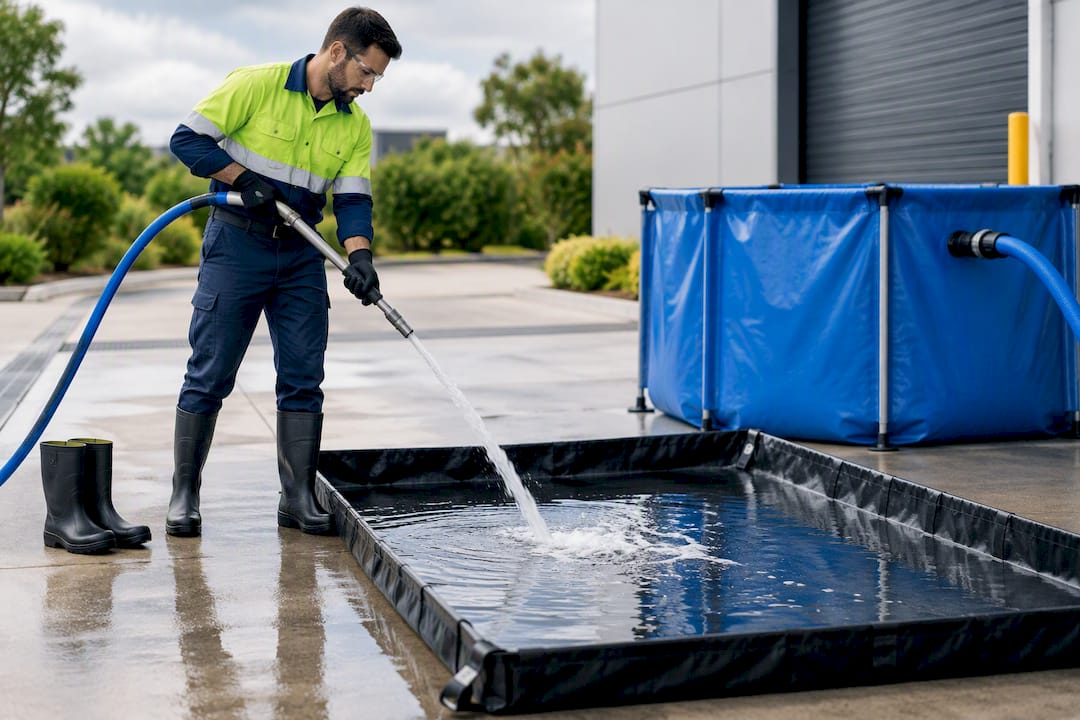
Pro Tip: Ask every quoting contractor one direct question: “Where does your wastewater go?” A vague answer is a red flag. A specific answer, capture mats, a tanker service, a trade waste agreement, tells you they’ve priced compliance into the number, not left it as a surprise.
Wastewater capture and lawful disposal is often the single largest add-on cost on industrial jobs, particularly inner-city sites with limited stormwater buffer. Compliant methods cost more upfront. They also mean you’re not the one holding a Clean Up Notice six months later.
Procurement checklist: what to ask before you sign a contract
A written scope beats a verbal estimate every time. Use this sequence when evaluating contractors for a commercial or strata job.
- Request a site inspection before any fixed quote, not after.
- Insist on a written scope of works that names inclusions and exclusions explicitly.
- Confirm the pricing model, per m², hourly, or fixed project, matches the site type.
- Ask for evidence of WHS training and plant registration where high-pressure equipment requires it.
- Require a wastewater management plan showing how runoff will be captured and disposed of.
- Check insurance certificates and ask for two recent commercial references.
- Clarify scheduling flexibility around your site’s operating hours and foot traffic.
Practical RFQ questions worth adding to your tender pack:
- What is your hourly or per-m² rate, and what triggers a variation?
- How do you handle wastewater on sites without stormwater buffer?
- What’s your average response time for urgent or after-hours jobs?
- Can you provide a Safety Data Sheet for the detergents you use?
- Do you carry public liability insurance, and at what level?
- What’s included in a standard clean versus a deep clean?
- How do you manage traffic control on live car parks?
- Can you supply references from similar-scale sites?
Do maintenance contracts actually reduce pressure washing costs?
Scheduled cleaning almost always beats reactive, one-off cleaning on total cost. Heavy contamination builds up between visits, and the longer it sits, the more chemical treatment and labour it takes to remove.
- Monthly or quarterly retainers typically reduce per-visit pricing compared with one-off callouts, because scheduled programmes smooth labour and cut heavy remediation frequency.
- Bundled services save money too. Combining mechanical sweeping, scrubbing and pressure washing on the same visit cuts mobilisation costs versus booking three separate contractors.
- Budget framing matters. Treat scheduled cleaning as an operational expense line rather than a capital one, it’s predictable, recurring, and easier to forecast against annual facility budgets than surprise deep-clean invoices.
For strata car parks and warehouses with consistent foot or vehicle traffic, a retainer contract is usually the cheaper path over a 12-month view, even though the monthly invoice looks higher than a single one-off job.
How does seasonal demand change pressure washing prices?
Demand for commercial pressure washing isn’t flat across the year, and pricing tends to follow it. Spring and early summer see a spike in bookings as property managers schedule pre-summer cleans ahead of higher foot traffic and outdoor events, which can stretch contractor availability and push quoted timelines out.
Post-storm periods create short-term demand surges too. Heavy rain events that wash silt, leaf litter and debris into car parks and loading docks often trigger a wave of urgent bookings, and contractors with limited crew capacity may charge a premium for expedited scheduling.
Winter months in most Australian states tend to be quieter for exterior commercial cleaning, which can work in a facility manager’s favour. Contractors with spare capacity are often more flexible on scheduling and, in some cases, pricing, particularly for maintenance contract sign-ups that lock in year-round work.
Construction-related cleaning follows its own cycle, tied to project completions rather than the calendar. Site handover cleans cluster around practical completion dates, which means demand for construction site pressure washing can spike independently of general seasonal patterns.
The practical takeaway for procurement: booking scheduled maintenance work outside peak demand windows, or locking in an annual contract instead of one-off bookings, gives you more leverage on both price and availability than chasing quotes during a seasonal rush.
Residential vs commercial pressure washing: why the price gap exists
Residential and commercial pressure washing operate on different pricing logic entirely, and comparing the two directly is one of the more common mistakes procurement teams make when benchmarking quotes.
Residential jobs, driveways, small patios, single-storey house exteriors, are typically quoted as flat job prices because the areas are small and access is straightforward. Commercial work is priced per square metre or per hour precisely because the areas are larger, more variable in surface type, and often carry compliance obligations residential jobs don’t.
Commercial rates in Australian pricing guides commonly sit at $2 to $5 per square metre, which looks cheaper per square metre than a residential job, but the total cost is naturally higher given the scale of a warehouse floor or multi-level car park versus a suburban driveway.
The other key difference is regulatory exposure. A residential job rarely triggers Protection of the Environment Operations Act scrutiny. A commercial site next to a stormwater drain, or a construction site with concrete slurry runoff, absolutely does. That compliance layer is baked into commercial pricing in a way it simply isn’t for a homeowner’s back patio.
If you’re benchmarking a facility quote against a residential price you saw online, you’re comparing two different products. Commercial pricing reflects scale, access complexity, and regulatory risk that residential work doesn’t carry.
What makes up the final invoice: labour, materials and equipment
Every commercial pressure washing invoice breaks down into three broad cost components, and understanding the split helps you spot an unusually high or low quote before you sign.
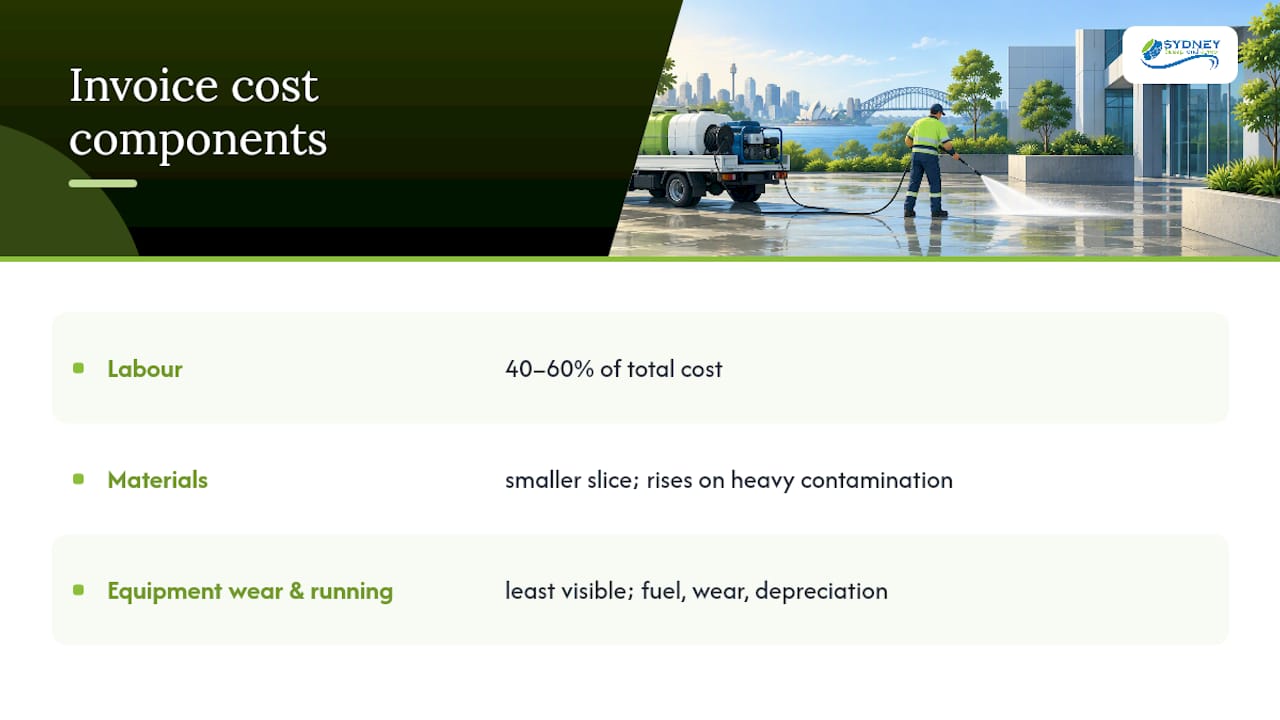
Labour is usually the largest single component, often 40 to 60% of total job cost depending on complexity. Crew size, job duration, and whether traffic control or specialist operators are needed all factor in here. A two-person crew on a straightforward hardstand job costs less per hour than a crew requiring EWP operators or confined-space training.
Materials, detergents, degreasers, and specialist chemicals for graffiti or biological growth, typically make up a smaller slice, but jump sharply on heavily contaminated sites. A standard clean might use a few litres of general-purpose detergent. An oil-stained loading dock can require multiple chemical passes plus a neutraliser before final rinse.
Equipment wear and running cost covers fuel or power for pressure units, hose and nozzle replacement, and vehicle costs to mobilise gear to site. This is the least visible cost to clients but it’s real, industrial pressure washers see heavy wear from daily commercial use, and contractors factor depreciation and maintenance into their rates whether or not it’s itemised on your invoice.
A quote that looks unusually cheap often means one of these three has been underestimated, most commonly labour hours on a site the contractor hasn’t physically inspected. That’s the strongest argument for insisting on a site walk-through before any number gets locked in.
Do eco-friendly detergents cost more for commercial cleaning?
Biodegradable and eco-friendly detergents are increasingly standard on Australian commercial cleaning contracts, partly driven by council stormwater rules and partly by client sustainability commitments. The cost implication is smaller than most facility managers expect.
Standard biodegradable detergents used for general grime and dirt removal are usually price-comparable to conventional equivalents, the raw chemical cost difference is marginal for everyday cleaning tasks. Where costs diverge is in specialist eco formulations for heavy degreasing or oil removal, which can carry a modest premium over conventional solvent-based degreasers because the biodegradable chemistry needs more concentrate or longer dwell time to match cutting power.
The bigger cost factor isn’t the detergent itself, it’s what pairs with it. Sites using eco-friendly chemicals near stormwater drains still need the same wastewater capture and disposal controls EPA guidance recommends, because “biodegradable” doesn’t mean “safe to discharge untreated.” A biodegradable detergent breaks down over time in the right conditions, it doesn’t neutralise on contact with a stormwater drain.
For facility managers weighing the trade-off, the eco-friendly premium on standard jobs is typically negligible, and it comes with a genuine upside: many strata and corporate clients now specify sustainable cleaning practices in their tender requirements, so a contractor already using biodegradable chemicals as standard practice removes a compliance question before it’s even asked.
Sydney Sweep and Scrub: getting a real quote for your site
Every range in this guide is a starting point, not a substitute for someone walking your site. Sweepandscrub is the practical alternative to guessing off a national average: a family-owned Sydney operator that prices car parks, warehouses and public spaces after seeing the actual surface, contamination and access, not from a generic rate card.
Sweepandscrub uses hot-water and eco-friendly equipment, offers pricing, and has an online booking system to schedule site inspections. That matters most for strata car parks and warehouses where oil staining, gum, and confined access make phone-quote estimates close to useless.
If you manage a car park with line marking wear, a warehouse floor overdue for a scheduled clean, or a general commercial site needing a compliant pressure washing quote with a proper wastewater plan attached, request a site inspection through Sweepandscrub and get a written scope back before you commit to anything.
Sources
- Guide: managing risks from high-pressure water jetting — Safe Work Australia
- Shoalhaven council briefing: high pressure cleaning and environmental obligations
- How much does high pressure cleaning cost? — Aus Pro Commercial Cleaners
- Roof cleaning and water quality guidance — EPA SA
FAQ
What’s the average cost per square metre for commercial pressure washing?
Most Australian commercial jobs fall between $2 and $6 per square metre for standard hardstand cleaning, rising above that for heavy contamination. A site inspection confirms where your job sits within that band.
Does my quote need to include wastewater disposal?
Yes, particularly for sites near stormwater drains, since discharging polluted runoff breaches the Protection of the Environment Operations Act. Always ask contractors to detail their wastewater capture and disposal method in writing.
How long does a site inspection take before I get a quote?
Most commercial site inspections vary in duration depending on site size and access complexity. Sweepandscrub books inspections online, with a written scope typically following shortly after the visit.
Are maintenance contracts cheaper than one-off cleans?
Yes, scheduled monthly or quarterly retainers generally lower per-visit cost by reducing heavy remediation build-up between visits. They also make budgeting more predictable across a financial year.
Does Sweepandscrub charge more for eco-friendly detergents?
Sweepandscrub doesn’t publish a separate rate for eco-friendly chemicals, current pricing is available by requesting a quote through the Sweepandscrub site. Standard biodegradable detergents are generally cost-comparable to conventional options for everyday cleaning.