
Expect to pay somewhere between $30 and $65 an hour for professional warehouse cleaning in Australia, or roughly $3 to $8 per square metre depending on scope and frequency. A small warehouse visit might land between $250 and $500, while a large 5,000m² site running between shifts often sits in the $400 to $900+ per visit bracket. Get a scoped written quote, confirm the contractor holds a current Safe Work Method Statement and public liability insurance, and treat Sydney Sweep and Scrub as one solid option to call for that quote.
TL;DR:
- Hourly rates for warehouse cleaning range from $30 to $65, with lower costs covering basic sweeping and higher rates reflecting specialized equipment and after-hours work.
- Per square metre prices vary from $1 to over $8 depending on contamination level, site complexity, and access requirements.
- Recurring contracts typically lower overall costs, with weekly cleaning for a 2,500m² warehouse averaging $1,800 to $3,000 per month, compared to $500 to $850 for a single visit.
- Quotes should include documented safety procedures, insurance proof, and a detailed scope, especially for complex or high-risk sites.
- Additional costs such as mobilisation, travel, after-hours loadings, and equipment surcharges can significantly increase the final invoice, so clarify these upfront.
Table of Contents
- What are the pricing models for warehouse cleaning?
- What does warehouse cleaning actually cost for different site sizes?
- What factors change your warehouse cleaning quote?
- What should you ask for in a warehouse cleaning quote?
- What WHS rules affect warehouse cleaning cost?
- How can you lower your warehouse cleaning bill?
- What’s the real average cost across one off and recurring warehouse cleaning?
- How long does a warehouse cleaning job take, from quote to completion?
- What hidden fees should you watch for in a warehouse cleaning quote?
- What service level do you actually get at each price point?
- Sydney Sweep and Scrub: get a compliant, scoped warehouse cleaning quote
- Sources
- FAQ
What are the pricing models for warehouse cleaning?
Contractors price warehouse work four different ways, and knowing which model you’re being quoted under matters more than the headline number itself.
Hourly rates suit ad hoc jobs, one off spill cleanups, or sites where scope is genuinely unpredictable. Per square metre pricing works best when you know exactly how much floor needs covering and want an apple to apples figure to compare bids. Per visit pricing bundles labour, machine time and consumables into one flat number for a defined scope, which is what most warehouse managers end up requesting once they’ve run a few cleans. Contract pricing locks in a recurring schedule, usually weekly or fortnightly, at a discounted rate against one off visits.
Nationally, commercial cleaning hourly rates commonly sit between $30 and $65, with the lower end covering basic sweeping and the top end reflecting specialised machine work or after hours labour. Per square metre, budget roughly:
- Light dust and sweep only: $1 to $3 per m²
- Standard scrub and sweep combination: $3 to $5 per m²
- Heavy contaminant removal (oil, chemical residue, product powder): $5 to $8+ per m²
CBD sites in Sydney, Melbourne and Brisbane typically carry a 5 to 10% premium over regional quotes, driven by travel time, parking and higher local labour costs. Some contractors also charge a separate mobilisation or travel fee for first time visits, particularly for sites outside metro areas.
What does warehouse cleaning actually cost for different site sizes?
Numbers make more sense against a real floor plan, so here’s how three common warehouse sizes typically price out, assuming a standard scrub and sweep scope with no heavy contamination.
- 1,000m² warehouse. A scrubber-dryer covers this in roughly 2 to 3 machine hours, plus 30 to 45 minutes prep and edge work by hand. Expect a per visit price of $250 to $450. On a fortnightly contract, that averages out to roughly $600 to $900 a month.
- 2,500m² warehouse. This usually needs 4 to 6 machine hours and two operators for racking aisles and dock areas. Per visit pricing lands between $500 and $850. A weekly contract typically averages $1,800 to $3,000 a month once the recurring discount applies.
- 5,000m² warehouse. Large sites with high-bay racking need dust suppression passes and often a second operator on a scissor lift for overhead cleaning. Per visit costs commonly reach $400 to $900+ per visit, rising past $1,200 where contamination or between-shift access windows apply.
Rubbish removal, bin area cleaning and line marking touch ups are the most common add-ons, usually costing an extra $80 to $250 per visit depending on volume. If your site carries any of those associated tasks regularly, it’s worth factoring the associated services into the base quote rather than treating them as surprises later.
What factors change your warehouse cleaning quote?
Two warehouses the same size can attract wildly different quotes, and the gap almost always comes down to a handful of specific variables rather than the contractor simply charging more.
Floor layout and racking density slow machine work considerably. A warehouse with tight racking aisles takes longer per square metre than an open floor plan because scrubber-dryers can’t run at full width, and operators need to hand clean edges and corners.
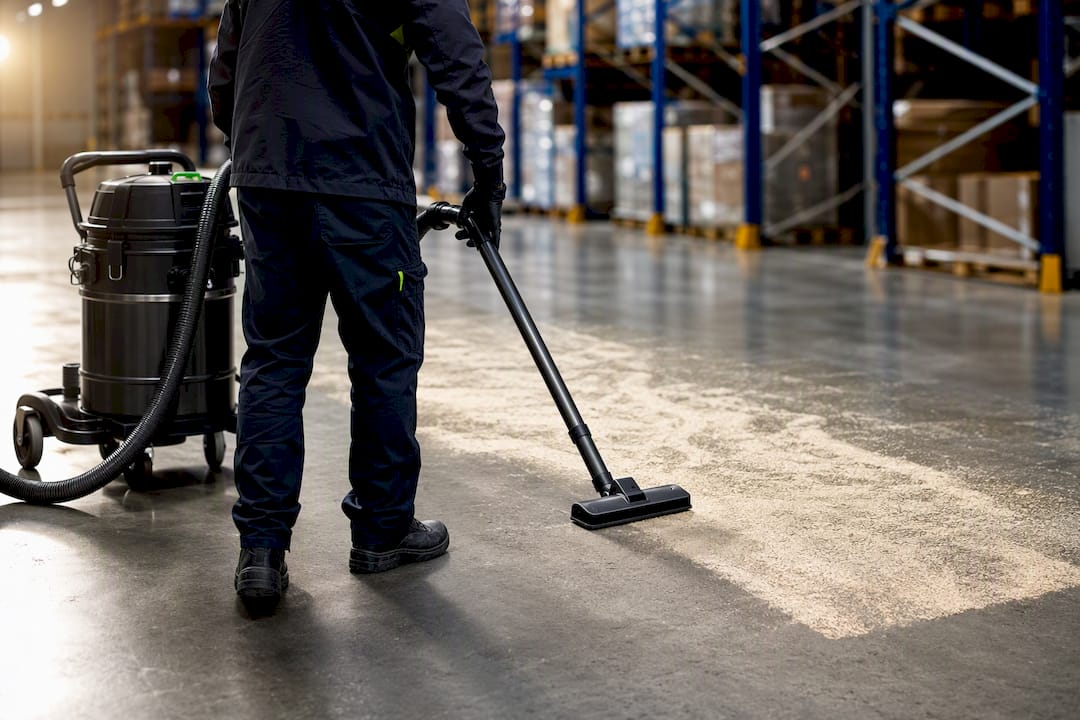
Contaminant type drives both time and chemical cost. Oil and grease need degreasing agents and multiple passes; fine product dust (flour, cement, timber) needs containment and often a HEPA-filtered vacuum pass before wet cleaning even starts; general grime is the cheapest and fastest to shift.
Ceiling height and high-bay access matter when overhead cleaning is in scope. Anything above standard reach needs a scissor lift or elevated work platform, which adds equipment hire and a second operator to the job.
Access windows change labour cost directly. Between-shift or weekend access usually carries a loading, while unrestricted daytime access keeps pricing at the lower end of the range.
- Floor surface and existing slip resistance rating
- Frequency (one off jobs cost more per visit than scheduled contracts)
- Contract length (longer terms typically earn a better rate)
- Labour skill required (forklift-rated operators cost more than general cleaners)
Pro Tip: Ask your contractor to quote the same scope two ways: as a one off visit and as part of a 12 month recurring contract. The gap between those two numbers tells you exactly how much you’re paying for the flexibility of not committing.
What should you ask for in a warehouse cleaning quote?
A vague quote is the single biggest source of billing disputes on commercial cleaning jobs, so specify the job properly before you ask anyone to price it.
Your request for quote should state: total floor area in square metres, cleaning frequency, known contaminant types, access hours, and any equipment constraints (low ceilings, narrow aisles, forklift traffic during cleaning hours). The more precise this brief is, the more comparable the bids you get back.
Before accepting any quote, require:
- A current Safe Work Method Statement (SWMS) covering the specific tasks on your site
- Proof of public liability insurance and current workers compensation cover
- Safety data sheets (SDS) for every chemical the crew plans to use
- A written scope that lists exclusions as clearly as inclusions
Ask bidders how long they’ve worked in industrial sites specifically, whether they can provide references from similar warehouses, and what their mobilisation lead time looks like. WorkSafe WA’s cleaning industry checklist is a useful practical vetting tool if you want a second opinion beyond your own instincts. A quote that’s dramatically cheaper than everyone else’s, especially one that skips SWMS or insurance details entirely, is a red flag worth walking away from, not a bargain.
What WHS rules affect warehouse cleaning cost?
Every PCBU (person conducting a business or undertaking) in Australia carries a legal duty to keep the work environment clean and safe, and Safe Work Australia’s model code of practice sets scheduled cleaning as part of managing slip, trip and fall risk. That obligation is precisely why a compliant contractor’s quote includes time and cost you might not expect from a backyard operator.
WorkSafe Queensland’s ‘clean-to-dry’ principle is worth specifying directly in your scope: the wrong chemical mix or method can leave a slippery residue that actually raises injury risk rather than lowering it. Cleaning agents also fall under hazardous chemical rules, meaning SDS management and risk assessment add administrative time that a proper quote accounts for.
- SWMS and SDS documentation checks typically add 15 to 30 minutes of admin per job
- Confined space or elevated work adds specialist competency requirements and higher labour rates
- Chemical selection needs to match your specific floor coating, not a generic all-purpose product
One figure worth remembering: CBD sites and jobs needing specialist competencies both routinely add 5 to 10% on top of the base quote, and the two premiums often stack when a high-rise CBD warehouse also needs elevated work platform access.
How can you lower your warehouse cleaning bill?
The single biggest lever is frequency. Scheduled cleans prevent heavy build up, which means less machine time and lower chemical use per visit, and contractors typically discount recurring contracts against one off call outs by a meaningful margin.
- Lock in a scheduled contract rather than booking reactive one off visits
- Bundle rubbish removal, line marking and pressure washing into one mobilisation to cut travel fees
- Compare night cleaning (often cheaper labour) against day cleaning (no after hours loading) for your specific site
- Set simple KPIs, like square metres cleaned per hour, to catch overservicing before it inflates your invoice
- Ask whether contractor supplied equipment beats renting your own scrubber-dryer for occasional jobs
What’s the real average cost across one off and recurring warehouse cleaning?
A one off warehouse clean for a mid-sized site typically averages $500 to $850 depending on contamination and access. That’s the number most first time buyers see when they request a single quote without any contract commitment.
Recurring contracts tell a different story. A 2,500m² warehouse on a weekly contract, for example, often averages $1,800 to $3,000 a month total, working out to a lower effective rate per clean than the equivalent one off job would cost on its own.
The gap widens further for larger sites. A 5,000m² warehouse booked as a series of one off visits could easily average $700 to $1,000 per clean, while the same site on a 12 month scheduled contract often settles closer to the lower end of that range consistently, because the contractor isn’t dealing with unpredictable build up between visits. If your warehouse gets cleaned more than once a month, a scheduled contract is almost always the cheaper path over a 12 month horizon, even though the sticker price on each individual visit looks similar to a one off job.
How long does a warehouse cleaning job take, from quote to completion?
Most contractors turn around a written quote within 24 to 48 hours of a site walk through, assuming you’ve given them the floor area, contaminant details and access windows upfront. A phone quote without a site visit is faster but less reliable, and it’s the kind of shortcut that leads to disputes later.
Mobilisation, meaning the time between accepting a quote and the first clean happening, typically runs 3 to 7 business days for standard jobs. That window shortens for contractors already servicing your area regularly and stretches longer if specialist equipment like a scissor lift needs booking in.
The clean itself is usually the fastest part of the whole process. A 1,000m² site with two operators and a scrubber-dryer wraps up in 2 to 3 hours. A 5,000m² warehouse with high-bay dusting and multiple contamination zones can run a full working shift, sometimes split across two visits if access is restricted to narrow after hours windows.
For scheduled contracts, the timeline compresses further once the relationship is established: the contractor already has your SWMS on file, already knows your floor plan, and already has a crew rostered. First cleans on a brand new site almost always take longer than the second or third visit, simply because operators are learning the layout, the racking configuration and where the trickiest contamination zones sit.
What hidden fees should you watch for in a warehouse cleaning quote?
The base per visit or per square metre rate rarely tells the whole story, and the gap between a quoted price and the final invoice usually comes down to a handful of predictable extras.
Mobilisation and travel fees catch out a lot of first time buyers, particularly for sites outside metro Sydney, Melbourne or Brisbane. Some contractors fold this into the first invoice only; others charge it every visit for regional sites.
After hours and weekend loadings commonly add 15 to 25% to the base rate, and these aren’t always spelled out clearly in an initial verbal quote, only in the fine print of the written scope.
Waste disposal surcharges apply when a clean generates volume beyond what’s included in the base scope, particularly after a spill event or a major stocktake clean out. Ask specifically whether bin disposal costs are included or billed separately.
Equipment surcharges show up when your site needs a scissor lift, specialised chemical treatment for a specific contaminant, or dust suppression equipment beyond the standard scrubber-dryer kit. These are legitimate costs, but they should appear as a line item in your quote, not as a surprise on the invoice.
Minimum call out fees apply to small jobs, meaning a tiny warehouse might pay a flat minimum regardless of actual floor area. Always ask whether a minimum applies before comparing per square metre rates across bids, because a low headline rate can hide a call out fee that makes a small job disproportionately expensive.
What service level do you actually get at each price point?
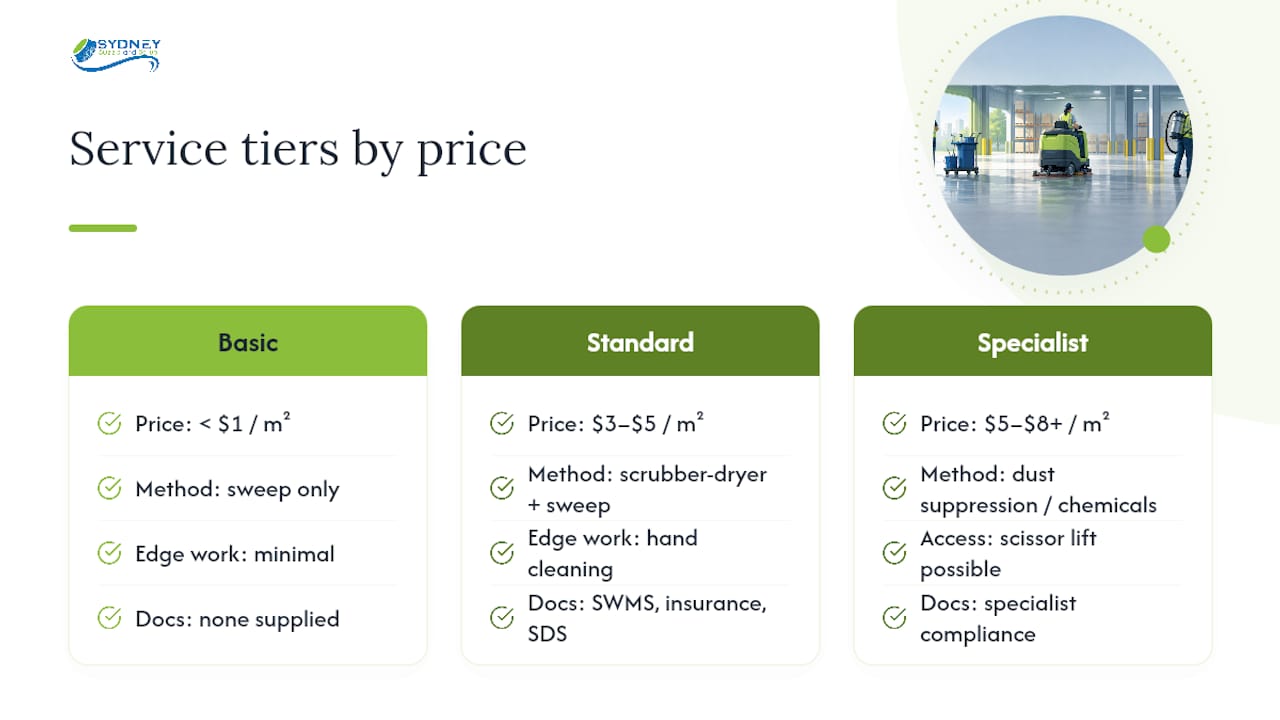
The cheapest quotes in the market, generally under $30 an hour or below $1 per m², usually buy you a basic sweep with minimal edge work and no scrubbing pass. That’s fine for a light industrial unit with low foot traffic, but it won’t touch oil stains, product dust build up or genuine grime on a working warehouse floor.
The mid range, roughly $3 to $5 per m² or $35 to $50 an hour, is where most warehouses should expect to sit for a standard scrub and sweep combination. This tier typically includes a proper scrubber-dryer pass, edge and corner hand cleaning, and a contractor carrying the compliance documentation (SWMS, insurance, SDS) that a serious facility manager should be asking for regardless of price.
At the top end, $5 to $8+ per m² or premium hourly rates, you’re paying for specialist capability: high-bay dust suppression, scissor lift access for overhead cleaning, chemical treatment matched to specific contaminants, or automated robotic cleaning for very large repetitive floor areas. This tier suits warehouses with heavy contamination, complex racking, or genuine WHS risk that a basic scrub won’t resolve.
The mistake most facility managers make isn’t picking the wrong tier, it’s assuming the cheapest quote and the mid range quote deliver the same result. They rarely do. A comparison of sweep and scrub versus mop and bucket methods makes the practical difference clear: mechanical methods lift contaminant that manual mopping simply redistributes across the floor.
Sydney Sweep and Scrub: get a compliant, scoped warehouse cleaning quote
Sydney Sweep and Scrub runs the full toolkit a warehouse actually needs: mechanical sweeping, scrubber-dryer cleaning, hot and cold pressure washing, rubbish removal, and automated robotic cleaning for larger repetitive floor areas. Every quote is built around your site’s actual floor plan, not a generic template, using advanced equipment that helps reduce environmental impact and can lower costs.
A quote from Sydney Sweep and Scrub includes the documentation this article recommends asking for anyway: current SWMS, public liability cover, and a written scope that spells out inclusions and exclusions before a crew ever turns up. Mobilisation is quick, and online booking means you’re not chasing a callback for a straightforward job. If your warehouse is due for a scrub, or you simply want a benchmark quote to compare against what you’re currently paying, head to the warehouse cleaning services page and request a site quote today.
Sources
- Managing the work environment and facilities (model code of practice) — Safe Work Australia (Dec 2025)
- Cleaning — WorkSafe Queensland
- How much does commercial cleaning cost in Australia? — hipages (2026)
FAQ
How much does commercial cleaning cost in Australia?
Commercial cleaning generally runs $30 to $65 an hour across Australia, with warehouse and industrial work sitting at the higher end due to machine time and contamination handling. Per square metre pricing typically ranges from $1 for light dusting to $8+ for heavy contaminant removal.
How much is a 1 hour clean?
A single hour of commercial or warehouse cleaning typically costs between $30 and $65, depending on your state, whether it’s after hours, and whether specialist equipment like a scrubber-dryer is required. Basic sweeping sits at the lower end; machine scrubbing and contaminant removal push toward the upper end.
How do you estimate a warehouse cleaning cost?
Start with your floor area in square metres, multiply by the relevant per m² band for your contamination level (light, standard, or heavy), then add mobilisation, after hours loadings and any equipment surcharges. A 2,500m² warehouse with standard scrub and sweep typically lands between $500 and $850 per visit using this method.
How do you quote for commercial cleaning?
A proper quote needs total floor area, cleaning frequency, contaminant types, access hours and equipment constraints stated upfront, then priced against hourly, per m², or per visit models. Always request a SWMS, insurance proof and SDS documentation alongside the price, and compare bids on scope, not just the bottom line figure. Providers like Sydney Sweep and Scrub build these documents into every quote as standard.
Does Sydney Sweep and Scrub publish fixed prices for warehouse cleaning?
Sydney Sweep and Scrub doesn’t publish a fixed rate card, since warehouse pricing depends on floor area, contamination and access. Request a scoped quote through the warehouse cleaning page for a price based on your specific site.