
For most commercial floors, a low-foam, pH-neutral scrubber-safe concentrate is the safest everyday choice. Reach for an alkaline degreaser only on heavy grease and an acidic cleaner only on mineral scale, and only where the surface can handle it. Before anything goes in the tank, confirm the label says low-foam and check the scrubber manufacturer’s guidance for your machine.
TL;DR:
- Use a low-foam, pH-neutral cleaner for daily maintenance on most sealed and coated floors to ensure surface safety and efficient water recovery.
- Match cleaning chemistry precisely to the floor material and soil type, avoiding strong acids on polished stones or untested surfaces to prevent damage.
- Test any new detergent on a small, out-of-sight patch for compatibility and residue before full-scale application to avoid costly rework or surface damage.
- Always confirm product label claims, dilution instructions, and machine compatibility, and run a small batch through your scrubber to check foam levels and recovery performance.
- Opt for professional-grade, scrubber-safe products with clear label instructions and SDS, and consider outsourcing heavy grease or mixed-floor cleaning to specialists for safety and efficiency.
Table of Contents
- What types of floor scrubber detergents exist and when should you use each?
- Why foam control and machine compatibility matter
- Matching detergent to floor type and soil
- Dilution, dosing and solution management
- Safety, SDS and storage requirements
- Troubleshooting foam, film and slippery floors
- Quick selection checklist for choosing a scrubber detergent
- When hiring a cleaning service beats buying detergents yourself
- How eco-friendly and biodegradable are these detergents?
- Comparing cost and value across detergent types
- Effectiveness against tougher stains and mixed soil types
- How often should you scrub for the best results?
- How to test a new detergent before rolling it out
- Where to check labels, SDS and machine guidance
- Sources
- FAQ
What types of floor scrubber detergents exist and when should you use each?
Every scrubber detergent sits somewhere on the pH scale, and that number tells you almost everything about what it will do to a floor.
Neutral detergents sit around pH 6 to 8. They’re the workhorse for daily maintenance because they clean effectively without attacking sealers, coatings, or finishes over repeated passes. Alkaline cleaners run pH 9 to 12 and cut through grease, oil, and heavy industrial soil, the kind you find in loading docks and workshop floors. Acidic cleaners, pH 1 to 5, dissolve mineral deposits, rust, and hard water scale, but they’re only for surfaces built to take that kind of chemistry. Enzymatic cleaners work differently again: they use biological enzymes to break down organic matter, making them useful for lingering odours from food waste, urine, or biological spills where standard surfactants leave a smell behind.
Getting the category wrong is where damage happens.
- Neutral cleaners: daily upkeep on sealed and coated floors, low risk, low reward on stubborn grease
- Alkaline cleaners: grease, oil, and carbon soil, but they can dull unsealed stone or strip certain coatings over time
- Acidic cleaners: mineral scale and rust stains, but they will etch marble, travertine, and some polished concrete
- Enzymatic cleaners: organic odour sources, slower acting than surfactant-based products but longer lasting on the smell itself
According to Metech Sweepers & Scrubbers, matching chemistry to soil type and floor material, rather than chasing one universal product, is what actually protects both the surface and the machine. Test any unfamiliar product in a small, out-of-sight patch before running it across the whole floor.
Why foam control and machine compatibility matter
High-foam cleaners are one of the fastest ways to damage a scrubber. Foam builds up in the recovery tank, overwhelms the vacuum system, and can force liquid into the motor housing where it has no business being. Professional scrubber detergents are engineered specifically for low foam to protect suction and keep water recovery working as intended, according to Multi-Clean. Household cleaners and generic mop-and-bucket detergents are built for suds, not suction, which is exactly why they don’t belong in a machine.
The phrase “scrubber-safe” on a label isn’t marketing fluff. It usually signals the formula includes a defoamer and has been tested for use in mechanical recovery systems. Look for explicit foam-level statements, dilution charts, and a note on machine compatibility on the packaging or SDS.
Pro Tip: Before you buy a drum of anything new, run a small batch through your machine on a test section and watch the recovery tank for 60 seconds after the pass. If foam is climbing rather than settling, that product isn’t right for your scrubber.
Run through this before any trial: check your scrubber’s manual for foam tolerance, confirm compatibility with your equipment supplier, and read the product’s SDS front to back. Skipping any one of those three steps is how avoidable service calls happen.
Matching detergent to floor type and soil
Floor material dictates chemistry as much as the soil does. A cleaner that’s perfect for sealed concrete can strip a polished stone finish in a single pass.
| Floor type | Recommended chemistry | Key caution |
|---|---|---|
| Sealed concrete | Neutral to mild alkaline | Avoid strong acids on unsealed sections |
| Epoxy coatings | Neutral, low-foam | Harsh alkalines can dull gloss over time |
| Vinyl / LVT | Neutral | Strong solvents can soften or lift seams |
| Ceramic tile | Neutral for tile; mild acid for grout haze | Test acid on grout only, never glazed tile broadly |
| Natural stone | Neutral, stone-specific formula | Never use acidic cleaners; they etch marble and travertine |
| Rubber flooring | Neutral, low residue | Alkaline build-up can leave rubber tacky |
The safest habit is treating every floor as untested until proven otherwise. Run a trial patch in a low-visibility corner, let it dry fully, and check for colour change, haze, or texture shift before committing the whole site to a new product. Coated and polished finishes are the least forgiving, and a wrong guess there often means a costly recoat.
Dilution, dosing and solution management
Dilution ratio matters as much as which detergent you buy. Getting it wrong either wastes product or leaves a film that dulls the whole floor.
- Light, routine cleaning: use dilute solutions fitting typical professional guidance
- Medium soil loads, moderate traffic areas: use moderate dilution according to soil and product instructions
- Heavy soil, grease-heavy or industrial zones: use stronger dilution tailored to soil and product specifications
These ranges align with typical professional guidance for dilution control on commercial scrubbers, though exact ratios always depend on the specific product’s concentration. Overdosing doesn’t clean better, it just leaves more residue behind, and that residue attracts more dirt and wears down brushes and squeegees faster. Mix with lukewarm water, around 30 to 40°C, since cold water slows surfactant activity and hot water can degrade some formulas or damage machine seals. Always add detergent to water, not the reverse, and follow the fill line marked on your solution tank.
Safety, SDS and storage requirements
Chemical safety in a scrubber fleet isn’t optional paperwork, it’s what keeps staff safe and your site compliant.
- Pull the SDS for every product before first use and confirm the PPE it specifies, gloves and eye protection at minimum for concentrates.
- Know the spill response and first-aid steps listed on the SDS before an incident happens, not during one.
- Label every container clearly and segregate acidic and alkaline products, since mixing the wrong two can release harmful fumes.
- Store concentrates in a cool, ventilated area away from direct sun, and keep the mixing instructions taped to or near the dispenser.
Skipping the SDS step is the single most common shortcut that leads to a workplace incident, and it costs nothing to check.
Troubleshooting foam, film and slippery floors
Most day-to-day scrubber problems trace back to the same handful of causes.
- Excess foam in the recovery tank usually means the wrong detergent, not a machine fault, switch to a certified low-foam product.
- A hazy film on dry floors is almost always overdosing, cut the dilution ratio and run a plain-water rinse pass to lift residue.
- Slippery floors after cleaning point to leftover surfactant, the same rinse-pass fix applies, and a temporary defoamer can help clear an already-foamy tank.
- Recurring odour despite regular scrubbing suggests organic matter trapped in grout or seams, an enzymatic cleaner targets that where surfactants can’t.
If the same issue keeps returning after you’ve adjusted dilution and rinsed properly, that’s the point to call your chemical supplier rather than keep guessing, or move to a specialist product built for that specific soil.
Quick selection checklist for choosing a scrubber detergent
Buying decisions get easier once you run through the same short checklist every time.
- Identify every floor type on site and the soil loads each area sees, then choose pH accordingly, neutral by default, alkaline or acidic only where warranted.
- Confirm the product label explicitly states low-foam performance and lists clear dilution ranges for light, medium, and heavy use.
- Request the SDS before purchase, not after, and check it against your existing chemical storage and PPE setup.
- Trial the shortlisted product on a small test patch, track cost-in-use per litre of solution mixed, and monitor for residue over a week of normal use.
A concentrated product with a higher unit price often works out cheaper per square metre once you factor in dilution ratios, so don’t judge cost by the drum price alone.
When hiring a cleaning service beats buying detergents yourself
Large sites, mixed-floor buildings, or consistently heavy grease loads often make in-house chemical management more trouble than it’s worth. A professional provider brings the correct chemistry for each surface, calibrated dosing equipment, safe disposal of spent solution, and ongoing machine maintenance, without you having to stock, store, or test a single product. When requesting a quote, ask what chemistry they use on each floor type, how dosing is calibrated, and what’s covered if a coating gets damaged. A professional provider can handle this end-to-end across warehouses, car parks, and commercial sites, and you can see the scope of a scheduled commercial cleaning arrangement before committing.
How eco-friendly and biodegradable are these detergents?
Biodegradability varies enormously between neutral, alkaline, and acidic formulas, and it’s worth checking before you buy in bulk. Neutral, pH-balanced detergents generally break down faster in wastewater treatment because they contain fewer aggressive builders and surfactants. Heavy alkaline degreasers and strong acidic descalers tend to carry more persistent chemical loads, which is one reason many facilities reserve them for spot use rather than daily scrubbing.
Phosphate-free and readily biodegradable formulations have become the norm in commercial cleaning supply chains, driven partly by trade waste discharge rules that restrict what can legally go down a drain in bulk. If your site discharges scrubber wastewater into stormwater or sewer systems, check local trade waste requirements, since some jurisdictions cap the pH and chemical load of what you’re allowed to release.
Choosing a biodegradable neutral cleaner for daily use and reserving stronger chemistry for occasional deep cleans cuts your overall chemical load without sacrificing results. It also reduces the volume of concentrate you need to store and transport, which matters for sites juggling multiple chemical categories in a compliance-heavy environment. Some commercial cleaning companies run carbon-neutral operations and eco-friendly equipment across mechanical cleaning work, which is one path for facility managers who want the sustainability box ticked without managing chemical selection themselves.
Comparing cost and value across detergent types
Sticker price is the worst way to judge a scrubber detergent. Neutral cleaners usually cost less per litre of concentrate but need more frequent replenishment on grease-heavy sites, since they’re not designed to cut heavy soil quickly. Alkaline degreasers and enzymatic cleaners often carry a higher per-litre price, but a small amount goes further on tough jobs because you’re not making multiple passes to shift the same soil.
The number that actually matters is cost-in-use, calculated per square metre cleaned or per week of operation, not cost per drum. A concentrated product diluted at 1:200 can work out far cheaper across a month than a “cheap” ready-to-use cleaner used at full strength on the same floor. Facility managers who track this over a full billing cycle often find the premium product wins on total spend, even though it looked more expensive on the purchase order.
Overdosing quietly erodes value too. Every litre of detergent used beyond what the floor actually needs is a litre wasted, plus the added wear on brushes, pads, and squeegees from residue buildup. Running the correct dilution isn’t just a machine protection measure, it directly controls your ongoing chemical spend. Facilities that standardise dosing across shifts, rather than letting individual cleaners eyeball the mix, typically see the most consistent cost outcomes over time.
Effectiveness against tougher stains and mixed soil types
Basic dirt and dust respond to almost any neutral cleaner run through a scrubber. The harder problems, tyre marks, oil stains, salt residue from winter foot traffic, and biological growth, need chemistry matched specifically to what caused them.
Tyre and rubber transfer marks in car parks respond best to a citrus-based or mild solvent degreaser rather than a straight alkaline product, since the marks are a polymer residue, not simple grease. Salt and mineral staining, common near entrances during wet weather, calls for the mild acidic cleaners that dissolve mineral deposits, applied carefully and rinsed thoroughly to avoid etching. Algae and biological growth on outdoor concrete or shaded areas is a different problem again, often needing a stronger treatment than a standard scrubber run, and removing algae from concrete without damaging the surface underneath takes a different approach entirely.
Mixed soil, where grease, dust, and organic matter are all present at once, is where enzymatic cleaners earn their keep. They keep working on organic residue after the surfactant-based cleaning has finished, which matters most in food service back-of-house areas and loading docks handling perishable goods.
How often should you scrub for the best results?
Frequency depends on foot traffic and soil type, not a fixed calendar. High-traffic zones like entrances, loading docks, and main corridors typically need daily scrubbing with a neutral cleaner to stop soil building into a film that gets progressively harder to shift. Lower-traffic areas, storage zones, or back offices often only need scrubbing two or three times a week without any drop in floor condition.
Grease-prone areas, kitchens, workshops, and vehicle bays, benefit from a scheduled deep clean with alkaline degreaser on top of daily neutral maintenance, rather than trying to make one product do both jobs. Stretching that deep clean out too far lets grease bond to the surface, which then needs a stronger product and more passes to remove, the opposite of what you want for cost and machine wear.
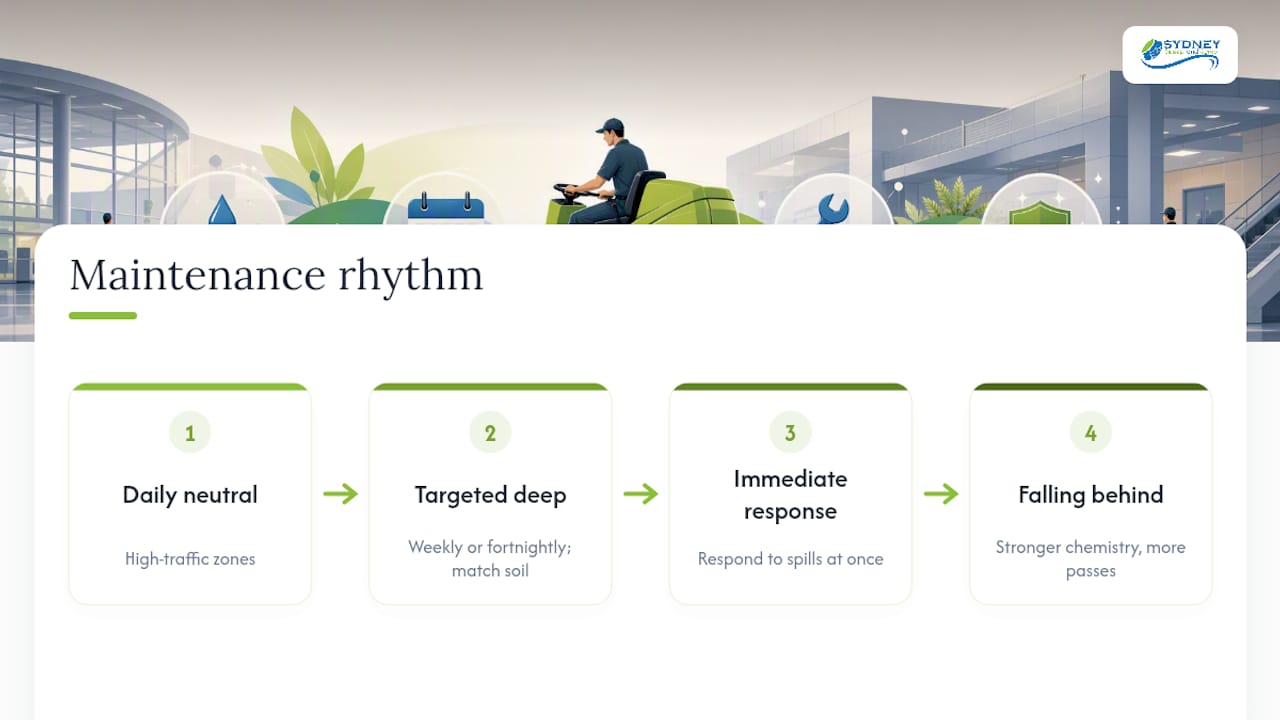
A simple rule that works across most commercial sites: daily neutral maintenance, weekly or fortnightly targeted deep cleaning based on soil type, and an immediate response to spills rather than waiting for the next scheduled pass. Sites that fall behind on this rhythm tend to end up needing a heavier chemistry just to catch up, which increases both cost and risk to the floor finish.
How to test a new detergent before rolling it out
Never trial a new product across an entire floor on day one, no matter how promising the label sounds. Pick a section that’s out of general view but sees genuine foot traffic, a stockroom corner or a rarely used hallway works well.
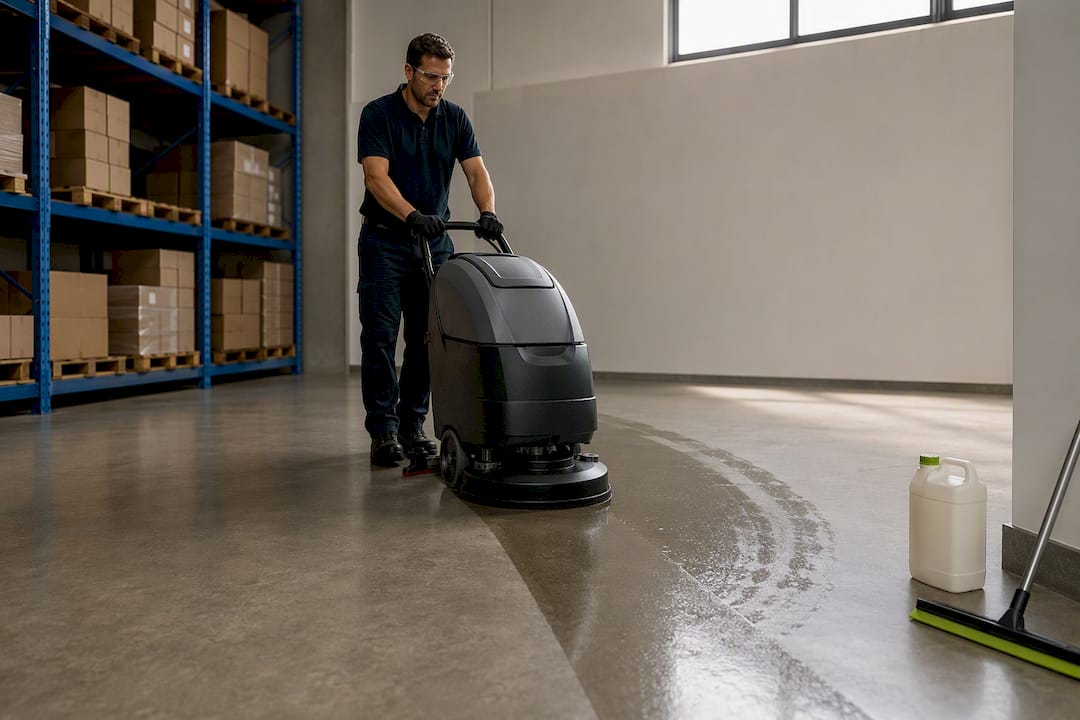
Apply the product at the manufacturer’s recommended dilution, run it through the scrubber exactly as you would in normal operation, and let the area dry completely before judging the result. Check for colour change, dulling, tackiness, or any texture shift, then repeat the same test a second time a day or two later, since some reactions with sealers and coatings only show up after repeated exposure. If the floor looks and feels the same as before, and the recovery tank showed no excess foam, you’ve got a green light to move to wider use.
Keep a simple log of which products have been tested on which floor types across your site. It saves the next staff member from repeating a trial you’ve already run, and it gives you a quick reference if a supplier changes a formula and you need to retest.
Where to check labels, SDS and machine guidance
Start with your scrubber manufacturer’s compatibility pages for machine-specific dosing advice, then cross-check the product’s own SDS and technical sheet before purchase.
Sources
- How to Select a Degreaser for an automatic scrubber – Multi-Clean
- What cleaners do you use with a scrubber? – Metech Sweepers & Scrubbers
- Commercial floor scrubber guide – Amherst Cleaning Services
FAQ
What Is the Best Detergent to Use With a Floor Scrubber?
A low-foam, pH-neutral concentrate is the safest everyday choice for most commercial floors. Switch to an alkaline degreaser for heavy grease or an acidic cleaner for mineral scale, but only on surfaces confirmed compatible with that chemistry, according to Metech Sweepers & Scrubbers.
What Is the Best Solution to Scrub Floors?
For daily maintenance, a neutral, low-foam cleaner diluted according to the manufacturer’s ratio gives the best balance of cleaning power and surface safety. Heavier soil loads justify a stronger alkaline formula, but always confirm it’s labelled scrubber-safe first.
What Do You Put in a Floor Scrubber?
You put a correctly diluted detergent solution mixed with lukewarm water, typically around 30 to 40°C, into the solution tank, never a raw household cleaner. The right product depends on your floor type and soil load, with neutral cleaners covering most daily scenarios.
What Is the Best Floor Cleaner Detergent for Commercial Use?
The best choice is whichever low-foam, scrubber-safe product matches your specific floor material and soil type, not a single universal product. Neutral cleaners suit sealed concrete, epoxy, vinyl, and rubber, while alkaline and acidic formulas are reserved for grease and mineral scale on compatible surfaces only.