
Sustainable facility cleaning means keeping a site safe and hygienic while cutting the water, chemicals, and energy that job normally burns through. The fastest way to start is simple: require GECA-certified products in your next cleaning contract, or begin tracking basic KPIs like litres of chemical used per square metre. Done properly, it lowers resource use without sacrificing cleanliness or safety.
TL;DR:
- Switching to GECA-certified or low-toxicity cleaning products can significantly reduce chemical and water use without sacrificing cleanliness or safety.
- Implementing automatic dosing systems, microfibre equipment, and ozone-based solutions further cuts resource consumption across various facility settings.
- Building clear, checkable procurement standards around certifications, equipment limits, staff training, and safety measures prevents greenwashing and ensures true sustainability.
- Tracking measurable KPIs such as water, chemical, and waste diversion metrics is essential to prove and improve ongoing environmental performance.
- Starting with targeted audits and phased shifts in chemicals and equipment within 30 to 90 days enables a smooth, low-disruption transition to sustainable cleaning practices.
Table of Contents
- What are the core sustainable cleaning practices for facilities?
- How do you write procurement standards that stop greenwashing?
- Which KPIs prove your cleaning operation is actually sustainable?
- A 30/60/90 day plan to green your cleaning operation
- How Sydney Sweep and Scrub applies sustainable cleaning on real sites
- Staff training, safe handling and dilution control that actually stick
- Building a sustainable cleaning checklist for your facility type
- How to move from conventional to sustainable cleaning without disrupting operations
- Keeping staff engaged with sustainable cleaning standards long term
- Staying compliant beyond ecolabels and certification
- Health and safety gains from lower toxic chemical use
- Setting sustainability goals that actually fit your facility
- Cutting waste through smarter cleaning operations
- Get a verified sustainable cleaning partner for your site
- Sources
- FAQ
What are the core sustainable cleaning practices for facilities?
Most facility managers already have the equipment and the contractor. What changes is what goes into the machine and how it’s dosed.
Start with the chemistry. GECA-certified or otherwise low-toxicity products are formulated to limit hazardous ingredients, aquatic toxins, and volatile organic compounds, but certification alone isn’t the full picture. A product’s true environmental cost includes how it’s manufactured, how it’s packaged, and how it’s disposed of, which is why lifecycle assessment matters more than reading a single label claim.
Equipment choice does more heavy lifting than most managers assume. Microfibre systems cut chemical and water use dramatically compared to traditional mop-and-bucket cleaning, mostly because microfibre lifts soil mechanically rather than relying on chemical breakdown. Pair that with dilution-control dosing systems, which meter exact chemical ratios automatically, and you eliminate the guesswork that leads to overuse.
On the machinery side:
- Mechanical sweepers and ride-on scrubbers reduce water use per square metre compared to manual methods, particularly on large hard surfaces like car parks and warehouse floors.
- Efficient pressure washers with adjustable flow settings avoid the water waste of older fixed-pressure units.
- Aqueous ozone and stabilised aqueous ozone (SAO) systems generate cleaning solution from tap water and electricity, cutting chemical purchases significantly in settings like schools and government facilities where it’s been trialled successfully.
- Automated robotic cleaning units run consistent, efficient cycles with less fuel and labour overhead than manual equivalents.
Waste reduction sits alongside all of this. Reusable microfibre over disposable wipes, bulk chemical concentrate over single-use bottles, and packaging that’s recyclable rather than landfill-bound all chip away at a facility’s waste stream without touching the cleaning outcome.
Pro Tip: Before swapping any product, check whether your highest-traffic areas (loading docks, main entries, communal bathrooms) are using the most concentrated, least efficient chemistry on site. Fixing the worst offenders first delivers the biggest sustainability gain for the least operational disruption.
None of this requires ripping out existing infrastructure. Most sites can transition chemistry and dosing within weeks, while equipment upgrades get scheduled around normal replacement cycles.
How do you write procurement standards that stop greenwashing?
Sustainability claims in a cleaning tender are only as good as the paperwork behind them. Without specific, checkable requirements, “eco-friendly” becomes a marketing word with no enforcement mechanism.
Build your tender language around these five requirements:
- Require named certification, not vague claims. Ask specifically for GECA certification scope and current documentary proof, not a general statement that the contractor “uses green products.”
- Set equipment and chemical limits explicitly. UNSW’s own green cleaning standard is a useful model. It mandates HEPA filtration on vacuum equipment, noise limits, dilution control systems, and restrictions on hazardous chemical classes, and it’s detailed enough to copy directly into contract clauses.
- Demand training records. Ask contractors to show documented staff training on safe chemical handling, correct dilution, and storage protocols, not just a claim that “staff are trained.”
- Check for physical safeguards. Locked, ventilated chemical storage and readily accessible safety data sheets (SDS) should be a condition of the contract, verified during site visits rather than taken on faith.
- Ask for auditable evidence beyond the ecolabel. ISO certification, carbon-neutral verification, and (where relevant to your sector) modern slavery statements give procurement teams a paper trail if the contract is ever challenged internally or externally.
Smaller, specialised contractors sometimes get overlooked in favour of large incumbents, but the cost case for going green shows that certified operators using efficient equipment and reporting tools can compete strongly on tenders once documentation is factored in, not just price per square metre.
Which KPIs prove your cleaning operation is actually sustainable?
Claims are cheap. Numbers hold up in an audit. If your sustainability reporting doesn’t include measurable figures, it won’t survive a serious ESG review or a tender evaluation.
Track these core metrics on a recurring basis:
- Water use per cleaning hour or per square metre
- Chemical litres consumed per square metre of cleaned area
- Energy or fuel consumption for mechanical equipment
- Waste diverted from landfill (recycled packaging, reused microfibre, bulk refill volumes)
- Staff training hours logged against safe handling and dilution protocols
Modern equipment makes this far easier to collect than it used to be. IoT-enabled machines can log run time, water use, and chemical dosing automatically, while digital client portals give facility managers real-time access to service records, GPS-verified attendance, and inspection logs rather than a stack of paper dockets at month’s end. Providers that centralise this reporting turn what used to be a manual audit nightmare into something you can pull up in minutes when a tender or ESG report is due.
The business case backs this up too. Operational sustainability tends to deliver measurable cost benefits through what’s called resource decoupling, doing more cleaning with less water, chemical, and energy input over time. That’s not a marketing angle. It shows up directly in reduced consumable spend and, in many cases, lower absenteeism from a workforce handling fewer harsh chemicals. For facility managers who need to show cost-effectiveness alongside environmental performance, that dual outcome is usually what gets sustainability initiatives approved by finance.
A 30/60/90 day plan to green your cleaning operation
You don’t need a full sustainability strategy document to start. You need a sequence.
- Days 1 to 30: Audit your current chemical inventory and pull every safety data sheet on site. Swap to GECA-certified products in your highest-use areas first, entries, bathrooms, loading docks, where the volume of chemical used is greatest.
- Days 31 to 60: Install dilution-control dispensers so dosing stops depending on staff judgement. Run formal training sessions on safe handling and storage. If your site has consistent high-traffic hard surfaces, trial aqueous ozone or another low-chemical system in one zone before committing site-wide.
- Days 61 to 90: Assess ageing equipment for replacement or servicing, inefficient scrubbers and pressure washers are often the biggest hidden cost. Embed your KPI reporting into monthly operations. Add certification and documentation clauses into any contract renewal or new tender.
- Ongoing governance: Set a standing monthly KPI review and keep all training records, SDS documentation, and certification proof in one place, ready for procurement or ESG reporting whenever it’s requested.
Pro Tip: Don’t wait for a full equipment refresh to start measuring. Even manual logging of chemical litres and water use for 30 days gives you a baseline you can compare against once you’ve made changes.
How Sydney Sweep and Scrub applies sustainable cleaning on real sites
Sydney Sweep and Scrub runs mechanical sweeping, pressure washing, and automated robotic cleaning across car parks, warehouses, construction sites, and public spaces, with carbon-neutral operations built into how jobs are scheduled and run.
That translates into a few practical choices on site:
- Mechanical sweepers and scrubbers replace slower, water-heavy manual methods on large hard surfaces.
- Robotic units handle repetitive high-traffic zones with consistent, efficient cycles.
- Carbon-neutral operations let clients factor sustainability into their own reporting without extra administrative overhead.
Property managers running multi-storey car parks or warehouse floors get the same operational outcome, clean, safe, compliant sites, with a lower environmental footprint attached to the work.
Staff training, safe handling and dilution control that actually stick
Training only works when it’s specific, not a one-off induction video. UNSW’s green cleaning framework treats staff training as an ongoing requirement, not a box ticked at onboarding, and that distinction matters for facility managers writing their own protocols.
Cover three things at minimum. First, correct dilution ratios for every chemical on site, taught with the actual dispensing equipment staff will use, not just a laminated chart. Second, safe storage: chemicals need locked, ventilated storage areas, separated by compatibility class, with safety data sheets physically accessible near the storage point, not buried in a filing cabinet three floors away. Third, spill and exposure response, what to do immediately if a concentrate contacts skin or gets mixed incorrectly.
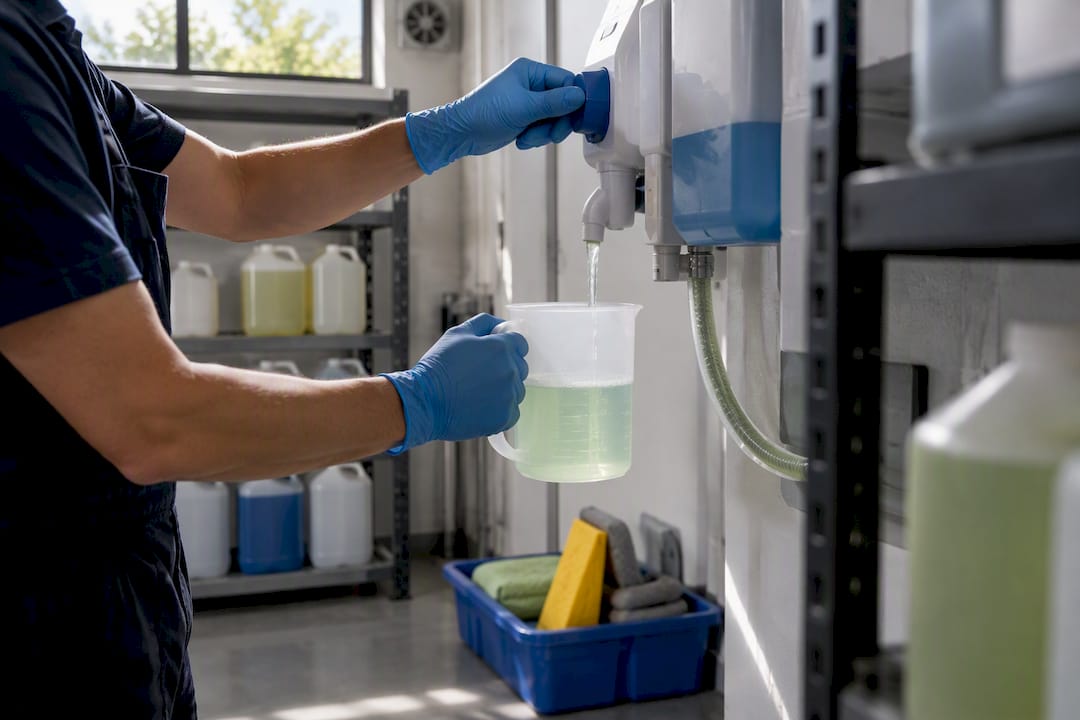
Refresher training matters as much as initial training. Dilution-control dispensers reduce human error, but they don’t eliminate the need for staff to understand what they’re handling if a dispenser fails or a job requires manual mixing. Build refreshers into your quarterly schedule rather than leaving training as a once-a-year compliance exercise.
Documentation closes the loop. Every training session should generate a record, date, topic, staff names, sign-off, because that record is exactly what a procurement audit or an incident investigation will ask for first. Contractors who can produce this on demand are the ones worth retaining; those who can’t are a liability regardless of what their marketing says about being eco-friendly.
Building a sustainable cleaning checklist for your facility type
A checklist built for a warehouse won’t fit a stadium, and a car park checklist misses half of what a public plaza needs. The mistake most facility managers make is copying a generic template instead of building around their site’s actual traffic, surfaces, and risk profile.
Start with facility-specific variables: surface type (concrete, epoxy, pavers), foot and vehicle traffic volume, exposure to weather, and any regulatory requirements specific to the sector (food service areas, healthcare-adjacent zones, public event spaces).
A workable checklist structure looks like this across facility types:
- Warehouses: GECA-certified degreasers, scheduled mechanical scrubbing frequency, spill response kit locations, dust control for high-traffic aisles.
- Car parks: Line marking and mechanical sweeping schedule, pressure washing frequency for oil and grime buildup, stormwater runoff controls for chemical use near drains.
- Public spaces and stadiums: High-frequency waste collection schedules, low-chemical surface cleaning for pedestrian areas, noise-limited equipment for use during operating hours.
- Construction sites: Rubbish removal cadence, dust suppression methods, de-flooding protocols for weather events.
Review the checklist quarterly against your KPI data. If chemical use per square metre isn’t dropping, or waste diversion has stalled, the checklist needs revising, not the target.
How to move from conventional to sustainable cleaning without disrupting operations
Facility managers usually delay this transition because they assume it means shutting down cleaning services for weeks while everything changes at once. It doesn’t need to work that way.
Run the transition in parallel with normal operations by zoning it. Pick one section, a single floor, one car park level, one warehouse bay, and pilot the new chemistry, dosing system, or equipment there first. This gives you real performance data before you commit budget to a full rollout, and it limits disruption to a contained area if something needs adjusting.
Sequence the change so equipment and consumables shift before contracts get rewritten. Swap chemical stock first, since that’s usually the fastest and cheapest change. Then move to dilution-control hardware, which requires some installation lead time. Equipment replacement (sweepers, scrubbers, pressure washers) comes last, timed against your existing maintenance or lease renewal schedule so you’re not writing off working machinery early.
Communicate the change to staff and site users before it happens, not after. A cleaning contractor switching products without notice often gets blamed for a “worse clean” simply because the smell or foam level changed, even when the actual cleaning performance improved. A short briefing avoids that friction entirely.
Finally, lock in your contract language only once the pilot has proven out. Writing GECA certification or specific equipment clauses into a contract before you’ve tested them on your own site risks specifying something that doesn’t suit your actual conditions.
Keeping staff engaged with sustainable cleaning standards long term
The hardest part of sustainable cleaning isn’t the initial rollout. It’s making sure staff don’t quietly drift back to old habits three months later when nobody’s watching.
Make the sustainability case tangible, not abstract. Staff respond better to “this dispenser saves us from over-ordering chemical every month” than to a general statement about environmental responsibility. Tie the practice to something they can observe directly, less lifting of heavy chemical drums, fewer skin irritation complaints, easier dosing.
Build short, recurring check-ins into existing shift routines rather than scheduling separate training events that feel like extra work. A five-minute toolbox talk before a shift, covering one specific practice, reinforces behaviour far better than an annual seminar staff forget within a week.
Recognise correct practice when you see it. If a supervisor spots correct dilution technique or proper chemical storage, saying so on the spot reinforces the behaviour more effectively than a formal review months later.
Rotate refresher content instead of repeating the same session. Covering dilution one month, storage the next, spill response after that, keeps the material from becoming background noise that staff tune out.
Finally, make non-compliance visible in your KPI data, not just verbal correction. If chemical use per square metre spikes on a particular team’s shifts, that’s a training conversation with evidence behind it, not a vague reminder to “be more careful.”
Staying compliant beyond ecolabels and certification
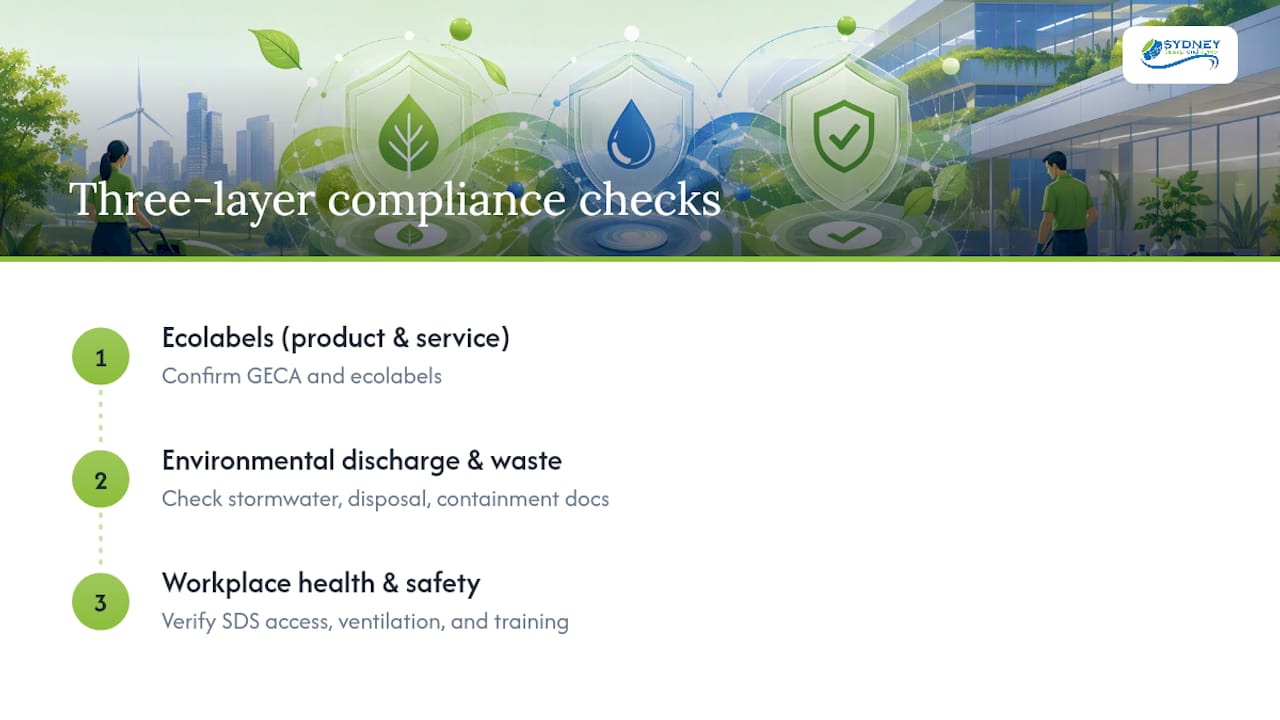
GECA certification is a strong signal, but it isn’t the only compliance obligation a facility needs to track. State and local environmental regulations around chemical disposal, stormwater runoff, and hazardous waste handling apply regardless of what’s printed on a product label.
Stormwater is the one most facility managers underestimate. Car park and outdoor pressure washing runoff can carry chemical residue directly into stormwater drains, which in most Australian jurisdictions is regulated separately from general waste disposal. Contractors need documented containment or runoff management procedures for any outdoor wet cleaning, not just a certified chemical.
Hazardous waste disposal, spent chemical concentrate, contaminated rags, filter media, typically falls under separate state-based waste regulations distinct from your recycling program. Confirm your contractor’s disposal method and ask for documentation, don’t assume certification covers this automatically.
Workplace health and safety obligations around chemical handling exist independently of any green certification too. SDS accessibility, ventilation requirements, and staff training obligations under workplace safety law apply to every chemical on site, certified or not.
The safest approach is layering compliance checks: ecolabel certification for product and service standards, separate confirmation of environmental discharge compliance, and a workplace safety review for handling and storage. Treating GECA as the only box to tick leaves gaps a regulator or insurer will eventually find.
Health and safety gains from lower toxic chemical use
Cutting harsh chemistry from a cleaning program isn’t purely an environmental decision. It changes the air people breathe and the exposure risk staff carry home.
Traditional cleaning chemicals, particularly concentrated degreasers and disinfectants, release volatile organic compounds that affect indoor air quality, especially in enclosed spaces like warehouses or underground car parks with limited ventilation. Switching to GECA-certified, lower-VOC products reduces that exposure for both cleaning staff and building occupants who use the space during and after cleaning.
Cleaning staff carry the heaviest exposure risk since they’re handling concentrate daily, not just diluted product. Reduced-chemical systems like aqueous ozone remove much of that risk entirely, since the “cleaning solution” is generated from water and electricity rather than stored concentrate that needs manual handling.
Skin and respiratory irritation from repeated chemical contact is a common, under-reported cause of absenteeism in cleaning teams. Lower-toxicity products and proper dilution control reduce that irritation, which shows up over time as fewer sick days and lower staff turnover, a genuine operational benefit alongside the environmental one.
Building occupants benefit too, particularly in spaces with vulnerable users, aged care facilities, childcare centres, or medical-adjacent buildings. Lower-toxicity cleaning reduces the risk of chemical sensitivity reactions among people who have no control over what products are used around them.
Setting sustainability goals that actually fit your facility
Generic sustainability targets, “reduce water use,” “go greener”, don’t survive contact with a facility manager’s actual operations. Effective goals are specific to the site and tied to a number you can track.
Start from your baseline KPI data, not an aspirational figure pulled from an industry report. If your current chemical use per square metre is your starting point, set a target reduction tied to a specific timeframe, six months, twelve months, and revisit it against real data rather than guessing.
Match the goal to the facility type. A warehouse’s biggest lever might be reducing water use through mechanical sweeping instead of hosing down floors. A car park’s biggest lever might be cutting chemical volume through dilution control on degreasers. Setting the same target across different facility types ignores where the actual savings are available.
Tie every goal to an operational outcome, not just an environmental one. “Reduce chemical spend by cutting overuse through dilution control” links directly to a budget line finance will care about, which makes the goal easier to defend when it competes for resources against other priorities.
Review benchmarks quarterly against the KPI data you’re already collecting, water per cleaning hour, chemical litres per square metre, waste diverted. If a goal isn’t moving after two review cycles, the target or the method needs revisiting, not just more time.
Cutting waste through smarter cleaning operations
Waste reduction in cleaning operations gets overlooked because it’s less visible than chemical or water use, but it adds up fast across a large facility.
Packaging is the easiest place to start. Bulk chemical concentrate delivered in refillable containers cuts single-use plastic dramatically compared to individual spray bottles replaced every cleaning cycle. Microfibre cloths and mop heads, properly laundered and reused, eliminate the disposable wipe stream entirely from most cleaning tasks.
Rubbish removal operations themselves can be tightened. Segregating recyclables at the point of collection, rather than relying on a single mixed-waste stream, increases the volume that actually gets diverted from landfill instead of sorted (or not sorted) downstream. For construction sites and warehouses generating consistent waste volumes, scheduled rubbish removal with clear segregation requirements written into the service contract makes this measurable rather than aspirational.
Equipment maintenance ties into waste reduction too. Well-maintained mechanical sweepers and scrubbers last longer before replacement, reducing the equipment waste stream that rarely gets counted in sustainability reporting but adds up over a facility’s operating life.
Track waste diverted as its own KPI alongside water and chemical metrics. A facility that’s cut chemical use but still sends the same volume of packaging and equipment to landfill has only solved part of the problem.
Get a verified sustainable cleaning partner for your site
Sydney Sweep and Scrub runs mechanical sweeping, pressure washing, and automated robotic cleaning across car parks, warehouses, construction sites, and public spaces, with carbon-neutral operations built into how jobs are scheduled, giving property managers a direct way to lower their site’s environmental footprint without adding admin work. Booking is straightforward: request a quote or book online for warehouse floors, multi-level car parks, or scheduled site maintenance, and pricing stays competitive against traditional contractors running older equipment.
Before signing with any provider, ask for the same evidence this guide recommends putting in your own tenders: GECA certification scope, ISO documentation where relevant, and access to service and audit logs rather than a verbal assurance. If a contractor can’t produce that on request, that’s worth noting before you commit to a contract.
Sources
For procurement teams building contract language, three references are worth keeping on file: the GECA cleaning services standard for certification scope, the UNSW green cleaning standard for equipment and training clauses, and industry analysis on the operational cost case for going green.
- Cleaning Services (CSv2.0-2021) — GECA | Good Environmental Choice Australia
- The cost case for going green — INCLEAN
FAQ
What Does GECA Certification Actually Cover?
GECA certification sets limits on hazardous ingredients, water use, and staff training requirements for cleaning products and services. It gives procurement teams a documented, third-party verified standard to reference in tenders instead of relying on a supplier’s own sustainability claims.
How Much Does Sustainable Cleaning Cost Compared to Conventional Methods?
Sydney Sweep and Scrub’s pricing for services like warehouse cleaning and car park cleaning is available on request through an online quote. Industry analysis suggests efficient equipment and lower-impact chemistries tend to reduce consumable costs over time rather than adding expense upfront.
What KPIs Should a Facility Track for Green Cleaning?
Core metrics include water use per cleaning hour, chemical litres per square metre, energy or fuel use for equipment, and waste diverted from landfill. These figures give facility managers auditable evidence for ESG reporting and tender responses.
Does Sustainable Cleaning Compromise Cleanliness or Safety?
No. Properly implemented sustainable cleaning, using certified products, efficient equipment, and correct dilution, maintains or improves cleaning outcomes while reducing chemical exposure for staff and occupants. Lower-toxicity products also tend to improve indoor air quality in enclosed spaces like warehouses and car parks.
How Do I Start Implementing Sustainable Cleaning This Quarter?
Begin with a chemical inventory audit and swap to GECA-certified products in your highest-use areas within the first 30 days. Follow with dilution-control installation and staff training in the next 30 days, then embed KPI reporting and certification clauses into contracts by day 90.