
Run three checklists, not one: pre-event bump-in, during-event live monitoring, and post-event reset. Each needs a documented, room-by-room sequence with timestamped verification, because a venue that “looks clean” isn’t the same as one that can prove it. Skip the paperwork and you’re exposed on safety compliance and bond disputes alike. Get all three right and the venue comes back to you clean, safe, and ready for the next booking.
TL;DR:
- Proper documentation of each cleaning phase, including timestamped checklists and photo evidence, is essential to demonstrate compliance and protect against disputes.
- Pre-event bump-in should follow zone-specific procedures, with benchmarks of 20 minutes for small rooms and up to 90 minutes for larger halls, plus a safety margin.
- During events, hourly checks in bathrooms, entry points, and food stations, with quick response times of 10 to 15 minutes for incidents, are critical for maintaining hygiene and safety.
- Post-event cleaning requires thorough waste segregation, deep cleaning, furniture resetting, and comprehensive documentation to avoid bond disputes and ensure venue readiness.
- Employing professional cleaning services is advisable when turnarounds are tight, the scope is large, or hygiene standards are particularly strict, with services scoped to zones and supported by digital reporting.
Table of Contents
- Pre-event cleaning checklist: bump-in and final setup
- During-event cleaning checklist: live monitoring and response
- Post-event cleaning and reset checklist
- Waste, recycling and hazardous items: how to segregate and document
- Cleaning frequencies, staffing and time benchmarks
- Quality assurance and documentation for WHS and handover
- Tools, chemicals and infection-control basics
- When to bring in a professional cleaning team
- How Sweepandscrub can help with event venue cleaning
- Sources
- FAQ
Pre-event cleaning checklist: bump-in and final setup
Bump-in is where most cleaning failures start, usually because teams clean rooms in whatever order contractors happen to finish them. Work zone by zone instead, and build in the safety checks that WorkSafe NSW guidance flags as recurring problems at events: pedestrian flow, trip hazards, and contractor coordination during setup.
Foyer and entry
- Lay entrance mats and check they sit flat, with no curled edges that create a trip hazard.
- Position signage so it doesn’t block sightlines or fire egress paths.
- Empty and reline all bins, then place extras near expected pinch points.
- Lay floor protection over any surface at risk from trolleys, rigging cases, or catering trolleys.
Function rooms
- Wipe every table and chair, checking for sticky residue from the previous bump-out.
- Clean AV surfaces, lecterns, and screens with a dry microfibre cloth, never a wet one near live electrics.
- Check backstage and green room areas for rubbish left by earlier crews.
- Align seating rows and check sightlines from the back row.
- Dust light fittings, ledges, and glass partitions, which show fingerprints under event lighting far more than daylight.
Catering and bar areas
- Sanitise all food-contact surfaces using the FSANZ two-step process: clean to remove debris, then sanitise with an approved product at the correct contact time.
- Confirm fridges and cool rooms are at temperature and free of leftover stock from a prior event.
- Position bar equipment so spill zones sit on non-slip matting, not bare tile.
- Stock glass racks and check for chips before service starts.
Back of house and loading dock
- Keep the loading dock and access corridors clear at all times, not just at the start of bump-in.
- Stage waste bins away from thoroughfares but close enough that catering staff will actually use them.
- Check staff amenities (toilets, break areas) are stocked and clean before the first contractor arrives.
Before the doors open, run through your consumables: spare mop heads, extra bin liners, backup microfibre cloths, and a spill kit positioned where bar staff can reach it in seconds.
Time benchmarks for bump-in
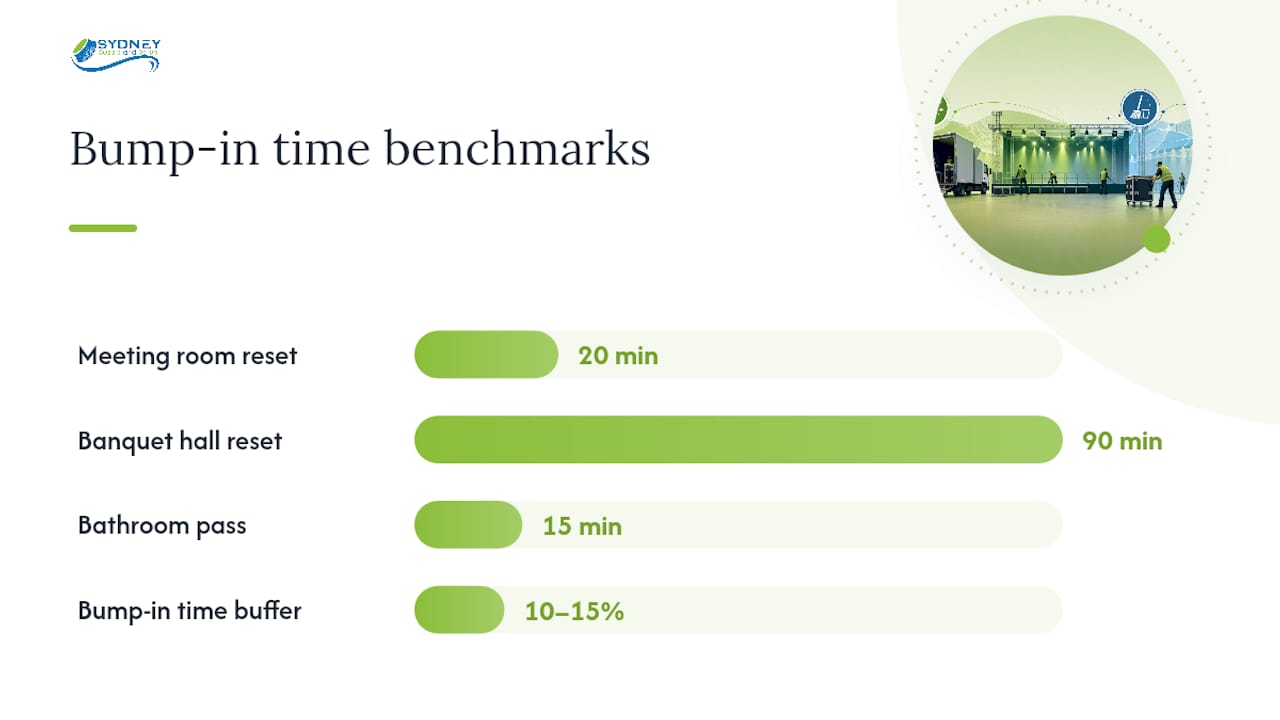
A standard meeting room takes around 20 minutes to reset for a single team member; a full banquet hall runs closer to 90 minutes with two or three staff working simultaneously, according to benchmarks used in conference centre cleaning planning. Bathrooms typically need 15 minutes each per pass. Build a 10 to 15 percent time buffer into every bump-in schedule, because real cleaning almost always runs slower under event pressure than it does in a dry run.
During-event cleaning checklist: live monitoring and response
Live cleaning during an event is a different discipline to bump-in. It’s reactive, discreet, and time-pressured, and it needs its own SLA rather than an informal “someone will get to it.”
Set hourly checks on the areas that degrade fastest:
- Bathrooms: restock, mop, and check bins every hour minimum, more often for events over 200 guests.
- Foyers and entry points: sweep and re-check mats hourly, since wet weather or high foot traffic changes the risk profile fast.
- Food stations: wipe down surfaces and clear plates continuously, not on a fixed hourly cycle.
- Bar areas: manage glass breakage and spills as they happen, with a dedicated response team on standby.
For public-area incidents, spills, breakages, overflowing bins, aim for a 10 to 15 minute response window. That benchmark comes directly from WorkSafe Victoria’s guidelines on planning safe public events, which treats documented incident response as part of demonstrating control measures during an inspection.
Assign one person to log incidents as they’re resolved, timestamp, location, action taken, and set up a simple contact cascade so floor staff know exactly who to call rather than hunting for a supervisor mid-event. Task completion should be visible, whether that’s a tick on a shared digital log or a radio call confirming the job’s done.
Pro Tip: Keep your live cleaning team small and mobile rather than one large roaming group. Two people who know their zones cold will beat five people covering the whole venue, because response time drops when nobody has to ask “whose area is this?”
Minimise disruption by using discreet uniforms, temporary cordons for wet floors, and clear signage rather than loud announcements. Guests notice a mop bucket left mid-aisle far more than they notice a quiet, quick clean.
Post-event cleaning and reset checklist
This is where bonds get lost and reputations get made. A post-event cleaning checklist needs to cover waste, deep cleaning, furniture reset, and a documented final inspection, because “we cleaned it” and “we can prove we cleaned it” are not the same claim to a venue manager checking a bond.
Waste removal and bin management
- Separate general waste, recycling, and food organics streams before they leave the building.
- Flag any hazardous items (broken glass, chemical containers, sharps from catering) for separate handling.
- Remove all bagged waste to the designated collection point, don’t leave it staged overnight in a function room.
Deep clean tasks
- Vacuum and spot-treat carpets, checking under tables and behind furniture where spills hide.
- Mop and buff hard floors, paying particular attention to bar and food service zones.
- Wipe down upholstery and check for stains that need treatment before they set.
- Deep clean kitchens and bars: equipment, benches, floor drains, and fridge interiors.
- Clean toilets to a hospitality standard, not a quick wipe, since this is the area most likely to trigger a complaint.
- Check air vents and light fittings for dust buildup from the event’s duration.
Furniture reset and handback
Return every table, chair, and fixture to the layout documented before bump-in, using photos taken at setup as your reference. A facility condition checklist used by local councils treats this “making good” step as the standard way to avoid bond disputes, because most deductions happen when a venue isn’t restored to its pre-event condition.
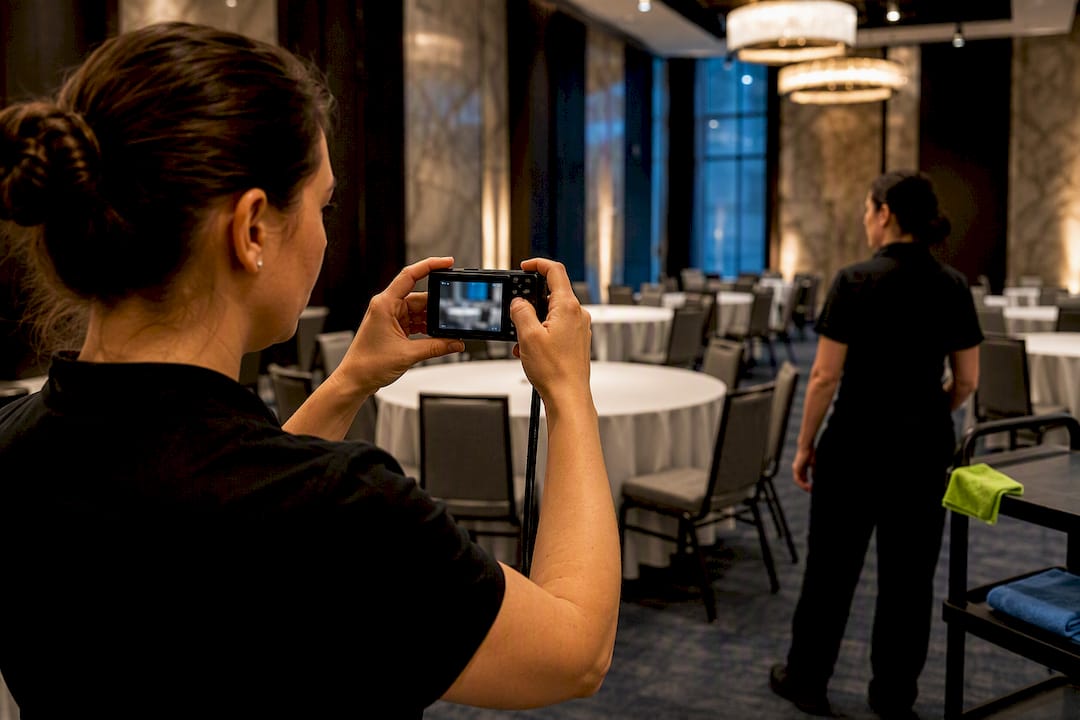
Run a final walkthrough with a second staff member, taking photos of every room against the pre-event baseline. Sign off on the condition report, get the client or venue representative to countersign where possible, and file the whole record, photos, timestamps, checklist, together. That paper trail is what protects you if a dispute comes up weeks later. For a fuller task list on this stage, see this guide to professional post-event cleaning.
Waste, recycling and hazardous items: how to segregate and document
Event waste isn’t one stream, it’s at least four: general, recycling, glass, and food organics, with clinical or hazardous waste as a fifth when catering or medical services are on-site. Mixing them at the bin creates problems downstream that are expensive to sort out later.
- Colour-code or label bins clearly for each stream and brief bar and catering staff before service starts.
- Keep disposal receipts and contractor dockets on file, they’re often the only proof you have for an audit or a council inquiry.
- Store any hazardous waste (broken glass, chemical residue, sharps) in sealed containers away from foot traffic until collection.
- Have a spill kit on-site for chemical or biological spills, not just a mop and bucket.
- Confirm your waste contractor’s collection times and local council rules before the event, not the morning after.
Cleaning frequencies, staffing and time benchmarks
Run sheets fall apart when cleaning time isn’t scheduled with the same rigour as catering or AV. Use zone-based benchmarks to size your team correctly rather than guessing.
| Zone | Typical time | Staffing note |
|---|---|---|
| Meeting room | 20 minutes | 1 person |
| Banquet hall | 90 minutes | 2 to 3 people working together |
| Bathroom (per pass) | 15 minutes | 1 person, hourly during event |
| Bar area reset | 30 minutes | 1 to 2 people |
These figures come from benchmarking used across conference centre and venue cleaning, and they scale with attendance, not just floor area. A 90 minute banquet hall reset with 300 guests needs more hands than the same room after a 50 person seminar.
Stagger shifts so your team isn’t all clocking off at once when the event peaks, and build buffer time into every block, benchmarks compress under real event pressure more often than they stretch. Call in specialist teams for carpet extraction, upholstery treatment, or hazardous waste removal rather than trying to stretch a general cleaning crew across every task.
Quality assurance and documentation for WHS and handover
Visual cleanliness doesn’t satisfy an auditor. WorkSafe guidance expects documented proof, not a clean-looking room, when reviewing control measures at events.
- Timestamped digital checklists for each zone, completed and signed off by the staff member who did the work.
- Photo evidence at each stage: pre-event baseline, during-event spot checks, post-event final condition.
- Chemical dilution logs recording what product was used, at what concentration, and when.
- Verification testing where hygiene matters most: ATP swab testing on food contact surfaces, targeting readings under 150 to 300 RLU.
Digital audit platforms and photo logs turn “we cleaned it” into something you can actually show a client, an insurer, or a WHS inspector months later. Your final inspection checklist should include bathroom hygiene, food surface sanitising, furniture layout match, waste clearance, and signage removal, each ticked with a name and time attached.
Tools, chemicals and infection-control basics
Cleaning and sanitising aren’t the same step. FSANZ requires cleaning to remove visible debris first, then a separate sanitising step using an approved product or heat, typically 77°C for 30 seconds, held for the correct contact time.
- Colour-code equipment by zone: red for washrooms, green for food areas, blue for general surfaces, to stop cross-contamination between high-risk zones.
- Use microfibre cloths and mop systems over cotton rags, they lift more soil and microbial load per pass.
- Keep Safety Data Sheets accessible for every chemical on-site and log dilution ratios each time a product is mixed.
- Stock ATP swabs for spot verification on high-touch surfaces like door handles, bar tops, and payment terminals.
When to bring in a professional cleaning team
In-house teams handle most single-day bookings fine. Bring in a professional crew when turnarounds are tight, soiling is heavy, or the event involves large crowds and food service where hygiene risk climbs fast; for detailed practical cleaning tips and activities for Melbourne venues, see cleaning activities. Professional scopes typically run on zone-based pricing with defined SLAs, digital reporting, and photo logs, exactly the documentation that protects you in a bond dispute or WHS audit. Professional cleaning companies can offer this kind of scoped support for venues that need it.
How Sweepandscrub can help with event venue cleaning
Running three checklists across a bump-in, a live event, and a bond-sensitive handback is a lot to manage with an in-house team stretched across other duties. Sweepandscrub handles the heavy end of that workload directly, mechanical sweeping and scrubbing for function halls and car parks, pressure washing for outdoor areas and loading docks, and rubbish removal for the waste volumes a single event can generate.
Every job runs on the same principle this checklist is built on: don’t just clean it, prove it. These crews often work with digital reporting and photo evidence built into the job, sometimes backed by eco-friendly, carbon-neutral operations if sustainability reporting matters to a client or council contract. For commercial cleaning scoped to your venue’s zones and event calendar, request a quote through the online booking system and get a schedule that matches your run sheet, not the other way around.
Sources
Check WorkSafe Victoria’s event guidance, FSANZ cleaning and sanitising rules, and a local facility condition checklist template before finalising your own run sheet.
- Victorian guidelines: planning safe public events (WorkSafe Victoria)
- Cleaning and sanitising (Food Standards Australia New Zealand)
- Post-event cleaning strategies for conference centres and venues (WesKleen Supplies)
FAQ
What is a standard cleaning checklist for an event venue?
A standard checklist covers three stages, pre-event bump-in and setup, during-event live monitoring with hourly checks, and post-event deep clean and handback, each with documented sign-off and photo evidence.
What is the 6 to 10 step cleaning process used in hospitality venues?
Hospitality-grade cleaning generally follows a six-step sequence: pre-clean, wash, rinse, sanitise, final rinse where required, and dry, verified in food areas with ATP testing rather than a visual check alone.
What are the 7 steps of cleaning for a venue reset?
A practical seven-step reset runs: clear waste, dust and wipe surfaces, clean floors and carpets, sanitise food and bathroom areas, reset furniture to the documented layout, run a final walkthrough, then sign off with photo evidence.
How do I build a cleaning checklist for my venue?
Break the venue into zones (foyer, function rooms, catering, back of house), list tasks per zone with a time benchmark, and add a documentation column for sign-off, timestamp, and photo evidence so the checklist doubles as an audit record.
How often should high-traffic areas be checked during an event?
Bathrooms, food stations, and bar areas need checks at least hourly, with a 10 to 15 minute response window for any spill or incident in a public area, in line with WorkSafe event guidance.