
Every pressure washing operator needs eye and face protection, pressure-rated waterproof clothing or overalls, chemical-resistant gloves, safety boots with lower-leg protection where the nozzle could strike the feet, hearing protection in high-noise environments, and a respirator when chemical vapours are present. None of this is optional gear you grab if you feel like it. PPE sits at the bottom of the WHS control hierarchy, meaning it backs up your other safety measures, not replace them.
TL;DR:
- Proper PPE—including face shields, waterproof clothing, chemical-resistant gloves, and safety boots—is essential for pressure washing, with additional hearing and respiratory protection based on site hazards.
- Eye and face protection must include a face shield with safety glasses underneath for high-pressure jobs, as glasses alone are insufficient against ricochet and splash risks.
- PPE selection and maintenance depend on task-specific hazards, proper fit, compliance with standards, and daily visual inspections to ensure safety.
- Engineering and administrative controls should be prioritized over PPE alone to reduce hazard exposure, such as nozzle shrouds and exclusion zones.
- Professional crews ensure PPE compliance through pre-start checks and proper training, providing safe, law-abiding pressure washing without client involvement in PPE management.
Table of Contents
- What PPE do you actually need for pressure washing?
- How do you choose, fit and maintain pressure washing PPE?
- Why isn’t PPE enough on its own?
- What does a professional crew actually check before starting?
- Does the right PPE change between residential, commercial and industrial jobs?
- What hazards does each piece of PPE actually stop?
- Want compliant pressure washing without managing PPE yourself?
- Sources
- FAQ
What PPE do you actually need for pressure washing?
Pressure washing PPE breaks down into six categories, and each one answers a specific hazard on site. Skip the wrong one and you’re not just uncomfortable, you’re exposed.
Head protection matters mainly on construction sites or under scaffolding, where falling debris is the real threat rather than the water jet itself. A hard hat compliant with AS/NZS 1801 covers that scenario; for straightforward driveway or car park work, it’s usually unnecessary.
Eye and face protection is where most people underestimate the risk. A high-pressure jet, particularly anything above typical domestic pressure levels, can fling grit, paint chips and detergent spray back at your face faster than you can blink away. Safety glasses alone won’t cut it because they leave your face exposed to ricochet and splash. Safe Work Australia’s guidance on managing high-pressure water jetting recommends eye protection paired with a face shield, and glasses meeting AS/NZS 1337 remain the baseline underneath that shield.
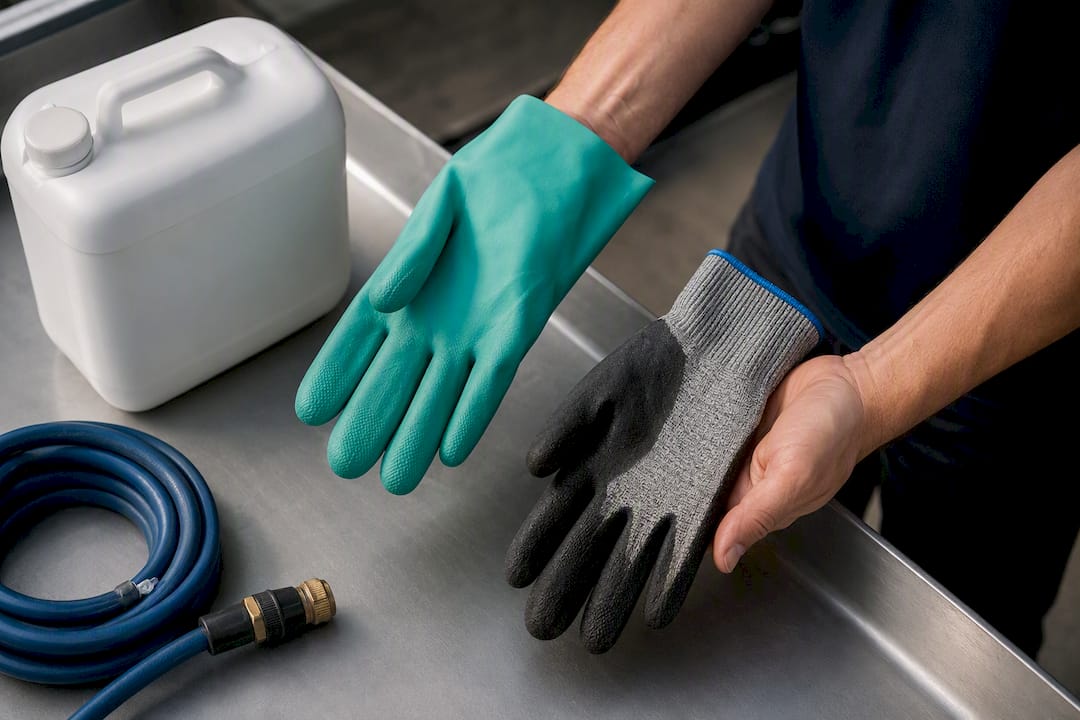
Hand protection depends on what you’re handling. Chemical-resistant nitrile gloves are the right call when you’re mixing or applying detergents, since they resist the surfactants and degreasers common in commercial cleaning. If you’re managing hoses and fittings under mechanical load, cut-resistant gloves rated against abrasion make more sense. Some jobs call for both, layered or swapped depending on the task.
Torso and leg protection is non-negotiable for anything above domestic-grade pressure. Pressure-rated waterproof jackets, trousers or full overalls stop a stray jet from lacerating skin, which sounds dramatic until you learn that a concentrated jet at close range can breach unprotected skin in a fraction of a second. Chemical-protective clothing referenced under AS 3765 covers additional protection where detergents or degreasers are in play.
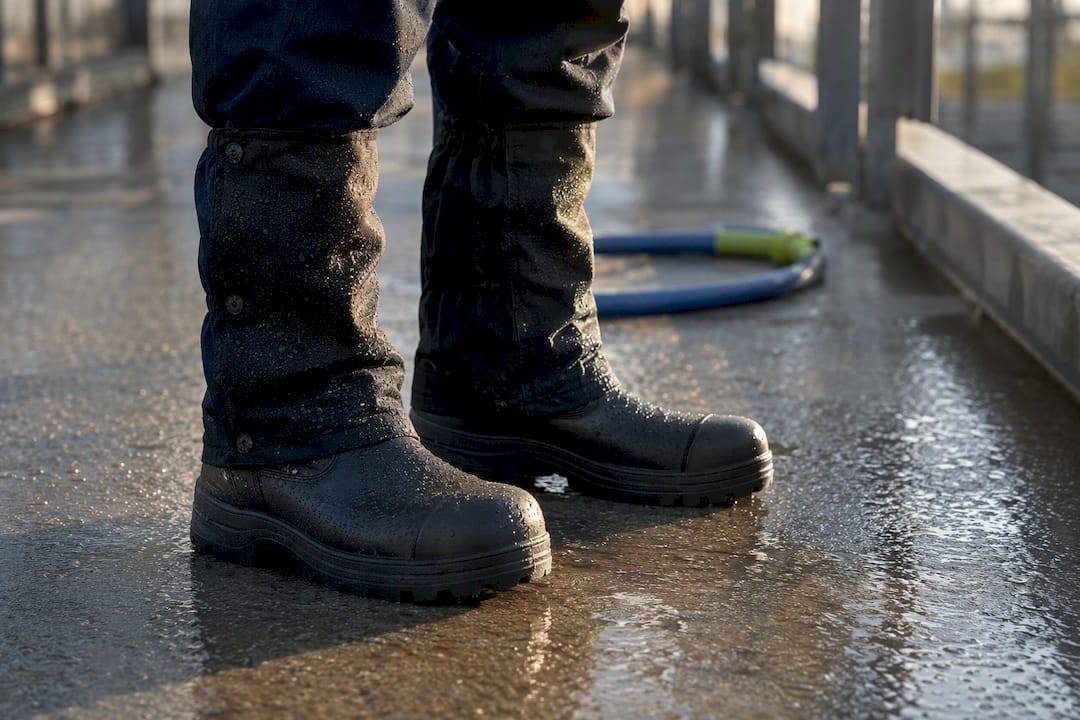
Feet and lower legs need steel-capped safety boots meeting AS/NZS 2210 as standard. Where the gun barrel is short enough that the nozzle can reach down toward the operator’s own feet, lower-leg spats or leg guards become essential. Hunter Water’s high-pressure jetting standard specifically calls out this scenario as one of the more common preventable injuries on jetting sites.
Hearing protection kicks in once ambient noise crosses the threshold where extended exposure causes damage, which on many commercial machines happens well before you’d expect. Earmuffs suit continuous high-noise tasks; plugs work for shorter, intermittent jobs.
Respiratory protection is situational, not automatic. If you’re working with chemical additives that produce vapour, or cleaning in an enclosed space with poor airflow, a properly fitted respirator with the correct cartridge for that specific chemical hazard is required. Respirators demand risk assessment and user training before use — they’re not a generic substitute for ventilation or safer chemical selection.
Quick specification checklist:
- Face shield + AS/NZS 1337 safety glasses for any jetting above domestic pressure
- Nitrile gloves for detergent handling; abrasion-rated gloves for mechanical tasks
- Pressure-rated jacket and trousers, or full waterproof overalls
- AS/NZS 2210 safety boots, plus spats where the barrel length allows nozzle contact with feet
- Hearing protection matched to noise duration and intensity
- Respirator with task-appropriate cartridge, used only after a documented risk assessment
How do you choose, fit and maintain pressure washing PPE?
Buying the right gear is only half the job. Fit and upkeep determine whether it actually protects you when something goes wrong.
Run through this before any pressure washing PPE purchase:
- Match the gear to the hazard. Chemical work needs chemical-resistant gloves; mechanical hose work needs cut-resistant ones. Don’t assume one glove covers both.
- Check standard compliance. Look for AS/NZS markings on glasses, boots and protective clothing rather than taking a supplier’s word for it.
- Get the size right. Loose gloves catch on fittings; oversized boots slow you down when you need to move fast.
- Confirm compatibility. A respirator that doesn’t seal properly under a face shield defeats both items — test them together before relying on either.
- Prioritise comfort for the shift length. Gear that chafes or overheats gets removed halfway through the day, and that’s when injuries happen.
Before every shift, run a fast visual check: look for cracks in visors, tears in waterproof fabric, and worn seals on boots or respirator masks. Replace anything showing cuts, tears or a compromised seal immediately rather than finishing the job first. After chemical use, clean gloves and clothing according to the product’s data sheet before storing them, since residue left on fabric degrades material faster than the manufacturer’s rated lifespan suggests.
Under WHS law, the person conducting a business or undertaking (PCBU) carries the legal duty here. That means providing suitable PPE, training workers in its use, and confirming compatibility between items before work starts. PPE requirements belong in the Safe Work Method Statement (SWMS) and in the daily pre-start check, not as an afterthought once the hose is already connected.
Pro Tip: Keep a spare set of gloves and glasses in the vehicle. A cracked visor or torn glove mid-job is the moment most operators are tempted to keep working without it, and that’s exactly when an eye injury happens.
Why isn’t PPE enough on its own?
PPE sits at the bottom of the hierarchy of controls for a reason: it protects the person wearing it, but it does nothing to reduce the hazard itself. Elimination and substitution come first (can the job be done at lower pressure or with a different method?), followed by engineering controls, then administrative measures, with PPE as the final layer.
Engineering controls that reduce reliance on PPE include:
- Nozzle shrouds that contain spray and reduce ricochet
- Hose restraints that prevent whip-back if a fitting fails
- Gun barrels long enough that the nozzle physically can’t reach the operator’s own feet
- Temporary barriers or covers protecting bystanders and nearby vehicles
Administrative controls matter just as much. A documented SWMS, clear exclusion-zone signage, active supervision and proper training all reduce the chance PPE ever needs to be the last line of defence. WorkSafe Victoria’s guidance on high-pressure water jetting reinforces this point directly: PPE backs up these measures, it doesn’t replace them. Higher-pressure or industrial jetting work often calls for specialist controls beyond standard PPE, particularly where class-based licensing or utility-specific standards apply.
What does a professional crew actually check before starting?
A trained commercial crew doesn’t improvise PPE on the day. On a typical Sydney job, that means face shields and safety glasses, chemical-resistant gloves matched to the detergent in use, waterproof pressure-rated clothing, AS/NZS 2210 boots, and hearing protection where machine noise demands it.
Before the hose goes live, the crew runs a documented pre-start check: visual inspection of every item, confirmation the SWMS matches the site conditions, and a quick briefing on exclusion zones. If you’re booking a contractor, ask to see their pre-start checklist and SWMS before the job begins. It’s a fair question, and a competent operator will have both ready without hesitation. Our guide on pressure washing concrete covers what that documentation should specify for hard-surface jobs.
Does the right PPE change between residential, commercial and industrial jobs?
Domestic driveway cleaning at moderate pressure calls for a lighter setup: safety glasses, sturdy closed footwear and gloves for detergent handling usually cover it, since the pressure and exposure time are both lower. A homeowner cleaning their own path once a year faces a genuinely different risk profile to someone running a commercial machine eight hours a day.
Commercial work, such as car park or warehouse floor cleaning, raises the bar. Sustained exposure to higher-pressure equipment, frequent chemical use and longer shifts mean full pressure-rated clothing, a face shield, chemical-resistant gloves and hearing protection become standard rather than optional. Our page on Sydney car park cleaning shows how that gear gets used in practice on a live commercial site.
Industrial and utility-grade jetting sits at the top of the risk scale. Pressure levels here can exceed what standard consumer equipment produces, and the consequences of a failure multiply accordingly. This is where lower-leg spats, full body armour, respirators fitted for specific chemical hazards, and formal training under units like CPPCLO3020A stop being best practice and become a baseline expectation. The gap between “hose the driveway” and “jet a warehouse floor” is bigger than most people assume until they’ve stood next to both machines.
What hazards does each piece of PPE actually stop?
Every item on the list exists to counter one specific, identifiable risk, not a vague sense of caution.
The water jet itself is the obvious hazard, and at close range it can break skin. Pressure-rated clothing and lower-leg spats exist specifically to stop that. Flying debris, grit and paint chips dislodged by the jet cause a different injury pattern, eye trauma, which is why the face shield and safety glasses combination matters more than either item alone.
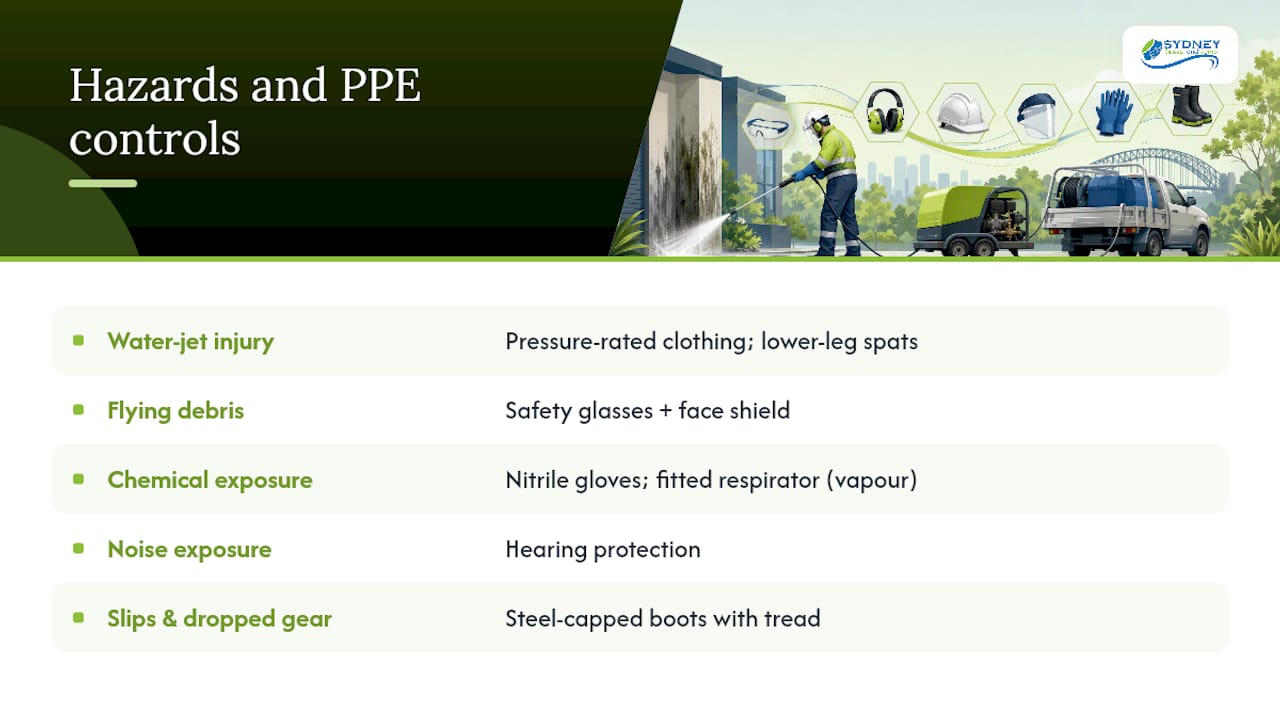
Chemical exposure through skin contact or inhalation is a third distinct hazard, addressed by nitrile gloves and, where vapour risk exists, a properly fitted respirator. One of the more overlooked risks is avoidable operator mistakes around handling and positioning, which good PPE selection reduces but doesn’t eliminate entirely. Noise-induced hearing loss builds up gradually rather than happening in a single dramatic moment, which is exactly why hearing protection gets skipped so often, and why it shouldn’t be.
Slips and falls round out the common hazard list, particularly on wet, freshly cleaned surfaces. Steel-capped boots with decent tread address the fall risk, while the toe cap protects against dropped equipment. Each hazard has a specific countermeasure. Mixing and matching without understanding which risk you’re covering is how gaps in protection creep in.
Want compliant pressure washing without managing PPE yourself?
Every point above is exactly what our crews check before a job starts. Operators are trained on PPE selection, SWMS documentation and pre-start procedures for commercial cleaning sites such as warehouse floors, car park decks or public plazas. Clients receive compliant crews using pressure-rated clothing, chemical-resistant gloves and appropriate eye and face protection for the job, without needing to source, fit or maintain PPE themselves. That’s the real advantage of hiring a professional crew over DIY equipment hire: you’re paying for the safety management as much as the clean result. Our hard surface cleaning service page covers what we handle for property managers and facility operators across Sydney, and for jobs needing extra grease or grime cutting, our hot water pressure washing option adjusts both the method and the PPE accordingly. Quotes can be requested online, with job scoping including safety documentation done before arrival.
Sources
- Personal protective equipment (PPE) – WHS duties | Safe Work Australia
- High pressure water jetting | WorkSafe Victoria
- High pressure water jetting standard (Hunter Water)
FAQ
What are the seven basic types of PPE?
The core categories are head, eye and face, hand, torso/body, foot and leg, hearing, and respiratory protection. For pressure washing, not every category applies to every job. Which ones you need depends on the pressure level, chemicals involved and site conditions.
What PPE should you use during pressure washing specifically?
At minimum, wear a face shield with safety glasses underneath, pressure-rated waterproof clothing, chemical-resistant gloves and safety boots meeting AS/NZS 2210. Add hearing protection and a respirator where noise levels or chemical vapours make them necessary.
What safety precautions should you take when using a pressure washer?
Beyond PPE, never aim the nozzle at yourself or bystanders, keep the gun barrel long enough that it can’t reach your own feet, use hose restraints to prevent whip-back, and follow a documented SWMS with clear exclusion zones. PPE backs up these controls, it doesn’t replace them.
Do you need a respirator for pressure washing?
Only when the risk assessment identifies a genuine vapour or chemical inhalation hazard, typically during chemical detergent application in enclosed or poorly ventilated spaces. Respirators require correct cartridge selection and proper fit, not casual use as a general precaution.