
After-hours cleaning is the simplest way to keep your workplace fully ready each morning without disrupting staff or customers. It’s the right call whenever daytime cleaning gets in the way of meetings, calls, or foot traffic through reception. Done properly, it means zero disruption, a deeper clean, and secure access managed on your terms. Before signing anyone, ask for a written scope of works and a certificate of currency.
TL;DR:
- Effective after-hours cleaning requires a written scope of tasks and periodic deep cleans that are itemized separately from daily service quotes.
- Professional providers use regulated safety documentation, including insurance, police checks, site inductions, and a designated site supervisor to ensure compliance and accountability.
- Scheduling during evenings, early mornings, or weekends depends on when the site is empty and traffic volume, which directly influences the cost based on floor type and access complexity.
- After-hours access enables thorough disinfection and deep cleaning of floors and high-touch surfaces, resulting in safer, presentation-ready spaces for the next day.
- Sydney Sweep and Scrub specializes in industrial-grade, eco-friendly deep cleaning with equipment like hot-water pressure washers, suitable for warehouses, car parks, and large surfaces.
Table of Contents
- What does after-hours cleaning actually cover?
- What business benefits come from cleaning after hours?
- When should you schedule cleaning, and what drives the cost?
- What security and compliance paperwork should the contract include?
- How do you choose and vet an after-hours cleaner?
- Why is Sydney Sweep and Scrub built for after-hours work?
- Get a written scope and site inspection for your after-hours program
- Sources
What does after-hours cleaning actually cover?
After-hours cleaning happens outside occupied hours, usually in the evening, early morning, or on weekends, and it runs on a pre-agreed checklist organised by area and frequency rather than a vague promise to “tidy up.” That checklist is what separates a professional operator from someone with a mop and good intentions.
A typical nightly scope covers reception, workstations, kitchens, restrooms, meeting rooms, floors, bin areas, and high-touch disinfection points like door handles and light switches. Providers offering sanitising services for desks and shared equipment usually build this into the nightly rate rather than charging extra.
Some tasks sit outside the standard nightly rate and get scheduled periodically instead:
- Carpet extraction and deep steam cleaning
- High-level dusting (light fittings, cable trays, air vents)
- Floor stripping and resealing on hard surfaces
- Window cleaning above ground level
- Upholstery treatment in reception or boardroom furniture
Ask your provider to separate nightly tasks from periodic ones in the quote. If it’s all lumped into one line item, you’ve got no way of checking whether you’re actually getting what you’re paying for.
What business benefits come from cleaning after hours?
Removing cleaners from the floor during business hours eliminates the interruptions that come with vacuums running past open-plan desks or a mop bucket blocking the path to the printer. Staff keep their focus, clients don’t walk into a half-finished clean, and cleaners aren’t rushing around people to get the job done.
After-hours access lets cleaning crews use heavy equipment like buffers, steamers, and pressure washers without staff exposure, which is a genuine selling point for facility managers dealing with insurers and workplace health and safety obligations.
That access also changes what’s physically possible. A scrubber-dryer can run across an entire warehouse floor. Restrooms get a proper disinfection cycle instead of a quick wipe between visitors. Wet floors dry overnight instead of becoming a slip hazard at 2pm.
The flow-on benefits show up the next morning:
- Floors are dry and safe before the first person walks in
- High-touch surfaces get proper disinfection cycles, not a rushed wipe
- Reception and common areas look presentation-ready for the day’s first client meeting
- Equipment noise and chemical odours have dissipated by opening time
If you’re weighing up whether disinfection frequency matters, it’s worth reading why regularly disinfecting surfaces genuinely reduces illness transmission in shared workspaces, not just how it looks.
When should you schedule cleaning, and what drives the cost?
Most sites choose between three windows: evening (roughly 5pm to 10pm), early morning (5am to 8am), or weekend deep cleans for sites that don’t operate on Saturdays or Sundays. Which one you pick depends on when your building is actually empty, not just what sounds convenient.
Frequency is where the real cost conversation happens. Offices with heavy foot traffic (medical centres, childcare, hospitality venues) tend to need nightly cleaning, while a quieter professional services office might only need three visits a week. Warehouses and strata common areas often sit somewhere in between.
A handful of factors move the price beyond simple square metreage:
- Floor type (carpet, polished concrete, vinyl all carry different labour and product costs)
- Traffic volume and soil load
- Specialist add-ons like pressure washing or hot-water cleaning
- Access complexity (multiple tenancies, lift bookings, security check-ins)
Pro Tip: Ask for the after-hours premium to be itemised separately from the base cleaning rate. Some providers fold it into the headline number, which makes it impossible to compare quotes properly against a competitor charging daytime rates for a lesser scope.
Payment is usually a fixed monthly or per-visit rate based on the agreed frequency, with periodic deep cleans (carpet extraction, pressure washing) billed as separate line items rather than buried in the recurring fee.
What security and compliance paperwork should the contract include?
Handing over building access after hours means handing over trust, and that trust needs paperwork behind it, not a handshake. A genuinely professional program documents every part of the compliance chain before the first shift starts.
At minimum, your contract should include:
- Certificates of currency for public liability and workers compensation insurance
- Police checks and documented site inductions for every staff member entering unsupervised
- An SDS (Safety Data Sheet) register with dilution protocols and colour-coded equipment to prevent cross-contamination between areas
- Clear key or fob custody, alarm codes, and a digital sign-in/out log
- A named site supervisor accountable for every shift
That last point matters more than it sounds. Without a named supervisor, a missed task or a security lapse has nobody responsible for fixing it. With one, you’ve got a single point of contact who answers for the quality of every visit.
How do you choose and vet an after-hours cleaner?
Comparing quotes on price alone is how businesses end up with a cheap contract and a dirty office six months later. Work through this checklist before you sign anything:
- Request a written scope of works. It should list every task, area, and frequency, not just a dollar figure per month.
- Ask for a sample inspection report. A provider with a genuine quality process can show you a real example with photo evidence, not just promise “we’ll check in.”
- Confirm the SLA and named supervisor. Get their name and direct contact before the first shift, not after a problem arises.
- Verify insurance, police checks, and induction records. Ask to see the certificate of currency directly, don’t just take a verbal assurance.
- Compare line items, not headline price. A quote $200 cheaper a month that skips periodic deep cleans isn’t actually cheaper.
When you interview a prospective supplier, ask directly: How do you handle a missed shift? Who inspects the work and how often? What’s your protocol if a staff member loses a building fob?
Pro Tip: Treat a provider’s reluctance to share their SDS register or insurance certificate as a red flag, not a formality they’ll get to later. A business with nothing to hide has these documents ready before you even ask.
Why is Sydney Sweep and Scrub built for after-hours work?
Sydney Sweep and Scrub runs mechanical sweeping, scrubbing, and pressure washing with hot water suited exactly to the deep, unsupervised tasks daytime crews can’t tackle, from warehouse floors to car park surfaces caked in grime.
Every job runs on carbon-neutral operations, with crews trained in SDS handling and proper dilution protocols before they touch a site. Bookings follow a custom scope built around your building, a named supervisor accountable for quality, and a site inspection process that catches issues before they become complaints. Getting started is as simple as the online booking system, no drawn-out sales process required.
Get a written scope and site inspection for your after-hours program
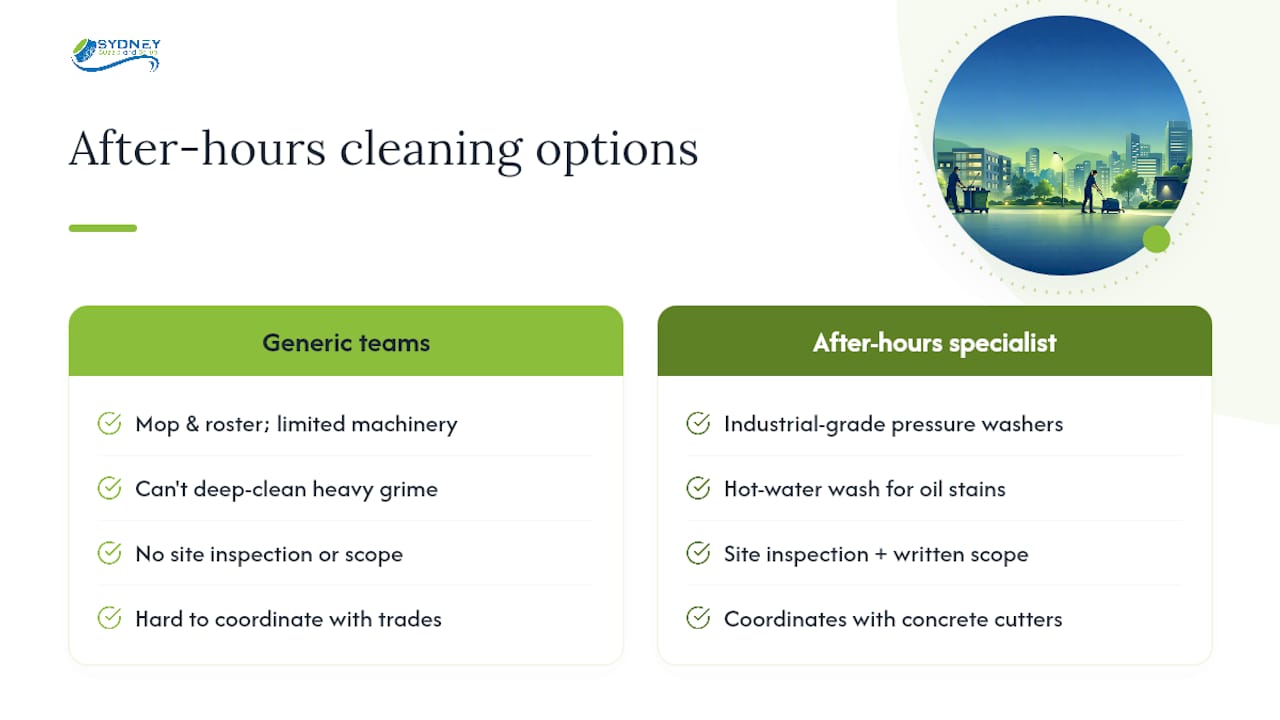
There are other ways to handle this: a general cleaning contractor with a mop and a roster, or an in-house team stretched too thin to do the deep work properly. Neither gives you the mechanical sweeping, scrubbing, and pressure washing capability that a car park, loading dock, or warehouse floor genuinely needs after hours.
Sydney Sweep and Scrub brings industrial-grade equipment and eco-friendly, carbon-neutral processes to exactly the tasks daytime teams skip: hot-water pressure washing for oil-stained concrete, carpark surfaces that need more than a quick hose-down, and hard surfaces that build up grime week after week. A first site inspection covers your access requirements, security documentation, and a written scope tailored to your building, so you’re comparing an actual proposal, not a guess. If your site also involves construction or trade works that need coordinated access, providers like Vic Sawing & Drilling handle the concrete cutting side while your cleaning schedule works around it.
Book a site inspection through the online booking system and get a written scope before your next cleaning contract renews.
Sources
- After Hours Commercial Cleaning: Room-by-Room Guide
- Melbourne after hours cleaning for modern workplaces | ACS