
Yes, steam cleaning works on concrete, but not on every finish and not without a few precautions. Steam suits sealed and unsealed concrete well, works on polished concrete only after a test patch, and should be avoided on some machine-polished floors where the manufacturer’s own maintenance guidance rules it out. The upside is real: heat sanitises surfaces and uses a fraction of the water a pressure washer needs. The risk is trapped moisture and, on sensitive coatings, etching or discolouration.
Before you run a full job, do this:
- Test a small, hidden patch and check it after 24 hours
- Use a dry-steam setting, not wet steam, on any sealed or polished surface
- Ventilate the space and get airflow moving straight after cleaning to force fast drying
Key Takeaways
Steam cleaning suits sealed, unsealed, and most polished concrete when you use dry steam, test first, and dry the surface fast, while heavy outdoor soiling and coated floors with strict warranty terms call for pressure washing or a professional crew instead.
| Point | Details |
|---|---|
| Test before you commit | Clean a hidden patch and check it after 24 hours for colour change or trapped moisture. |
| Use dry steam on sensitive floors | Dry steam reduces moisture load and cuts drying time on sealed or polished concrete. |
| Match the tool to the job | Steam suits indoor hygiene work; pressure washing suits heavy outdoor soiling and deep-pore grime. |
| Dry immediately after cleaning | Force airflow with fans straight after the pass to avoid moisture getting trapped under sealers. |
| Call in Sweepandscrub for scale | Sweepandscrub handles hot-water cleaning, mechanical scrubbing, and carbon-neutral options for larger or coated concrete sites. |
Table of Contents
- Steam cleaning vs pressure washing for concrete
- Which concrete finishes tolerate steam cleaning?
- How do you steam clean a concrete surface step by step?
- What equipment and temperature settings work best for concrete?
- What safety controls should you have in place?
- How do you remove grease, oil and stubborn stains from concrete?
- How should you dry and maintain concrete after steam cleaning?
- When should you book a professional concrete cleaning crew?
- Get a concrete cleaning crew that gets the drying right
- Sources
Steam cleaning vs pressure washing for concrete
Steam and pressure washing solve different problems. Steam relies on heat, typically delivered as low-moisture vapour, to break down grease and kill bacteria on contact. Pressure washing relies on force, usually measured in PSI, to physically blast soil and grime off a surface. Neither is universally “better.” They’re built for different jobs.
Steam is the right call indoors, in food-contact areas, change rooms, or anywhere hygiene matters more than deep soil removal, because it sanitises without producing litres of contaminated runoff. Pressure washing wins outdoors, on heavily soiled car parks, loading docks, and stained concrete where you need raw force to dig grime out of the surface pores. Plenty of commercial operators run both, pairing pressure washing for exterior areas with steam for interior, hygiene-sensitive zones as part of one cleaning programme rather than picking a single tool for every job.
Run through this before you decide:
- What’s the surface finish? Polished and coated concrete favour steam; bare, heavily soiled concrete favours pressure
- Is it indoors or outdoors? Indoor jobs lean steam for lower runoff and better sanitisation
- What’s the soil type? Surface grime and bacteria respond to heat; ingrained oil and years of grit need force
Which concrete finishes tolerate steam cleaning?
Not all concrete behaves the same under heat and vapour, and guessing wrong can cost you a resurfacing job. Here’s how the common finishes stack up.
- Polished concrete: some coatings tolerate dry steam fine; others don’t. Trade guidance on diamond-polished floors warns against steam mops on some machine-polished surfaces, so always check the manufacturer’s maintenance sheet first.
- Sealed concrete: generally handles steam well since the sealer resists moisture penetration, but check for wear or cracking in the seal first.
- Unsealed concrete: more porous, so it absorbs moisture faster. Drying time matters more here than technique.
- Acid-stained or dyed concrete: treat as sensitive. Heat can shift colour on some stains.
- Epoxy-coated floors: high heat can soften or dull certain epoxy finishes. Test before committing.
Pro Tip: Keep a small offcut or hidden corner as your permanent test zone. Run every new cleaning product or setting there first, not on the main floor, so a bad result costs you nothing.
How do you steam clean a concrete surface step by step?
Getting the sequence right matters more than the equipment you’re holding. Rush the prep or skip the drying step and you’ll trap moisture under a sealer or leave streaks that need redoing.
- Sweep and clear the area. Remove loose grit, dust, and debris. Steam doesn’t lift heavy particulate, it just pushes it around, so a mechanical sweep first saves you time and protects the nozzle.
- Cordon off and protect. Rope off the work zone, cover skirting, timber trims, and any exposed electrical fittings nearby. Heat and moisture together are hard on materials that aren’t rated for either.
- Run a test patch. Pick an inconspicuous section, clean it, then wait 24 hours and check for colour change, softening, or trapped moisture before you commit to the whole floor.
- Set the machine to dry steam. Lower moisture content means faster drying and less risk of pooling on sealed or polished surfaces.
- Work in overlapping passes. Move in straight, methodical lines with roughly 25 to 30 percent overlap between passes so you don’t leave dry strips or double up on the same spot too long.
- Wipe or squeegee immediately behind the steam head. Don’t let vapour sit and re-condense on the surface. A microfibre pad or squeegee mounted just behind the nozzle keeps the floor from re-wetting.
- Force-dry with fans or air movers. Especially on unsealed or porous concrete, get airflow across the surface the moment you finish. Natural evaporation alone can take hours longer than necessary in a closed warehouse.
- Check moisture levels before reopening the area. A simple moisture meter reading, or even a dry paper towel test, tells you whether the surface is genuinely ready for foot or vehicle traffic.
- Log the job and set a follow-up. Note what settings and passes you used so the next clean, whether weekly, monthly, or quarterly, is faster and more consistent.
Pro Tip: If you’re steam cleaning a large warehouse floor, work in sections no bigger than what you can dry within 15 minutes. Trying to cover the whole floor before drying starts is how moisture ends up trapped under a sealer.
What equipment and temperature settings work best for concrete?
Not every steam machine is built for concrete, and using the wrong class of equipment wastes time or damages the surface.
- Consumer steam mops suit small domestic patios or light indoor touch ups, not commercial-scale concrete.
- Portable steamers handle spot cleaning, stairwells, and smaller sealed areas reasonably well.
- Commercial high-temperature steam systems are built for facility work, and they operate at higher temperatures, sometimes in the 150 to 180°C range, with continuous flow that consumer units can’t match.
- Favour dry steam settings over wet steam on any sealed, polished, or coated floor. Wet steam adds moisture load you don’t need.
- Factor in power draw, water supply access, noise levels, and ventilation before booking equipment for an indoor job.
What safety controls should you have in place?
A wet, heated concrete floor is a slip hazard the moment you start, so controls need to be in place before the machine turns on.
- Wear slip-resistant boots, heat-resistant gloves, and eye protection when operating steam equipment.
- Use wet floor signage and physical barriers around the work zone throughout the job.
- Protect timber, rubber seals, and electrical fittings from direct heat and moisture exposure.
- Keep the area ventilated. Heat and vapour build up fast in enclosed spaces like loading docks or basements.
- Steam cleaning cuts wastewater volumes dramatically compared with detergent-based pressure washing, which simplifies runoff handling on sites without stormwater capture.
How do you remove grease, oil and stubborn stains from concrete?
Steam alone rarely shifts old oil stains or ground-in grease on its own. Pair it with light mechanical agitation, a soft-bristle brush or floor pad, and a low-foaming degreaser at manufacturer-recommended dilution, then rinse with steam to lift the residue.
- Avoid solvent-based degreasers and abrasive pads on sealed or polished finishes. They strip the coating along with the stain.
- If a stain has soaked deep into unsealed concrete, or covers a large area, that’s usually a sign the job needs industrial-grade equipment and mechanical scrubbing rather than another round of steam.
How should you dry and maintain concrete after steam cleaning?
Drying is where most steam cleaning jobs go wrong. Get airflow moving immediately, and don’t reopen the area to traffic until a moisture check confirms the surface is dry, not just dry to the touch.
- Check moisture levels again after two to four hours on unsealed concrete before resuming normal use.
- Reseal or refresh protective coatings if you notice dulling, whitening, or reduced water beading after cleaning.
- Set a routine maintenance schedule (monthly or quarterly depending on foot traffic) so you’re never facing years of built-up grime in one deep clean.
When should you book a professional concrete cleaning crew?
Large sites, heavy soiling, or coated floors with tight moisture tolerances are where DIY steam cleaning stops making sense. Sweepandscrub runs hot-water cleaning, mechanical scrubbing, and waste handling with carbon-neutral options across warehouses, car parks, and public spaces. Professional crews use industrial-grade machines that dry faster and verify results with proper reporting, something a hired domestic steamer can’t do.
- Ask any quote for the equipment class being used, expected drying time, and how results are checked.
- Expect pricing structured around site size, soil level, and whether it’s a one-off or recurring contract.
Pro Tip: If your floor has a coating warranty, ask your cleaning provider to confirm their process won’t void it before they start. It’s a five-minute question that saves a much bigger headache later.
Get a concrete cleaning crew that gets the drying right
Sweepandscrub is the alternative to guessing your way through a DIY steam job on a warehouse floor or car park you can’t afford to get wrong. Where a hired domestic steamer leaves you checking moisture levels with a paper towel, our crews bring industrial-grade hot-water pressure washing and mechanical scrubbing equipment built for fast, verified drying on sealed, polished, and heavily soiled concrete alike. We run carbon-neutral operations, so you get a cleaner result with a lighter environmental footprint, and our online booking system means you’re not waiting days for a quote to land in your inbox.
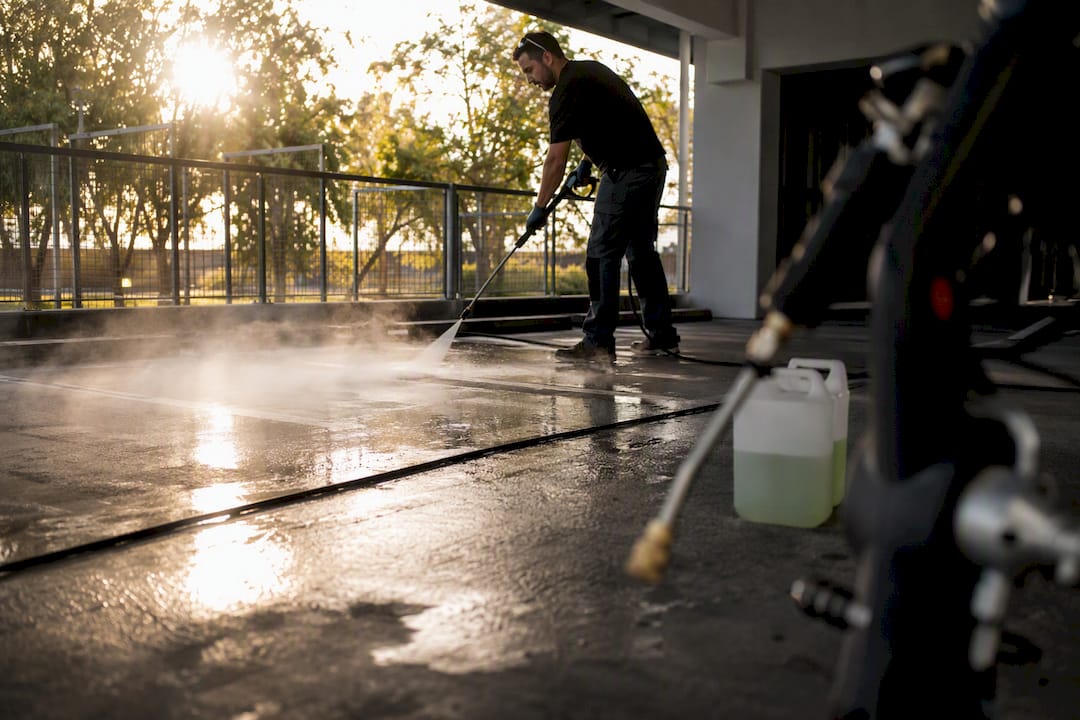
If your site has coated concrete, a warranty to protect, or grime that’s outlasted a few DIY attempts already, get a quote through our hard surface cleaning service and find out what a properly equipped crew can do with your floor.
Sources
- Pressure Washer vs Steam Cleaner – Which Do You Need? – Pure Clean Supplies
- Steam cleaning vs pressure washing comparison for business cleaning equipment
- Maintenance of diamond polished concrete — PCCAustralia position statement
- Industrial steam cleaning equipment: your complete guide to choosing the right steam cleaner for your facility – Intersteam
Recommended
- Cleaning Concrete: Domestic vs Commercial – Sydney Sweep and Scrub – Commercial Cleaning – Carpark Cleaning – Warehouse Cleaning
- Tips on Cleaning Your Concrete Event Space – Sydney Sweep and Scrub – Commercial Cleaning – Carpark Cleaning – Warehouse Cleaning
- Post-Event Cleaning: Concrete Surfaces – Sydney Sweep and Scrub – Commercial Cleaning – Carpark Cleaning – Warehouse Cleaning
- Automated Cleaning: The Pros and Cons – Sydney Sweep and Scrub – Commercial Cleaning – Carpark Cleaning – Warehouse Cleaning