
Start a safety-first dock cleaning program that combines daily housekeeping, weekly mechanical scrubbing with degreaser, and monthly deep pressure washing. That three-tier structure is the single highest-impact program you can implement, and it covers the full range of hazards a busy dock generates.
Get these five things done before your next shift handover:
- Secure a spill kit at every dock bay (absorbent pads, granules, and a drip tray minimum)
- Mark any wet or greasy areas with wet-floor signage immediately
- Clear pallet debris, stretch wrap, and cardboard from dock plates and leveller pits
- Notify supervisors of any standing water, fuel stains, or blocked drains
- Confirm fire and emergency exit routes are clear and unobstructed
Pro Tip: Pre-treat grease patches with a biodegradable degreaser and let it dwell for five to ten minutes before pressure washing. Skipping this step is the single most common reason pressure washing fails to remove embedded oil and leaves a residual slick.
Key Takeaways
A structured loading dock cleaning program that includes daily housekeeping, weekly degreaser scrubbing, and periodic pressure washing are effective ways to reduce slip hazards, protect equipment, and maintain operational throughput.
| Point | Details |
|---|---|
| Three-tier cleaning schedule | Daily sweeping, weekly scrubbing with degreaser, and monthly pressure washing covers the full hazard range. |
| Pre-treat before pressure washing | Apply biodegradable degreaser and allow 5–15 minutes dwell time before washing to remove embedded grease. |
| Inspect components during cleaning | Check dock levellers, seals, drains, bumpers, and lighting weekly; document and escalate defects within 24 hours. |
| Hire a contractor when gaps appear | High traffic volume, hazardous contaminants, or regulatory requirements are clear triggers for professional service. |
| Sweepandscrub for Sydney facilities | Sweepandscrub provides mechanical scrubbing, hot-water pressure washing, wastewater capture, and recurring contracts. |
Table of Contents
- Why loading dock cleaning is a safety and operations priority
- What a practical dock cleaning schedule looks like
- Which cleaning methods and equipment actually work
- How to respond to spills on the dock
- Inspecting and cleaning dock components
- When should you hire a professional cleaning contractor?
- Practical notes on buying or renting equipment
- What we see on real jobs, and what actually fixes it
- Sweepandscrub handles the heavy work so your team doesn’t have to
- Sources
Why loading dock cleaning is a safety and operations priority
A neglected dock is not just an eyesore. It is a liability that compounds daily. Grease, grit, spilled fuel, and wet cardboard reduce surface traction to the point where forklift operators and pedestrians are working on surfaces that no longer meet safe-work standards. Slips, trips, and falls in dock areas account for a disproportionate share of warehouse injuries, and most of them trace back to surfaces that were not cleaned on schedule.
The operational consequences are just as direct. Debris tracked from the dock onto warehouse floors contaminates clean aisles, damages racking-area flooring, and slows turnaround times when drivers are waiting for a bay that cannot be safely accessed. Damaged or contaminated inventory discovered at the dock costs more to process than a scheduled cleaning cycle ever would.
Then there is the equipment angle. Grease, road salt, and grit are abrasive. They work into the pivot points of dock levellers, accelerate corrosion on dock plates, and degrade rubber seals faster than normal wear. A dock leveller that fails mid-shift because its mechanism is packed with grit is a maintenance bill and a safety incident waiting to happen.
Seasonal conditions add another layer. Summer dust and pollen, fall leaf buildup, and winter wet and icy surfaces all shift the cleaning priority and frequency. A static cleaning schedule that ignores seasonal variation will always leave gaps, as year-round dock programs consistently show.
What a practical dock cleaning schedule looks like
The recommended frequency for busy docks is daily housekeeping, weekly mechanical scrubbing, and monthly deep pressure washing. The table below maps tasks to frequency and ownership so you can paste it directly into your SOPs.
| Task | Frequency | Recommended Owner |
|---|---|---|
| Sweep dock plates, leveller pits, and bay floors | Daily | Operations / dock staff |
| Remove pallet debris, stretch wrap, cardboard | Daily | Operations / dock staff |
| Check and clear drain grates | Daily | Operations / dock staff |
| Post wet-floor signage where needed | Daily | Operations / dock staff |
| Mechanical scrubbing with approved degreaser | Weekly | Maintenance or contractor |
| Inspect dock seals, levellers, and bumpers | Weekly | Maintenance |
| Clear drains thoroughly (flush if needed) | Weekly | Maintenance |
| Hot-water or cold-water pressure washing | Monthly | Contractor or maintenance |
| Deep clean under levellers and around drains | Monthly | Contractor |
| Full dock component inspection and documentation | Monthly | Maintenance supervisor |
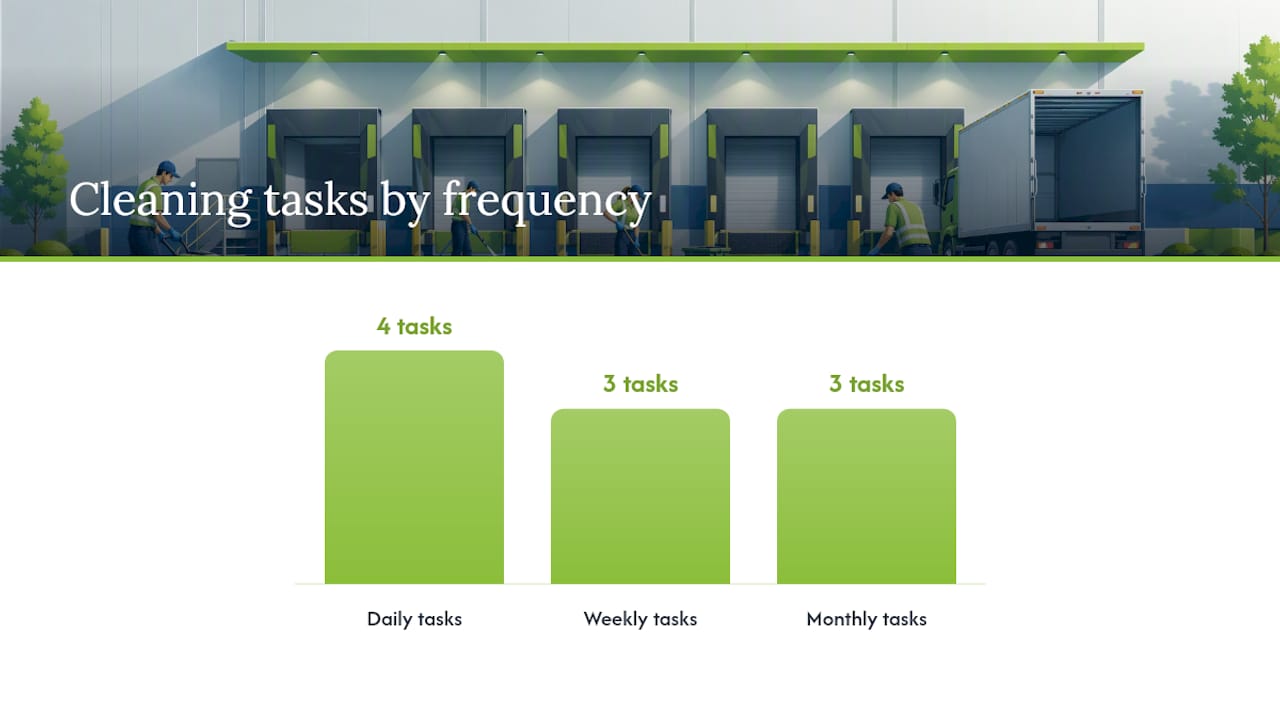
Daily tasks are the front line. Sweeping removes the loose grit and debris that would otherwise be ground into the surface by forklift tires and foot traffic. Spot cleanup of any spill or drip should happen within the shift it is discovered, not at end of day. Drain checks take two minutes and prevent the slow blockages that cause standing water.
Weekly tasks go deeper. A walk-behind or ride-on scrubber with a biodegradable degreaser solution removes the grease film that daily sweeping cannot touch. This is also when maintenance should run a quick eye over seals and levellers for visible wear or debris accumulation.
Monthly tasks are where the heavy work happens. Scheduled pressure washing, combined with a degreaser pre-treatment on grease-heavy zones, removes embedded contamination that scrubbing alone leaves behind. The area under dock levellers and around drain grates deserves particular attention because debris accumulates there invisibly until it causes a blockage or a mechanical failure.
Pro Tip: Schedule weekly scrubbing and monthly pressure washing during off-peak receiving windows, early mornings, evenings, or weekends. Running heavy equipment through an active dock bay creates a safety conflict and slows both the cleaning crew and the receiving operation.
Which cleaning methods and equipment actually work
The right method depends on the contaminant. Matching the tool to the job is what separates a dock that looks clean from one that actually is.
Mechanical sweepers handle loose debris, dust, and grit efficiently. A ride-on sweeper with an adequate hopper size clears a standard dock bay in minutes. Walk-behind models work for tighter bays or areas with obstacles. Neither replaces scrubbing for grease.
Ride-on and walk-behind scrubbers are the workhorses of weekly dock maintenance. They apply solution, agitate the surface with a rotating brush, and recover the dirty water in a single pass. For forklift lane degreasing, a scrubber with a cylindrical brush head performs better than a disc brush on textured or uneven concrete because it reaches into surface pores.
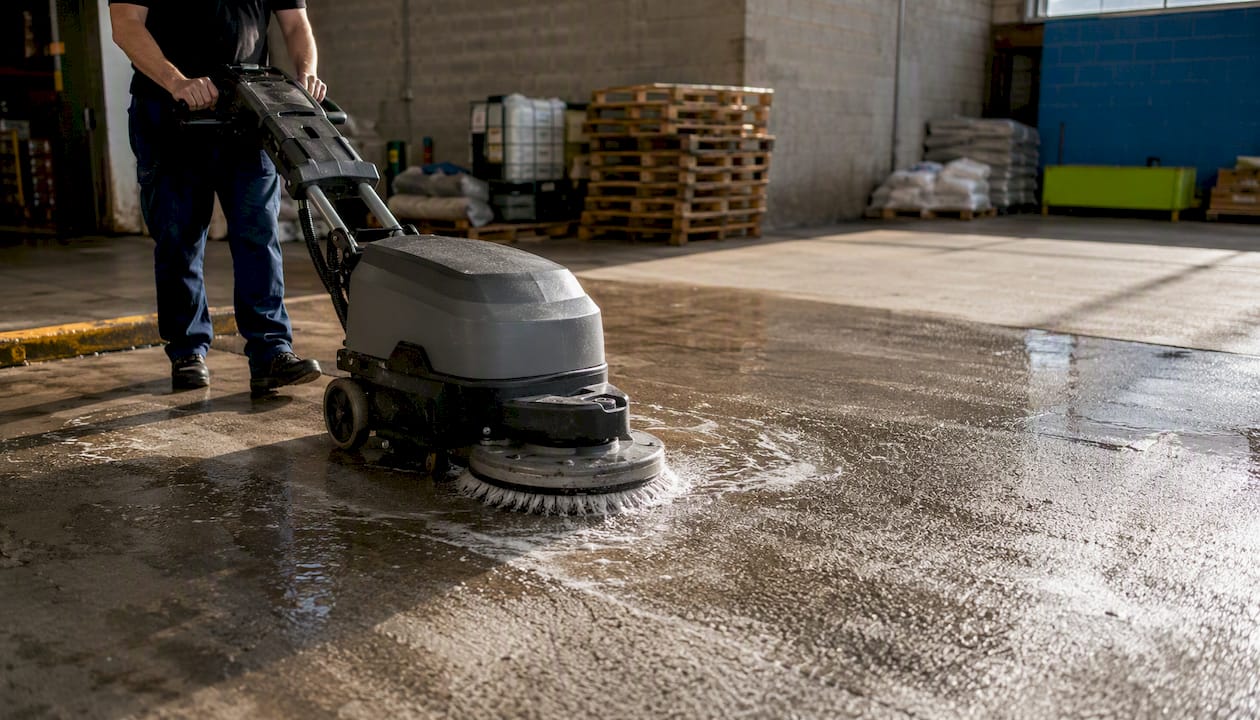
Hot-water pressure washing is the most effective method for heavy grease and oil. Hot water breaks down grease at the molecular level in a way cold water cannot, which is why it is the standard for dock areas with fuel spills or heavy vehicle traffic. Cold-water pressure washing is adequate for salt, grit, and general surface contamination where grease is not the primary issue.
Absorbents are not a cleaning method but a containment tool. Granular absorbents, absorbent pads, and drip trays should be deployed immediately on any liquid spill before any other cleaning step begins.
Chemicals: what to use and what to avoid
Use biodegradable, pH-neutral to mildly alkaline degreasers for routine scrubbing. They are effective on grease, safe for most concrete and coated surfaces, and compliant with most wastewater discharge requirements. Always request a Safety Data Sheet (SDS) before using any chemical on-site.
Categories to avoid:
- Solvent-based degreasers (petroleum distillates, chlorinated solvents): they damage rubber seals, degrade coatings, and create hazardous wastewater
- Highly acidic cleaners: they corrode steel dock plates and leveller components
- Bleach-based products on metal surfaces: corrosion risk, particularly on galvanized components
- Any product without an SDS or without clear drain-safe certification
For guidance on which products to exclude from your procurement list, the cleaning chemicals to avoid resource covers the categories most likely to cause surface or compliance problems.
Equipment specs and procurement notes
When specifying or renting equipment, use these as minimum benchmarks:
- Pressure washer: 2,000–3,500 PSI for dock surfaces; hot-water capability for grease-heavy bays; a downstream injector port for degreaser application
- Ride-on scrubber: cylindrical brush head for textured concrete; solution and recovery tank sized for the bay count (at least 60 liters recovery for a multi-bay dock)
- Sweeper: hopper capacity of at least 150 liters for a standard dock; side brushes to reach wall edges and leveller pits
- PPE: chemical-resistant gloves, non-slip safety boots, eye protection, and high-visibility vest as a minimum for any chemical or pressure-washing task
Rent equipment for one-off deep cleans or seasonal programs. Buy or contract when the frequency exceeds monthly and the in-house team has the training to operate it safely. The mechanical vs. manual cleaning comparison is worth reviewing before committing to a purchase.
Pro Tip: Always test a degreaser on a small, inconspicuous section of the dock surface before full application. Some coated or sealed concrete reacts poorly to alkaline products, and a patch test costs nothing compared to a reseal job.
How to respond to spills on the dock
Speed and containment are the two variables that determine whether a spill becomes a minor cleanup or a regulatory and safety incident. The sequence matters.
- Isolate the area immediately. Cordon off the spill zone with cones or barrier tape. No forklifts, no foot traffic until the surface is safe.
- Stop the source. If the spill is ongoing (a leaking drum, a vehicle drip), stop it before deploying absorbents. Containing a live source wastes materials and extends the hazard.
- Deploy absorbents. Apply granular absorbent or pads to the gross contamination. Work from the outside of the spill inward to prevent spreading. Allow dwell time before sweeping up.
- Remove gross contamination. Sweep or scoop absorbed material into a labeled waste container. Do not wash it into drains.
- Pre-treat with degreaser. Apply a biodegradable degreaser to the residual stain. Oily areas require pre-treatment before pressure washing to be effective and safe.
- Agitate and pressure-rinse. Scrub the pre-treated area, then pressure-rinse with containment in place. Capture wastewater; do not allow it to run freely into stormwater drains.
- Dispose of wastewater correctly. Oily wastewater must be disposed of through a licensed trade waste service or an approved on-site separator. Discharging oily water to stormwater is a regulatory violation in most jurisdictions.
- Document the event. Record the time, nature of the spill, response steps, and who was involved. This protects you in the event of a WorkSafe or insurer inquiry.
PPE for spill response: chemical-resistant gloves, safety glasses or face shield, non-slip boots, and a chemical-resistant apron for fuel or solvent spills. If the spill involves an unknown chemical or a volume large enough to generate vapors, evacuate the area and contact your hazmat response protocol before re-entry.
Inspecting and cleaning dock components
Cleaning and inspection are the same task done at the same time. A crew that sweeps and scrubs without looking at what they are cleaning misses the early signs of mechanical failure that cost far more to fix later.
Work through each component on a weekly basis during the scrubbing cycle, and document findings monthly.
- Dock plates and threshold plates: sweep clear of debris after every shift; inspect for bent edges, cracks, or surface corrosion monthly. A dock plate with a raised edge is a trip hazard and a forklift tire hazard.
- Dock levellers: clear the pit of debris daily; degrease the underside and pivot points weekly. Grease and grit packed into the leveller mechanism cause slippage and premature wear. Check that the lip extends and retracts smoothly during the weekly inspection.
- Edge seals and dock seals: wipe down with a damp cloth weekly; inspect for tears, compression damage, or gaps monthly. A damaged seal lets in weather, pests, and temperature variation that affect adjacent inventory.
- Dock bumpers: clear of debris weekly; check for cracking, delamination, or displacement monthly. A bumper that has shifted out of position no longer protects the dock face or the trailer.
- Drain grates: clear daily; flush and inspect for blockages weekly. Debris-clogged drains cause standing water, which is the fastest route to a slip incident.
- Dock lighting: wipe lenses weekly; confirm all fixtures are operational monthly. Poor lighting in a dock bay is a contributing factor in most dock-area near-misses.
- Vehicle restraints: clean the hook and track mechanism weekly; test operation monthly. A restraint that is fouled with grease or debris may not engage correctly.
Pro Tip: Keep a simple paper or digital log at each bay. When a crew member spots a bent dock plate edge or a torn seal during cleaning, they record it on the spot. That log becomes your maintenance work order queue and your compliance record.
For broader warehouse floor maintenance practices that complement dock-specific inspection routines, the principles around surface protection and inspection frequency translate directly to dock environments.
Small defects found during cleaning, a loose anchor bolt, a cracked bumper bracket, should be tagged and reported to maintenance within 24 hours. Anything that creates an immediate safety risk, a leveller that will not lock, a drain that is completely blocked, gets escalated the same shift.
When should you hire a professional cleaning contractor?
In-house cleaning handles the daily and weekly cycle well when you have trained staff, the right equipment, and a documented procedure. The case for a professional contractor gets stronger as any of these conditions appear:
- High traffic volume: more than 20 truck movements per day generates grease and grit loads that exceed what most in-house programs can keep up with.
- Heavy or hazardous contaminants: fuel spills, chemical residues, or food-grade contamination require specialist equipment and compliant wastewater disposal that most in-house teams are not equipped for.
- Regulatory or insurer requirements: some insurers and food-safety auditors require documented professional cleaning at defined intervals. In-house records alone may not satisfy the requirement.
- Equipment gaps: if you do not own a hot-water pressure washer and a ride-on scrubber, the cost of renting and operating them monthly often exceeds a contractor quote.
- Staff time and training: a dock cleaning cycle done properly takes time. If your maintenance team is already stretched, outsourcing the monthly deep clean is a straightforward trade.
Recurring professional cleaning restores traction, keeps drains clear, and reduces the frequency of safety incidents in ways that ad hoc in-house cleaning rarely matches.
What to require from a contractor
When you put a dock cleaning contract out for quotes, specify these deliverables:
- Scope of work: which bays, which components, which contaminants are included
- Methods: mechanical scrubbing, hot-water pressure washing, degreaser type and SDS
- Wastewater containment and disposal: how runoff is captured and where it goes
- Scheduling: after-hours, weekend, or pre-delivery windows to avoid operational disruption
- Documentation: a post-service report covering tasks completed, issues found, and disposal certificates
- Insurance: public liability and workers’ compensation as a minimum
- Equipment specs: PSI rating, water temperature capability, scrubber recovery capacity
Trust signals worth asking for: references from comparable facilities, equipment maintenance records, and any accreditations relevant to the IICRC standards for cleaning methods and staff training. A contractor who cannot provide an SDS for every chemical they use on your site is not a contractor you want on your dock.
Practical notes on buying or renting equipment
Before you commit to a purchase or a rental agreement, confirm the specs match your actual dock conditions.
- Pressure washer: minimum 2,000 PSI; hot-water capability if grease is present; downstream injector for chemical application. Cold-water units are adequate for salt and grit only.
- Ride-on scrubber: cylindrical brush head for textured concrete; recovery tank of at least 60 liters; onboard solution tank sized for your bay count.
- Walk-behind scrubber: useful for tight bays or areas around leveller pits where a ride-on cannot maneuver.
- Sweeper: side brushes to reach wall edges; hopper of at least 150 liters; dust suppression for enclosed bays.
- Containment: portable berms or drain plugs to prevent wastewater runoff during pressure washing.
For chemical sourcing, require an SDS for every product before it arrives on site. Verify that the degreaser is listed as drain-safe or trade-waste-compliant for your local authority. Sustainable cleaning practices and water-saving techniques are worth factoring into your procurement criteria, particularly if your facility has environmental reporting obligations.
When evaluating contractors, ask specifically how they manage wastewater. A contractor who pressure-washes without containment is creating a stormwater compliance problem for your site, not solving a cleaning one.
Scheduling flexibility is a practical requirement, not a nice-to-have. After-hours and weekend availability means the cleaning program does not compete with your receiving operation. Build that into the contract from the start.
What we see on real jobs, and what actually fixes it
Three problems come up on almost every dock job we attend.
The first is embedded grease that has been pressure-washed without pre-treatment, repeatedly. The surface looks like it has been cleaned, but the grease has been pushed into the concrete pores and then sealed over by the pressure wash itself. The fix is a longer degreaser dwell time, 10 to 15 minutes minimum, followed by mechanical agitation with a stiff brush before the pressure wash. One properly executed cycle removes more than three cycles of wash-only treatment.
The second is drain blockages that nobody noticed because the drains were never part of the daily checklist. By the time we arrive, the grate is clear but the trap below is packed with grit, grease, and debris. Flushing the drain and clearing the trap takes 20 minutes. The standing water that built up because of the blockage took weeks to create the slip hazard that prompted the call.
The third is scheduling misalignment: cleaning is booked during peak receiving hours because “that’s when the dock is empty between trucks.” It is not empty. It is in active use. The result is a cleaning crew working around moving forklifts, which is a safety conflict that slows both operations. The fix is a simple calendar block: cleaning goes into the schedule before the receiving window opens or after it closes.
Tracking two metrics makes the cleaning program defensible to management: slip incidents per month in the dock area, and average dock turnaround time. Both tend to improve within the first 60 days of a structured program. Neither requires sophisticated software, just a consistent record.
One field tip that saves time on every pressure-washing job: plug the dock-area floor drains with a rubber drain plug before you start. Capture the wastewater in a portable berm, then pump it to a waste collection point. It takes five minutes to set up and eliminates the risk of contaminated water tracking into the warehouse interior through the drain system.
Sweepandscrub handles the heavy work so your team doesn’t have to
Dock cleaning done right requires hot-water pressure washing, mechanical scrubbing, and proper wastewater capture. That combination is exactly what Sweepandscrub delivers for warehouses and logistics facilities across Sydney.
The service covers mechanical sweeping, ride-on scrubber service, hot-water pressure washing for grease-heavy bays, wastewater containment and disposal, and recurring maintenance contracts for facilities that need a documented cleaning schedule. Scheduling is flexible: after-hours and weekend slots are available so the cleaning program never competes with your receiving operation.
A quote starts with a site assessment. Sweepandscrub reviews your bay count, contaminant types, and frequency requirements, then provides a scope of work you can use directly in your procurement records. For facilities that need hard surface cleaning on a recurring basis, a maintenance contract locks in the schedule and the price. Request a site inspection or quote at Sweepandscrub.
Sources
The following resources support the guidance in this article and are useful for building procurement documents, verifying standards, or planning a contractor brief.
- IICRC
Recommended
- Regular Warehouse Cleaning Promotes Efficiency – Sydney Sweep and Scrub – Commercial Cleaning – Carpark Cleaning – Warehouse Cleaning
- Exterior Warehouse Cleaning: A Comprehensive Agenda – Sydney Sweep and Scrub – Commercial Cleaning – Carpark Cleaning – Warehouse Cleaning
- The Best Practices for Warehouse Floor Maintenance – Sydney Sweep and Scrub – Commercial Cleaning – Carpark Cleaning – Warehouse Cleaning
- The Ultimate Lobby Cleaning Checklist – Sydney Sweep and Scrub – Commercial Cleaning – Carpark Cleaning – Warehouse Cleaning