
Pressure washing wastewater from a Sydney site must never go down a stormwater drain. It either goes to sewer under written approval, or it is treated and recycled. If you manage a carpark, warehouse, construction site or public space, the practical job is to contain the water, choose the right destination for it, and keep records that show you did.
This guide explains what counts as trade waste, when approval is needed, what Sydney Water charges, and how to document compliant washing at your property.
TL;DR
- Pressure washing runoff is not stormwater, and it must not enter stormwater drains. The NSW EPA says wash-down water should go to a collection pit and then to sewer with council trade waste approval, or be treated and recycled.
- Discharging trade wastewater to Sydney Water’s system needs written permission first, except for low-risk deemed processes.
- Sydney Water’s 2026-27 fees start at $577.84 for a low-complexity application, plus quarterly permit fees.
- Penalties for getting it wrong are steep, so ask your cleaning contractor how they contain and remove wash water before the job starts.
- Keep a simple file per site: approvals, a wash plan, photos of drain covers and disposal records.
Table of Contents
- What counts as trade waste from pressure washing
- Where pressure washing wastewater can and cannot go
- When you need approval to discharge to sewer
- What it costs: fees and penalties
- A containment plan for each wash
- How to document compliant pressure washing
- What this means by site type
- Booking pressure washing for your Sydney site
- FAQ
- Sources
What counts as trade waste from pressure washing
In NSW, liquid trade waste is any discharge to a sewerage system other than sewage of a domestic nature. Water that has washed oil, grease, sediment, detergent or rubbish off a surface is not domestic sewage. If you send it to sewer, it is trade waste, and the business or agency discharging it needs prior approval from the authority that regulates sewerage in that area.
That authority depends on where you are. In most of Sydney it is Sydney Water. In some areas of NSW it is the local council. Check which applies to your suburb before you plan anything.
How trade waste differs from stormwater
The two systems are separate on purpose.
- Sewer: carries domestic sewage and approved trade waste to a treatment plant under a permit or agreement.
- Stormwater: carries rain only. As Hornsby Shire Council explains, it often goes untreated into creeks, rivers, estuaries and the ocean, picking up pollutants on the way.
Stormwater and unpolluted water are not liquid trade waste, but Wingecarribee Shire Council notes they still cannot go into the council sewer without approval. So rainwater is not a free pass in either direction: dirty wash water does not belong in the stormwater drain, and clean stormwater does not belong in the sewer.
Why runoff from a simple wash still matters
Hornsby Shire Council lists high-pressure cleaning runoff as a common type of water pollution. Its example is cleaning without containment, which sends dirt, chemicals and debris into the drain. Council officers can respond with penalty infringement notices, clean-up notices or prevention notices under the POEO Act 1997.
That applies to a carpark wash just as it does to a roof. A car park collects oil drips, brake dust, tyre residue and food waste, and a pressure washer moves all of it toward the nearest grate.
Where pressure washing wastewater can and cannot go
The NSW EPA’s position is short: the runoff from any washing activity must not enter stormwater drains. Its guidance says cleaning of vehicles, equipment or work floors should be confined to a designated wash bay. Wastewater then goes to a collection pit and from there either:
- to sewer, with Local Council Trade Waste Agreement approval, or
- through water treatment equipment, where it is treated and can be recycled.
The EPA also states it is against the law to place any material where it can flow into a local waterway and cause pollution.
In legal terms, Baldwin’s summary of the law is that discharging trade waste to stormwater breaches the POEO Act 1997 (NSW) and triggers strict liability water pollution offences. Strict liability means the prosecution does not need to prove you meant to pollute. A contractor’s mistake at your site can still become your problem as the occupier or owner, so the arrangements need to be clear in writing.
Open areas without a wash bay
Most commercial carparks, loading docks and footpaths do not have a plumbed wash bay. For those, the EPA’s measures are about stopping water leaving the work area and then removing it:
- dry-clean first, so loose litter, dust and sediment are swept up rather than washed away;
- cover stormwater grates before washing starts;
- channel wash water with berms or recovery mats;
- vacuum-recover water from sealed areas;
- uncover grates only once runoff has stopped.
This is why a site that starts with mechanical sweeping tends to produce less contaminated wash water. We cover how pressure washers fit into carpark cleaning in a separate guide.
When you need approval to discharge to sewer
Sydney Water is direct: you must have written permission before discharging trade wastewater into its systems. If you discharge without approval, the trade waste service may be disconnected, and the water service may be disconnected or restricted.
Some processes are low risk and are deemed to be covered, so they do not need formal approval. Sydney Water lists automotive businesses such as car detailers, hand-wash and pressure-spray car washes, and mechanical workshops among its commercial trade wastewater customers, so a business that washes vehicles or equipment on site should check which category it falls into rather than assume.
What approval usually involves
Approval is not just paperwork. Trade Environmental’s overview of wash bay approvals describes the typical conditions when wash water goes to sewer:
- a Trade Waste Agreement with the local water authority;
- pre-treatment, typically oil-water separation;
- exclusion of rainwater, often by roofing or first-flush systems;
- ongoing compliance, sampling and fees.
On pre-treatment, CCC Engineering reports that separators must be sized for the catchment area and the expected contaminant load. It adds that coalescing plate separators are generally required for automotive workshops. For a plumbed wash bay, that detail goes to your hydraulic designer and Sydney Water, not to the cleaner.
Your property must also hold the relevant land-use and operating approvals. You can start the process by completing an application for connection to discharge trade wastewater through Sydney Water’s Tap in service.
Who needs to apply: you or the contractor
The approval attaches to the discharge point at a property. That generally makes it a matter for the site owner or occupier, not a mobile cleaning crew. A contractor that works with containment and removes the water from site is not asking you to open a new sewer connection. Ask which approach your contractor will use, and get the answer in the quote or work method statement.
What it costs: fees and penalties
Fees and penalties are the reason the question matters commercially. Sydney Water’s 2026-27 trade wastewater fees include the following.
| Item | 2026-27 charge |
|---|---|
| Quarterly permit fee, first process | $31.91 |
| Quarterly permit fee, each additional process | $10.11 |
| Application fee, low complexity | $577.84 |
| Application fee, medium complexity | $640.92 |
| Application fee, high complexity | $842.79 |
| Automotive waste quality charge | $0.830 per kL |
| Equipment hire washing charge | $4.352 per kL |
Sydney Water also charges a wastewater service charge and usage charges based on the measured or estimated volume discharged. For commercial and industrial properties, the standard wastewater usage discharge factor is 95%. Fees are reset each financial year, so confirm the current schedule on Sydney Water’s page before budgeting.
Penalties for non-compliant discharge
CCC Engineering’s summary of Sydney Water’s powers says it can issue penalty infringement notices of up to $44,000 per offence, require remediation works, install monitoring equipment at the business owner’s cost, restrict or disconnect the sewer connection, and recover the cost of damage to the sewer network.
On the environmental side, Baldwin summarises the POEO Act as amended in April 2024 as follows:
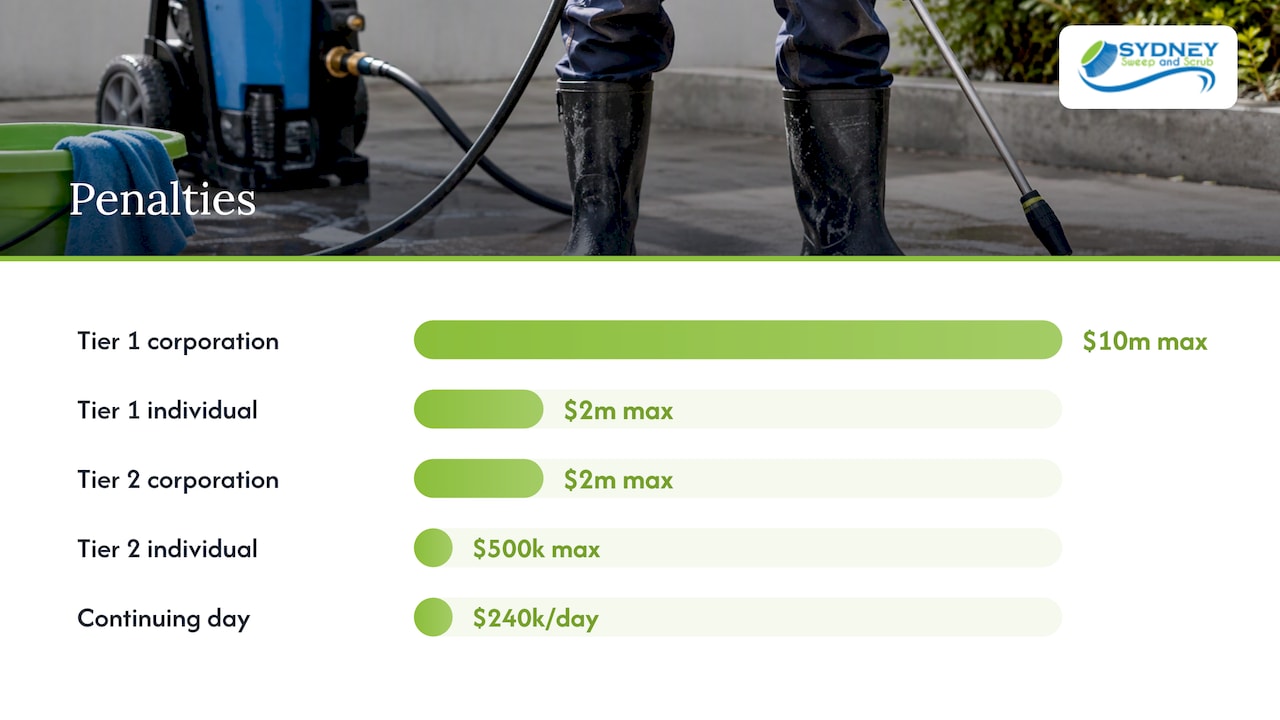
- Tier 1 (wilful water pollution causing serious harm): up to $10,000,000 for a corporation, and for an individual up to $2,000,000 plus 7 years imprisonment.
- Tier 2 (strict liability water pollution): up to $2,000,000 for a corporation and $500,000 for an individual, plus $240,000 for each continuing day.
- EPA penalty notices: $15,000 to $30,000 per offence.
Those are maximums, not what a routine wash costs. The point is that one uncovered grate costs far more than the containment that would have prevented it.
A containment plan for each wash
Whatever the destination, the same sequence works on most commercial sites.
- Walk the site and map the drains. Mark every stormwater grate, pit and kerb inlet within the wash area and downslope of it.
- Dry-clean first. Sweep or vacuum litter, dust and sediment before any water is used. Mechanical sweeping is built for this step.
- Cover and seal grates. Use drain covers or mats rated for the job, and check them again after any change of weather.
- Control the water. Use berms or recovery mats to direct wash water to a single recovery point.
- Recover, don’t release. Vacuum water from sealed surfaces and take it to an approved destination: a permitted sewer connection or a treatment and recycling system.
- Check before uncovering. Remove drain covers only after runoff has stopped and the area is clean.
- Treat detergents with care. Chemicals and oils do not belong in stormwater, so the wash method and any cleaning products should be agreed in advance.
If a spill does reach a drain, stop the washing, contain what you can and contact the site owner straight away. The council or EPA can then advise on clean-up.
How to document compliant pressure washing
The point of records is simple: if a council officer or Sydney Water asks what happened to the water, you can answer in a minute. The following is practical good practice rather than a legal checklist, so confirm any specific requirement with your council, Sydney Water or an environmental consultant.
A one-page file for each site
- Approvals: any trade waste approval or agreement, with its reference number, or a note that wash water is recovered and removed from site rather than discharged on site.
- Drain map: a marked-up plan showing stormwater grates and sewer connection points.
- Wash method statement: how water is contained, where it is recovered, and what happens to it afterwards.
- Photos: drain covers in place before work, containment during work, and the area after.
- Disposal record: the date, volume if known, and where recovered water went.
- Chemicals list: products used and their safety data sheets.
- Incident log: anything that escaped containment and the response.
Who keeps what
Property and strata managers should hold the approvals and the contractor’s method statement, since they sit with the owner. Facility managers can keep the photo and disposal records with each job sheet. Construction companies will usually fold this into their site environmental management plan. Councils and event organisers should put the wash method into the contract or run sheet, so crews on the day follow it.
What this means by site type
Carparks. Oil, grease and sediment are the concern. Strata and building managers booking regular scrubs should expect sweeping first, then contained washing. See our carpark cleaning service.
Warehouses. Internal floors, loading docks and hardstand are different cases. Floor washing inside a building can be a trade waste matter if it reaches the sewer, while a dock apron is usually near stormwater grates. See warehouse cleaning, including cleans at the end of a lease.
Construction sites. Sediment-laden water is a pollution risk, and sweeping before washing keeps the load down. Dry methods come first.
Public spaces and footpaths. Footpath washing in a public place raises extra questions about permission from the council. Our guide to footpath cleaning rules in Sydney covers that side.
Event venues and stadiums. Food, drink and litter loads are high. Sweeping and rubbish removal before any washing is the usual order.
For more on the wastewater side, see our checklist on pressure washing wastewater checks and the page on what happens to recovered waste.
Booking pressure washing for your Sydney site
Sydney Sweep and Scrub is a family-owned Sydney business offering mechanical sweeping, mechanical scrubbing, hot water cleaning and pressure washing for carparks, warehouses, construction sites, public spaces and event venues. We can talk through your site, its drains and the method before work begins, and you can request a quote or book online.
See our pressure washing service or go to the Sydney Sweep and Scrub home page to get started.
FAQ
Can I let pressure washing water run into a stormwater drain in Sydney?
No. The NSW EPA states that runoff from any washing activity must not enter stormwater drains. Wash water should go to a collection pit and then to sewer with approval, or be treated and recycled.
Do I need Sydney Water approval to wash my carpark?
You need written permission if you discharge trade wastewater into Sydney Water’s system, unless the process is a low-risk deemed process. If the water is contained and removed from site instead, ask your contractor and Sydney Water which rules apply to your arrangement.
How much does a trade waste application cost?
For 2026-27, Sydney Water lists application fees of $577.84 for low complexity, $640.92 for medium and $842.79 for high. Quarterly permit fees are $31.91 for the first process and $10.11 for each additional one. Check Sydney Water’s fees page for the current year.
Who is responsible if a contractor’s wash water pollutes a drain?
Water pollution offences under the POEO Act are strict liability, so intent does not have to be proven. Responsibility can reach more than the person holding the hose, so agree the wash method, containment and disposal in writing before the job.
What records should I keep after a wash?
Keep your approvals, a drain map, the method statement, photos of drain covers and containment, the disposal record and any incident notes. This is good practice, and your council or Sydney Water can confirm anything specific to your site.
Sources
- NSW EPA: The drain is just for rain
- Sydney Water: Commercial trade wastewater
- Sydney Water: Trade wastewater fees
- NSW DCCEEW: Liquid trade waste
- Wingecarribee Shire Council: Liquid Trade Waste
- Hornsby Shire Council: Pollution incident or a concern
- Baldwin: Industrial Wastewater Treatment FAQ
- CCC Engineering: Trade Waste Requirements NSW
- Trade Environmental: Wash Bay Approvals in Australia