
Keep worker exposure to respirable crystalline silica below the 0.05 mg/m3 exposure standard as an 8-hour average, and as low as reasonably practicable. If a material holds at least 1% crystalline silica, or a task is likely to exceed half the standard (0.025 mg/m3), you need a silica risk control plan, engineering controls, accredited training, air monitoring and health monitoring before work starts.
TL;DR:
- For material containing at least 1% silica, likely exposure above 0.025 mg/m3 triggers a plan, training, engineering controls, and air and health monitoring before work.
- Prioritize isolation and engineering controls over respirators; options include wet suppression, tool extraction, local exhaust ventilation, or an enclosed operator cabin with HEPA filtration.
- Since July 1, 2024, new engineered stone benchtops, panels, and slabs are banned, but removal and repair of existing installations require high risk controls.
- Use WES through November 30, 2026, then update plans, templates, and monitoring reports to WEL from December 1, 2026, to match the rules.
- If monitoring exceeds 0.05 mg/m3, stop or restrict the task, repair the failed controls, and notify your regulator when local rules require it.
Table of Contents
- What should you check on your site first?
- Which duties and exposure limits apply under WHS law?
- How do you identify high-risk crystalline silica work?
- What does the engineered stone ban mean for your business?
- Which controls must come first?
- What goes in a silica risk control plan?
- When is air and health monitoring required?
- How do you show you comply in practice?
- What should cleaning contractors and facility managers do?
- How can we help with silica dust on your site?
- FAQ
- Sources
What should you check on your site first?
Triage comes before paperwork. Walk the site, list every task that could put silica into the air, and decide which ones need a stop-and-plan response. These are the checks we recommend, in order:
- Check the silica content of every material using the safety data sheet (SDS) or supplier information.
- Identify processes that could generate respirable crystalline silica, such as cutting, grinding, polishing, crushing, or pressure washing that creates dust plumes.
- Assume a task is high risk if it is likely to exceed 0.025 mg/m3, then stop and plan before it proceeds.
- Apply isolation and engineering controls first, and use respiratory protective equipment (RPE) only where controls cannot remove the exposure.
- Arrange air monitoring and health monitoring, and keep the records.
- Provide nationally accredited crystalline silica training before any high-risk work begins.
Pro Tip: If a supplier cannot tell you the silica proportion in writing, treat the material as containing at least 1% until you have evidence otherwise.
Regulators look hard at that proportion. Queensland’s regulator is explicit that materials with at least 1% crystalline silica trigger the stricter rules, and that includes cleaning contractors and sweepers working around them.
Which duties and exposure limits apply under WHS law?
Under the model WHS laws, a person conducting a business or undertaking (PCBU) must eliminate the risk of silica exposure or, where that is not possible, minimise it so far as is reasonably practicable. The workplace exposure standard for respirable crystalline silica sits at 0.05 mg/m3 averaged over an eight-hour day. Safe Work Australia also notes that silica is most dangerous when dust is airborne and inhaled, and that health monitoring must be provided where there is a significant risk to workers’ health.
Terminology is changing, which matters for your documents. Australia is moving from workplace exposure standards (WES) to workplace exposure limits (WEL). Until 30 November 2026 PCBUs comply with the WES, and from 1 December 2026 the WEL list takes effect. Update your plans, templates and monitoring reports so they use the right term for the date they were written.
Key duties at a glance:
- Eliminate or minimise exposure so far as is reasonably practicable, following the hierarchy of control.
- Keep airborne respirable crystalline silica below the exposure standard, whatever limit label applies.
- Control the processing of crystalline silica substances (materials with at least 1% crystalline silica), which the model regulations deal with in a dedicated part, including the clauses numbered 529B and 529C.
- Prepare a silica risk control plan before high-risk processing begins.
- Provide training, air monitoring and health monitoring where the work is high risk.
The model Code of Practice states the benchmark plainly: keep the airborne concentration of respirable crystalline silica below 0.05 mg/m3, and use a plan, training and monitoring to prove you are doing it.
One point trips up many businesses: your duty to control exposure does not wait for a monitoring result. If you suspect a task generates silica dust, you put controls in place first and monitor to verify they work. Safe Work Australia’s guidance adds that from 1 September 2024 there are extra requirements for PCBUs processing crystalline silica substances, and that where you are uncertain, you should assume the work is high risk until you can show otherwise.
State and territory regulators administer these laws, and details such as notification processes and local templates vary. Check your own regulator’s page alongside the national model.
How do you identify high-risk crystalline silica work?
A decision path keeps this practical. Work through the following in order for each task on your site:
- Is it a crystalline silica process? Typical examples include using power tools to cut, grind, polish or crush material containing crystalline silica, as well as road headers, quarrying, tunnelling and mechanical screening. WorkSafe Victoria’s guidance lists these processes and provides a flowchart for identifying high-risk work.
- Does the material contain at least 1% crystalline silica? Read the SDS or ask the supplier. Concrete, brick, mortar, tiles, many natural stones and engineered stone commonly contain crystalline silica, but the proportion varies, so verify it rather than assuming.
- Is the task likely to exceed half the exposure standard? Any task reasonably likely to exceed 0.025 mg/m3 is high risk. If you cannot say it will stay below that level, treat it as high risk.
- Does anything push the risk higher? Consider how often the task happens, how long it runs, how many workers are exposed, any previous monitoring results, and the physical form of the material (dry, powdered, wet, sealed).
- Have you documented the finding? Record your assessment, who made it and what evidence it rested on, since the guidance expects PCBUs to document whether processing is high risk.
Be honest about frequency and duration, because that is where assessments tend to fail. WorkSafe Victoria’s enforcement experience shows many PCBUs overlook the proportion of silica and the frequency and duration of tasks. In one case, a company agreed to spend $929,500 on education after unsafe high-risk work where air monitoring exceeded the exposure standard.
A task’s risk depends on the likely exposure, so assess the material, process and controls rather than relying on the job title.
What does the engineered stone ban mean for your business?
From 1 July 2024, the manufacture, supply, processing and installation of engineered stone benchtops, panels and slabs has been prohibited across all Australian jurisdictions. SafeWork NSW confirms the same national scope.
The ban is not a blanket stop on all contact with existing installations. Here is how it plays out for PCBUs:
- New engineered stone benchtops, panels and slabs cannot be manufactured, supplied, processed or installed.
- Removal, repair or minor modification of already installed engineered stone is permitted only if it is controlled and treated as high-risk work.
- Plan for dust when handling pre-existing engineered stone, and check with your WHS regulator how the rules apply to the work.
- Permitted work still needs a silica risk control plan, engineering controls, air monitoring and health monitoring.
- Jurisdictions differ in some details, so confirm local requirements with your WHS regulator.
Safe Work Australia’s jurisdictional guidance confirms that exceptions exist and that legacy work must be controlled and assessed for high risk. WorkSafe ACT also reflects the ban from 1 July 2024 and sets out risk management steps for dust-generating tasks.
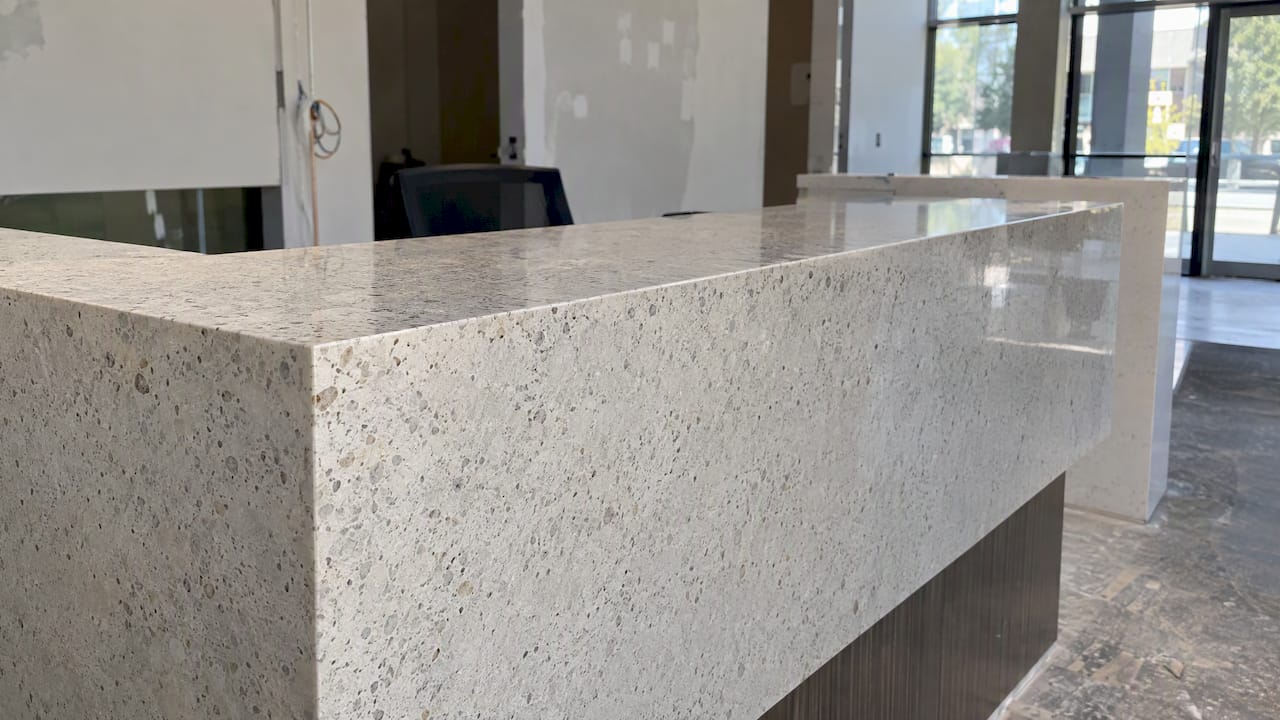
If you manage a building with engineered stone kitchens, laboratories or reception counters, factor that into refurbishment planning. Any contractor you engage should be able to show you how they will control dust before they touch the material.
Which controls must come first?
The hierarchy of control is not optional. Safe Work Australia guidance states that isolation and engineering controls must be used before relying on personal protective equipment.
Work down the hierarchy in order:
- Eliminate the hazard where you can, for example by choosing a different method that does not cut or grind silica-containing material.
- Substitute with a lower-silica material or a prefabricated component that needs no on-site cutting.
- Isolate the process from people, or isolate the person from the process.
- Use engineering controls to capture or suppress dust at the source.
- Use administrative controls such as exclusion zones and scheduling.
- Use RPE only for the risk that remains.
For processing crystalline silica substances, Safe Work Australia lists the required isolation or engineering controls:
- Isolating the person from the process.
- An enclosed operator cabin with HEPA filtration.
- Effective wet dust suppression.
- Effective on-tool extraction.
- Effective local exhaust ventilation.
RPE may be used only if a risk remains after these measures are in place.
How to tell whether a control is actually working
A control on paper is not a control in practice. Check for these signs:
- No visible dust at the point of work or drifting into adjacent areas.
- Extraction units running with intact, correctly fitted hoses and clean filters.
- Water reaching the cutting or grinding point at the flow rate the tool needs, not just a trickle nearby.
- No dust leaks at joins, seals or door gaps on enclosures and cabins.
- A maintenance schedule that is written down, followed and signed off.
Think about the life cycle of your equipment. Hoses split, seals harden, filters clog and pumps lose pressure. Build inspection into daily pre-start checks and into a scheduled service, and record both. Worn parts are a common reason a once-effective control quietly stops working, and then a monitoring result brings the failure to light.
Pro Tip: Do not rely on a visual check to verify dust controls. Arrange appropriate air monitoring to assess exposure.
Where a cleaning task follows high-risk work, those controls need to carry over. Avoid dispersing settled silica dust during cleaning. Use methods that capture rather than disperse dust. Our page on construction dust cleanup explains what a compliant service delivers.
What goes in a silica risk control plan?
A silica risk control plan, called a crystalline silica hazard control statement in some jurisdictions, is mandatory before any high-risk crystalline silica processing begins. WorkSafe Victoria’s practitioner guidance warns that many businesses fail by doing high-risk work without one, and that it must be written and available before work starts.
Minimum contents
- A description of the process and the task.
- The proportion of crystalline silica in the material.
- The controls identified and the reasons they were chosen.
- The air monitoring schedule.
- The health monitoring plan.
- Training records for the workers involved.
- The outcomes of consultation with workers and health and safety representatives.
- Maintenance arrangements for control equipment.
- Review triggers, meaning the events that force you to revisit the plan.
How to prepare it
- Complete your high-risk assessment first, using the steps in the previous sections, and keep the evidence.
- Draft the plan around the actual task, not a generic template. A copied document that does not match the work on site will not hold up at an inspection.
- Consult your workers and any health and safety representatives while you draft, and record what they raised and what you changed.
- Finalise the controls, confirm the equipment is on site and tested, and schedule monitoring.
- Make the plan available to workers before the work begins.
- Review it when controls change, when monitoring shows a problem, or when the task, material or equipment changes.
The plan must also be reviewed when controls turn out to be ineffective. Treat a poor monitoring result or a near miss as a trigger, not as an item for the next annual review.
Regulators publish templates and toolkits that help you complete the document. The model Code of Practice sets out the expectation that PCBUs develop a plan for high-risk processing, provide accredited training, monitor the air and provide health monitoring. Use your own state regulator’s template where one exists, since formats and wording differ by jurisdiction.
When is air and health monitoring required?
Air monitoring is required for high-risk crystalline silica processing. Queensland’s regulator lists mandatory air monitoring alongside the plan, training and health monitoring for high-risk work.
How monitoring works
- It must assess respirable crystalline silica as an 8-hour time-weighted average.
- Sampling should be representative of the work and the people doing it, not a single convenient moment.
- The respirable fraction is what gets measured, because those are the particles that reach deep into the lungs.
- Results are compared with the 0.05 mg/m3 exposure standard.
- Monitoring follows regulation 50 of the model WHS Regulations, as the Code of Practice describes.
The benchmark your results are measured against: 0.05 mg/m3 as an 8-hour average, per Safe Work Australia.
Health monitoring for high-risk workers
PCBUs must provide health monitoring for workers doing high-risk work. Consult a suitably qualified medical practitioner about the appropriate monitoring and handling of results. If results suggest a worker’s health is being affected, review your controls straight away rather than waiting for the next scheduled round.
Reporting an exceedance
If monitoring shows exposure above the standard, treat it as a failure of your controls. Stop or restrict the task, find out why the controls fell short, fix them, and notify the regulator where your jurisdiction requires it. Check your regulator’s notification rules, since results must be provided as required and the process differs between states and territories.
How do you show you comply in practice?
Compliance is not only what you do on site, it is what you can prove when an inspector asks.
Training
Crystalline silica training must be nationally accredited or otherwise approved by the WHS regulator, and it must cover both the health risks and the required controls. The Code of Practice expects this before high-risk work, so schedule it into onboarding rather than treating it as an afterthought.
Records worth keeping
- Silica risk control plans, with version history.
- Air monitoring results and the reports behind them.
- Health monitoring records, kept confidentially.
- Maintenance and inspection logs for extraction, water suppression and enclosures.
- Training attendance and certificates.
- Evidence of consultation, such as meeting notes and sign-offs.
Consultation
Consult workers and any health and safety representatives when you develop and review the plan. Make the finished plan available before work starts, and keep a record of who saw it and when. Consultation done properly also improves the plan, because workers know where the dust really comes from.
Silica should sit inside your wider safety management system, not alongside it. Link it to your risk register, contractor management, induction, incident reporting and audit schedule, so it gets reviewed with everything else.
What should cleaning contractors and facility managers do?
Cleaning work can generate or disturb silica dust, particularly after construction, demolition or grinding. Here is how we approach it, and how you can check any contractor you hire.
Work out whether a cleaning task involves crystalline silica. Check the SDS, identify the material type, and judge how much dust the task is likely to produce. Sweeping settled dust from a concrete-cutting job is not the same as mopping an office floor. When the task disturbs silica-containing material or dry dust, treat it with the same care as processing.
Control tactics that suit cleaning
- Validated wet suppression, applied before and during the task.
- Controlled-pressure water application, so pressure washing does not throw up dust plumes.
- On-machine water delivery on mechanical sweepers and scrubbers.
- Enclosed vacuum attachments with appropriate filtration.
- Scheduled exclusion zones, so other workers are not in the area while dust is being managed.
Our mechanical sweeping and scrubbing services and pressure washing are available, and our guide to construction site sweeping requirements explains how sweeping aligns with WHS obligations. If you use water suppression, also plan for runoff, as our note on pressure washing wastewater explains.
When to pause
Stop and reassess if you see visible dust during cleaning, or if you do not know the material composition. Treat the task as high risk until you have evidence otherwise, and hand over to a contractor who can supply a silica risk control plan and the controls to match.
Contractor recordkeeping and client communication
- Supply the silica risk control plan to the client before work begins.
- Keep monitoring and maintenance logs for sweepers, scrubbers, extraction and water systems.
- Hold evidence of worker training.
- Tell the client what you found, what you did and what remains to be done.
Pro Tip: Ask any cleaning contractor for their silica risk control plan, equipment maintenance log and worker training records before they start. A contractor who can provide these records is better placed to show how they manage silica risks.
How can we help with silica dust on your site?
If your site has settled dust from cutting, grinding or demolition, the safest approach is to remove it with methods that capture rather than disperse it. We run mechanical sweeping, scrubbing and pressure washing, and we plan each job around the material and the dust it produces. Our warehouse cleaning and carpark cleaning teams work to the same discipline, and our background piece on silica dust as a hazard sets out why it matters. Book through our services page and we will confirm the right method for your site.
This article is general information, not a substitute for advice from a qualified doctor. Consult a qualified healthcare professional about your own circumstances before acting on anything here.
FAQ
What is the mandatory limit for silica dust exposure in Australia?
The workplace exposure standard for respirable crystalline silica is 0.05 mg/m3, averaged over an eight-hour day, as set out by Safe Work Australia. PCBUs must also keep exposure as low as reasonably practicable. The exposure limit terminology moves from WES to WEL from 1 December 2026.
What triggers a silica risk control plan?
A plan is required before high-risk crystalline silica processing starts, which means work on materials with at least 1% crystalline silica where exposure is likely to exceed half the standard (0.025 mg/m3). WorkSafe Queensland lists the plan, training and monitoring as mandatory for that work.
Can you get silicosis from a single exposure?
Regulators focus on repeated and prolonged exposure, but very high short-term exposures to respirable silica are also a serious concern. Because dose and dust levels vary so much, the safe approach is to control every exposure at the source rather than relying on a “one-off” being harmless. Speak to a registered medical practitioner about any specific exposure.
Can PPE alone satisfy the rules?
No. The hierarchy of control puts isolation and engineering controls ahead of RPE, and Safe Work Australia’s guidance allows RPE only if a risk remains after those controls are in place.
Sources
- Focus on crystalline silica substances: air monitoring | WorkSafe Queensland
- Silica | Safe Work Australia
- World-first engineered stone ban is now in effect to protect workers | Safe Work Australia
- Preparing a crystalline silica hazard control statement for high risk crystalline silica work | WorkSafe Victoria
- Airborne contaminants: workplace exposure standards/limits | Safe Work Australia
- Engineered stone prohibition to commence 1 July 2024 | SafeWork NSW
- $929,500 safety spend after unsafe crystalline silica work | WorkSafe Victoria
- High risk crystalline silica work: identification and management | WorkSafe Victoria
- Working with crystalline silica substances | Safe Work Australia
- Controlling the risks from silica dust | Safe Work Australia
- Managing risks of respirable crystalline silica in the workplace (November 2025) | Safe Work Australia
- Managing risks of respirable crystalline silica in the workplace (August 2025) | Safe Work Australia
- Silica: engineered stone ban, jurisdictions | Safe Work Australia
- Silica: engineered stone ban | Safe Work Australia
- Silica dust | WorkSafe ACT