
Night cleaning is allowed in most places, but it always sits under noise controls and carries complaint risk. In NSW the EPA’s neighbourhood noise rules and the Noise Policy for Industry apply, and the City of Sydney handles local complaints. Health guidance points to a night benchmark of 55 dB(A), so control equipment, timing and contract wording before the first complaint arrives.
TL;DR:
- Use 55 dB(A) at the nearest residential façade over eight hours at night as a practical sleep benchmark, while checking for stricter local rules.
- NSW restricts some powered tools in residential areas before 7 AM on weekdays and 8 AM on weekends, with 8 PM curfews.
- Authorities assess noise by its character and timing, not decibel readings alone; contravening a control notice can cost corporations up to $60,000 plus daily fines.
- Schedule loud tasks away from dawn, use quieter maintained equipment, prevent metal impacts, and record boundary readings, complaints, crew training, and corrective actions.
- Write permitted hours, change approvals, equipment standards, repair deadlines, and complaint response windows into contracts, then preserve logs and contact the council about recurring disturbances.
Table of Contents
- What Australian rules and policies apply to night cleaning noise
- Who enforces noise rules and when to contact them
- Practical steps to reduce night cleaning noise on site
- Contract and procurement controls for after-hours cleaning
- What to do if neighbours complain
- Practitioner insights: why these measures work
- FAQ
- Sources
What Australian rules and policies apply to night cleaning noise
In New South Wales, noise is regulated through the Protection of the Environment Operations Act 1997 (POEO Act), which targets “offensive noise”. Authorities weigh the level, nature, character or quality of the sound and the time of day. A decibel reading is not the only factor authorities consider when assessing offensive noise. That is why a vacuum, sweeper or pump that seems unremarkable at 2pm can attract a complaint at 2am.
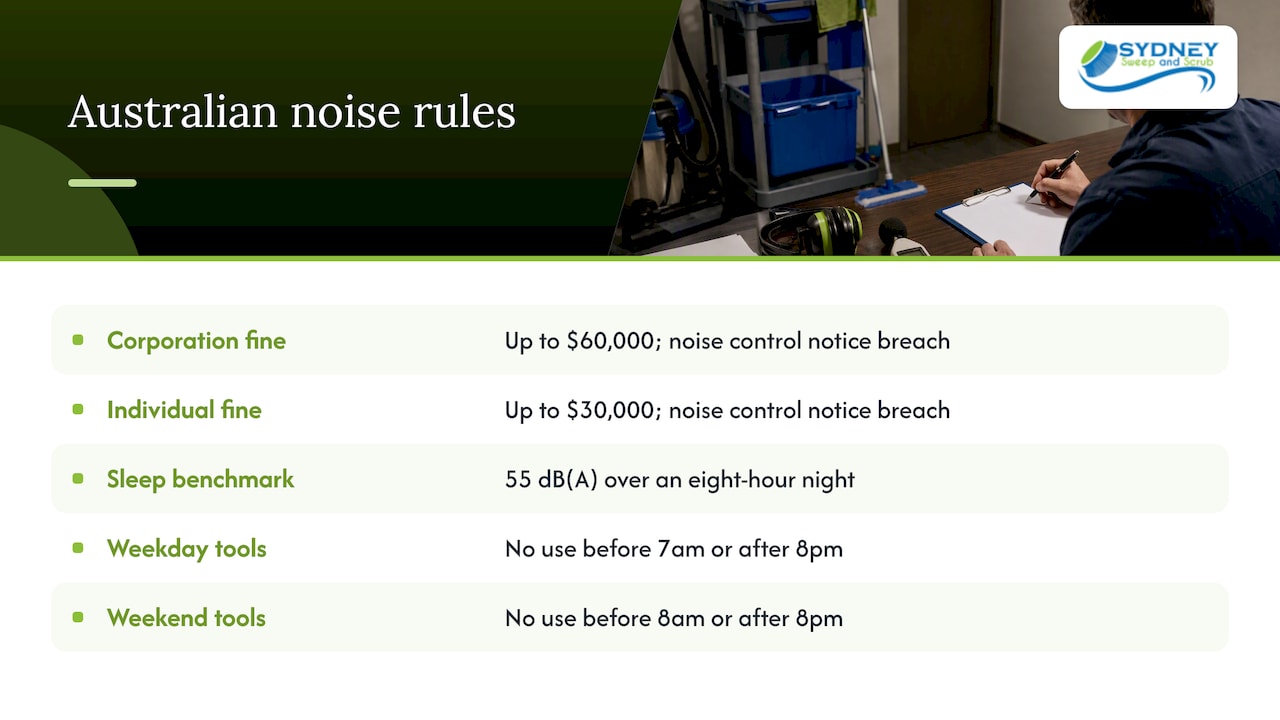
The penalties are real. Contravening a noise control notice can cost a corporation up to $60,000 and an individual up to $30,000, with additional daily fines for continuing offences, according to the EPA’s guidance on preventing neighbourhood noise. Because the offensive-noise test is partly subjective, a pattern of complaints can matter as much as a meter reading.
For businesses working extended hours, the Extended Business Hours Noise Guide explains that the Noise Policy for Industry sets project noise trigger levels. These depend on the time of day, the background noise and the nearby land uses. The Noise Policy for Industry separates day, evening and night, with tighter limits at night, and uses LAeq descriptors and sleep-disturbance screening levels to decide when a detailed assessment is needed.
Health guidance gives the practical benchmark. Australian guidance consistent with WHO advice suggests 55 dB(A) at the façade over an eight-hour night to protect sleep, and links environmental noise exposure with sleep disturbance and longer-term health risks. Treat it as your yardstick even where local rules differ.
Time restrictions on common equipment vary by state and council. In NSW, some powered tools and garden equipment are prohibited in residential areas before 7am or after 8pm on weekdays, and before 8am or after 8pm on weekends and public holidays. Check your council’s published rules, because local limits can be stricter than the state baseline.
Who enforces noise rules and when to contact them
Several bodies handle noise, and knowing which one to contact can save time. The City of Sydney neighbourhood noise fact sheet explains that councils, the EPA and police play different roles, and that mechanical plant and equipment fall within neighbourhood noise.
Local councils and police generally regulate neighbourhood noise, including the timing of noisy activities. Councils are the first contact for residential complaints and can refer matters to the EPA where appropriate. The EPA focuses on licensed industrial premises and major sources. For an urgent disturbance, contact the appropriate local authority.
Investigators may consider whether noise is offensive and, where relevant, measured levels and sleep-disturbance screening levels. Screening levels in the Noise Policy for Industry, for instance, include an LAFmax of 52 dB(A) trigger in some assessments, which is why a single loud clang can matter more than steady background hum.
Possible outcomes include a warning, a noise control notice, an abatement direction or a fine. Each step is easier to avoid than to unwind, so proactive mitigation is the cheaper path.
Practical steps to reduce night cleaning noise on site
Complaints can arise from a range of controllable sources. Work through these in order.
- Choose quieter equipment. Prefer electric or low-noise models, and keep mufflers and bearings maintained so a worn machine does not become your loudest asset.
- Avoid metal-on-metal impacts. Dragging bins, dropping tools and slamming gates carry far at night, so use padded surfaces and slower handling.
- Review reversing alarms where safe. Consider quieter equipment and other best-practice noise controls, as outlined in the Extended Business Hours Noise Guide.
- Cluster and stagger noisy tasks. Run loud work in the least sensitive hours and avoid starting several noisy activities at once, which stacks the peaks.
- Keep work away from residential boundaries. Locate noisy tasks as far from bedrooms as the site allows, and use temporary screens or enclosures where practical.
- Close doors and windows where safe. It is a free way to cut transmission from loading docks and plant rooms.
Timing matters most around dawn. Refuse-collection guidance from EPA Victoria notes that the main annoyance is early morning, before 7am, and recommends routing and timing work to avoid residential disturbance. The same logic applies to sweeping and scrubbing.
Crew behaviour counts too. Brief your team on quiet-work practice, keep shouted conversation to a minimum, and clean up spills immediately. The City of Sydney’s model waste contract specification asks contractors to keep noise to a minimum, remove spilt material at once and keep vehicles stationary while emptying mobile bins. Those are sensible habits for any night crew.
Finally, keep a noise log, run spot checks and tell nearby residents before planned noisy tasks, with a promised response window for complaints. Our routine cleaning approach for public spaces shows how scheduling and equipment choices fit together, and our post-event cleaning tips cover timing and notification in practice. Where residents already face traffic or plant noise, receiver-side measures such as better glazing can also lower what they hear indoors.
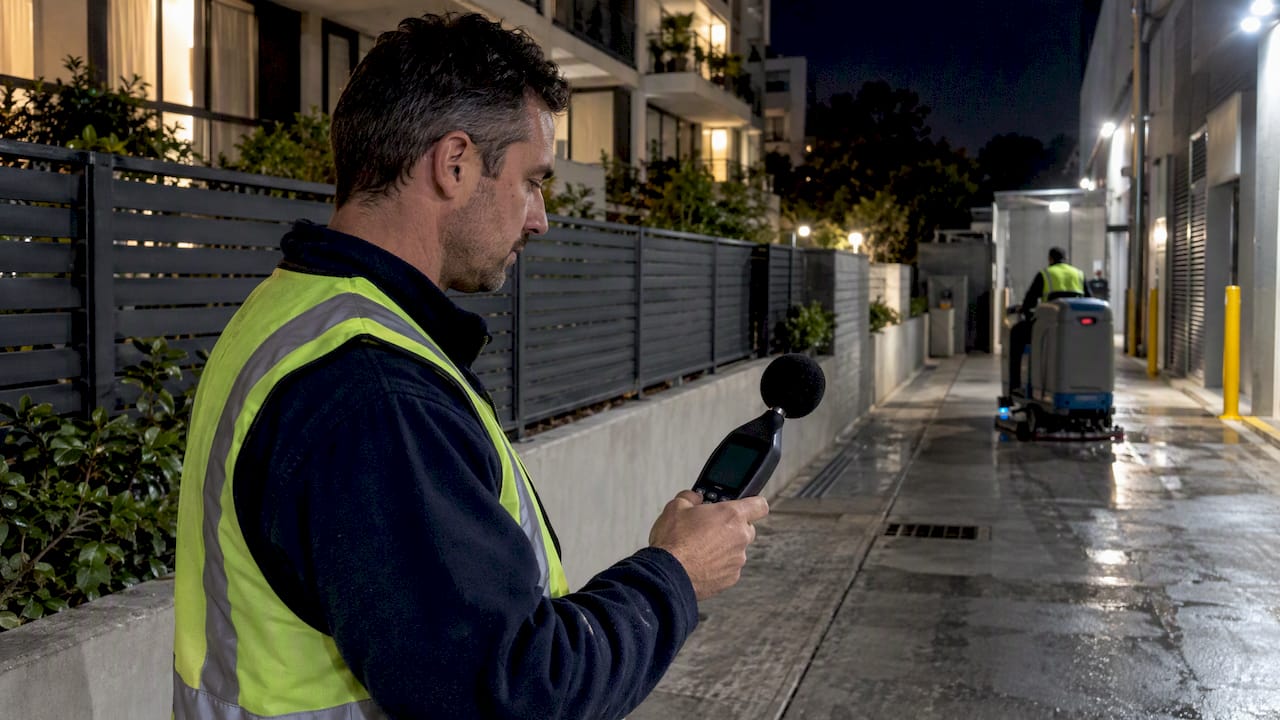
Pro Tip: Record a short baseline reading at your nearest residential boundary during a quiet night, then repeat it while the machines run. The difference tells you whether you are adding a few decibels or a lot.
Contract and procurement controls for after-hours cleaning
Noise management works best when it is written into the contract, not left to goodwill. Start by defining permitted operating windows and a designated early start and late finish. Require written approval for any deviation, along with a notification plan. The City of Sydney’s model contract specification takes this approach for collections: a published schedule, with council consent needed for changes.
Next, set equipment and conduct obligations. Specify low-noise equipment types, require machinery to be maintained, and demand prompt repair or replacement of noisy plant. Set performance standards and remedies as well. Because after-hours services happen when staff are absent, residents often notice problems the next day, so the City of Sydney’s noise reporting guidance points to contractually requiring missed collections or noise issues to be resolved within a short, specified timeframe.
- Name the permitted hours and the approval process for any change.
- List approved equipment and require maintenance records.
- Set a complaint-response window and a rectification deadline for missed or noisy services.
- Require incident logs and proof of crew training.
- Include a neighbour-notification protocol as a tender evaluation criterion.
A written scope protects both sides, and our guide on insisting on a written scope for after-hours cleaning walks through what to include.
Pro Tip: Score tenders on how the contractor will handle a complaint, not only on price. A short, specific response plan is a good sign that the crew takes noise seriously.
What to do if neighbours complain
Act on the day you hear. Check your logs and any CCTV for the time in question, contact the contractor, and offer a fix. Write down every action you take, because prompt, documented management is the strongest evidence that you treat the issue seriously.
If a resident escalates, expect the council, EPA or police to ask for specifics: the time and day of events, any recordings, your logs and witness details. The EPA’s explainer on how it investigates noise shows that councils are usually the first stop and can pass complex cases on. Call police only for an active disturbance, and the council for a recurring pattern.
Possible outcomes range from a warning to a noise control notice, a fine or an order. The EPA’s penalty figures of up to $60,000 for corporations and $30,000 for individuals apply to contravening a notice, and daily fines can add up if the problem continues.
After you resolve the immediate issue, keep the records, follow up with the complainant, and adjust the schedule or equipment. A clean paper trail also helps if the dispute reaches a formal process.
Practitioner insights: why these measures work
Early-morning collections and activity in the small hours generate the most complaints, which is why route planning and timing reduce exposure so effectively. The EPA Victoria guidance identifies early morning as the main annoyance period for refuse collection. Our cleaning services can be scheduled to suit site needs.
Regulators can act on subjective reports. EPA Victoria notes that the nature and timing of an activity can be enough to deem it unreasonable without a decibel reading, so nuisance and sleep disturbance can trigger investigation on their own. Proactive mitigation and a fast response remove the administrative and reputational cost of enforcement.
Contract clauses with a short repair or recall window limit escalation by tenants and neighbours alike. Ask contractors to commit to rectifying missed or noisy services quickly. Our commercial cleaning and warehouse cleaning pages provide more information about these services.
FAQ
What are the noise restrictions in the City of Sydney?
The City of Sydney handles neighbourhood noise under NSW law, and its fact sheet explains offensive noise and the role of council, EPA and police. Some powered tools and garden equipment are restricted in residential areas before 7am and after 8pm on weekdays, so check the council’s current rules for your site.
What time should you be quiet for neighbours?
In NSW residential areas, some powered tools and garden equipment are restricted before 7am or after 8pm on weekdays, and before 8am or after 8pm on weekends and public holidays. Sleep guidance points to a night benchmark of 55 dB(A), so keep late-night work as quiet as practical.
What are the noise laws in South Australia and Melbourne?
Each state sets its own rules. In Victoria, EPA Victoria can treat the nature and timing of an activity as unreasonable noise without a meter reading. For South Australia, check the state EPA and your local council directly, because limits differ by location and activity.
What happens if I ignore a noise complaint?
A complaint can escalate to a warning, a noise control notice, an abatement direction or a fine. Penalties for contravening a notice reach $60,000 for corporations, so respond quickly and keep records.
Sources
- Preventing neighbourhood noise | EPA
- Extended Business Hours Noise Guide
- Neighbourhood noise fact sheet