
The controls that stop most pressure cleaning downtime are simple: right-sized equipment, documented preventative maintenance, a small stock of critical spare parts, a properly designed wash-water and recovery setup, and a pre-job substrate check before the machine even starts. Together these address both the mechanical failures that halt a crew mid-shift and the site issues, like full containment or a suspected asbestos surface, that stop a job even when the gear is running fine.
TL;DR:
- Most downtime is caused by small, recurring equipment failures such as hose cracks, nozzle clogs, or detergent injector issues, not rare catastrophic failures.
- Tracking and analyzing cause codes from detailed logs help identify the most frequent failure points, like hoses or sediment traps, to inform targeted replacements.
- Wastewater containment limits and substrate hazards, like asbestos or silica, are common overlooked causes of work stoppages that require proper planning and substrate screening.
- Having rapid-response vendor relationships and on-site spare parts reduces repair lead times and minimizes multi-day operational delays.
Table of Contents
- What actually causes pressure cleaning downtime
- How to measure the true cost of downtime by cause
- Preventative maintenance that reduces unplanned stops
- Five-minute pre-start checks that prevent the most common failures
- Wastewater and hazardous substrates: plan them out before you start
- Emergency response and vendor relationships that cut repair lead times
- How Sydney Sweep and Scrub helps reduce downtime
- Authoritative guidance to consult
- A practical next step for facility managers
- Sources
- FAQ
What actually causes pressure cleaning downtime
Most unplanned stops trace back to a short list of repeat offenders rather than rare catastrophic failures. An undersized pump working beyond its rated flow overheats and trips out, hoses crack or burst at pressure cycling points, nozzles wear or clog with grit, and detergent dosing systems lose prime or drift out of ratio.
- Undersized or mismatched pumps that overheat under sustained load
- Hose and nozzle wear, including cracked fittings and clogged orifices
- Detergent injector failure or incorrect dosing that stalls a clean mid-job
- Water pressure or supply issues, including inconsistent mains feed
- Access and traffic hold points that delay setup or force relocation
- Weather delays and wash-water containment reaching capacity
The site and process causes are just as costly as mechanical ones. A carpark job can stall because a sediment trap fills before the run is finished, or because a delivery truck blocks the only access point for an hour. Weather rarely stops hot water cleaning outright but can shut down high-pressure work on exposed rooftops or elevated decks.
The pattern that matters most for a maintenance budget is that small, recurring failures cost more over a year than one big breakdown. A nozzle that clogs twice a week, or a hose that needs replacing every few months because it was never rated for the pressure cycle, quietly eats far more crew time than a single pump failure that gets fixed once and forgotten.
How to measure the true cost of downtime by cause
You cannot fix what you do not track, and pressure cleaning downtime is easy to underestimate when it is spread across small stoppages rather than one dramatic breakdown. A basic log, kept on a clipboard or a shared spreadsheet, turns guesswork into a repair-or-replace decision.
- Record the start and stop time of every stoppage, however short.
- Note the crew idle minutes and the number of people affected.
- Log the direct repair or parts cost against a simple cause code (pump, hose, nozzle, detergent, water supply, access, weather, containment, regulatory).
- Calculate the daily or weekly cost: idle labour minutes converted to an hourly rate, plus repair and parts cost, plus any knock-on delay to the next booked job.
- Review cause codes monthly to see which failure type is driving the most lost time, not just which one happened most recently.
Once you have a few months of data, the pattern usually points to one or two equipment items or process gaps that justify a bigger fix, whether that is replacing an underrated hose across the whole fleet or investing in a second sediment trap so containment capacity never becomes the bottleneck.
Preventative maintenance that reduces unplanned stops
A maintenance schedule only works if it matches how hard the equipment is actually used. Daily pre-starts catch the obvious faults, weekly visual checks catch developing wear, and quarterly hose and pump inspections catch the failures that build up slowly under repeated pressure cycles. Major servicing should follow manufacturer guidance and be carried out annually or at the intervals the maker sets, and specialist repairs are best left to suitably qualified people, as recommended in guidance on high-pressure water jetting.
- Test hoses when new, after any repair, re-ending or exposure to adverse conditions, and keep a written record of every test.
- Check nozzle condition and spray pattern weekly, since a worn nozzle raises pressure demand and speeds up pump wear.
- Clean or replace filters on schedule, since a blocked filter starves the pump and triggers overheating faults.
- Check pump oil level and condition, and inspect belt tension on schedule rather than waiting for a failure.
- Keep a rotating minimum spares list on-site: hose assemblies, common seals, nozzle kits, and simple valves.
Set a trigger rule for replacement rather than repeat repair: if the same component fails more than twice in a defined period, replace the unit or the whole assembly instead of patching it again.
Pro Tip: Keep a simple failure register by equipment ID. It takes minutes to update and is the fastest way to spot the one item quietly causing most of your downtime.

Five-minute pre-start checks that prevent the most common failures
Most on-shift stoppages are trivial to prevent if the crew runs a short pre-start routine before the first spray.
- Inspect the hose along its full length for cracks, bulges or loose fittings.
- Confirm the correct nozzle is fitted and clear of debris.
- Check water supply pressure at the source before connecting.
- Prime the detergent pump and confirm dosing ratio with a quick test spray.
- Log the check with time, operator name and any fault noted.
This record does more than catch faults early. It supports scheduled servicing decisions and gives you a paper trail if a client disputes a delay or a result. Treat any hose that has been re-ended or repaired as suspect until it has been properly pressure-tested rather than assuming a quick fix is safe to run.
Wastewater and hazardous substrates: plan them out before you start
A machine can be fully operational while the job itself is stopped, and this is one of the most underrated causes of pressure cleaning downtime. Wash-water recovery systems and sediment traps have finite capacity, and once they are full, the crew has to stop and pump out before continuing, exactly the risk flagged in guidance on mechanical-equipment wash-down.
- Screen the substrate before mobilising: a suspected asbestos-containing surface must stop work and trigger a competent assessment, as set out in a 2026 alert on high-pressure cleaning of asbestos roofs, which warns that discovering asbestos after mobilisation can halt a job outright.
- Check for silica-generating surfaces and use industrial-rated wet extraction rather than dry sweeping or compressed air, following guidance on industrial vacuum cleaners and hazardous dust.
- Confirm trade-waste consent conditions and servicing intervals for pre-treatment equipment before discharge, since breaches can force a suspension of work.
- Design the wash-down area with an impervious pad, bunding and detention sized for the job’s peak flow, so containment capacity is never the reason a crew stands idle.
Emergency response and vendor relationships that cut repair lead times
A failure only becomes a multi-day outage when there is no plan behind it. Keep hose assemblies, common seals, nozzle kits and simple valves on-site as critical spares, and negotiate a rapid-response agreement with your equipment supplier that sets a clear call-out response time, priority access for booked contracts, and an agreed parts list.
- Use quick diagnostic triage on-site to decide whether to swap a part or repair it later, rather than stopping the whole job to diagnose fully.
- Keep the failure history log from your maintenance programme handy when negotiating supplier terms or lodging a warranty claim, since a documented pattern carries more weight than a one-off complaint.
How Sydney Sweep and Scrub helps reduce downtime
Some professional cleaning companies build uptime controls directly into their service model rather than treating them as an afterthought. Scheduled maintenance contracts, pre-job substrate surveys and wash-water design are part of how jobs are planned, and hot water pressure cleaning handles greasy or oily soils faster than cold water on repeat visits. For high-use sites like carparks and warehouses, automated robotic cleaning reduces the repetitive manual runs where wear and downtime accumulate fastest. Facility managers can request a site audit or set up recurring servicing through the pressure washing or warehouse cleaning service pages.
Authoritative guidance to consult
For compliance backing the maintenance plan above, see guidance on high-pressure water jetting on hose testing and recordkeeping, the asbestos roof cleaning alert on substrate screening, and wash-down containment guidance on wastewater controls.
A practical next step for facility managers
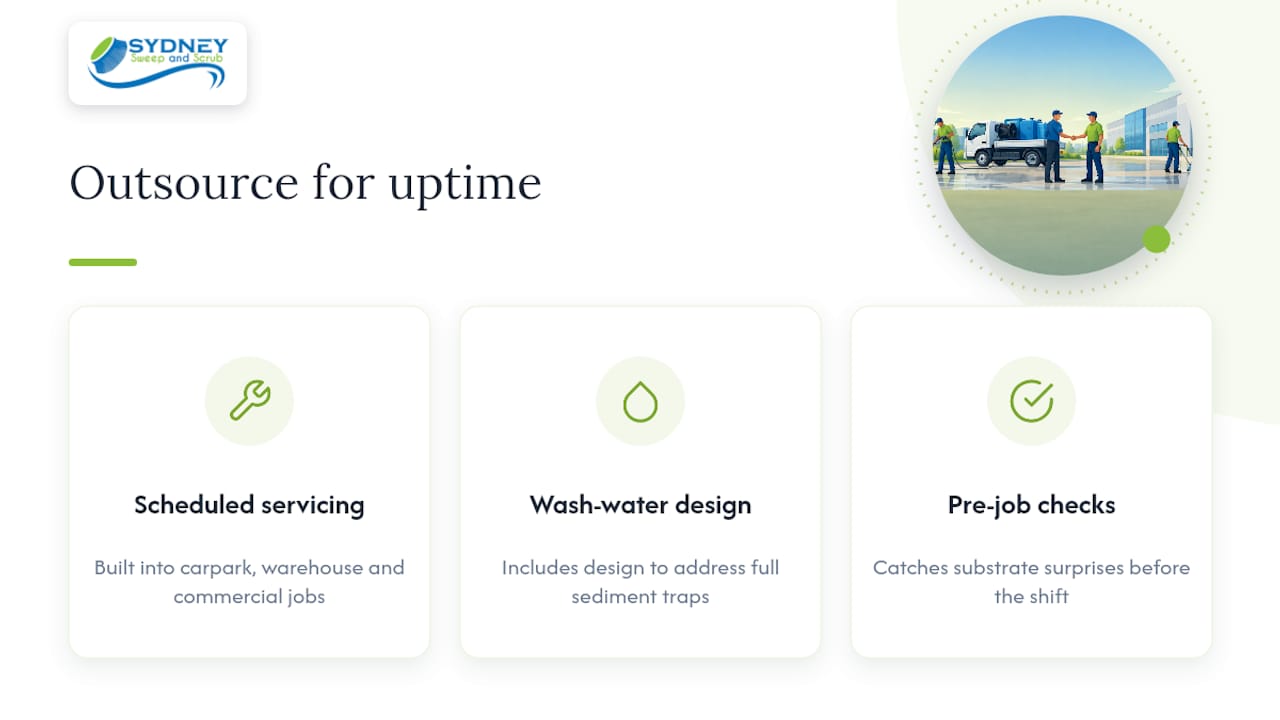
If your team is losing hours to hose failures, full sediment traps or last-minute substrate surprises, the fastest fix is often to hand the maintenance planning to someone who already runs it daily. Sydney Sweep and Scrub combines scheduled servicing, wash-water design and pre-job checks across carpark cleaning, warehouse cleaning and commercial pressure washing, so the operational gaps covered in this article are built into the job from the start rather than discovered mid-shift. That matters most for sites with recurring cleaning needs, like carparks, loading docks and construction sites, where one avoidable stoppage can push out an entire week’s schedule.
For teams comparing methods, our notes on pressure washing with cold water and common mistakes to avoid when pressure washing cover related operational pitfalls. To get a site audit or set up a recurring contract, book a pressure washing service and get a plan built around your site’s actual failure points.
Sources
- WorkSafe Queensland: High-pressure water cleaning on an asbestos roof (alert 2026)
- Water Quality Protection Note 68 — mechanical-equipment wash-down (Western Australia)
FAQ
How long does a house stay clean after pressure washing?
This depends heavily on the site, traffic and weather rather than a fixed period. Commercial sites with vehicle traffic or exposed carparks tend to accumulate grime faster than sheltered areas, which is why scheduled recurring cleaning suits high-traffic sites better than one-off jobs.
How long should a pressure washing job take?
Job duration depends on surface area, soil type and equipment condition, and there is no universal figure. A well-maintained machine with the correct nozzle and dosing setup finishes faster and with fewer stoppages than one running on worn parts or an undersized pump.
What happens if you pressure wash and paint after 24 hours?
Painting over a surface that has not fully dried can trap moisture under the coating and affect adhesion. Drying time varies with substrate, temperature and airflow, so it is safer to confirm the surface is fully dry rather than relying on a fixed waiting period.
How many times a year should you pressure wash commercial surfaces?
Frequency depends on foot and vehicle traffic, exposure to soiling, and any trade-waste or lease conditions that set minimum servicing intervals. High-use sites like carparks and warehouse floors generally need a more frequent schedule than low-traffic areas, and a recurring maintenance contract is the simplest way to match frequency to actual wear.