
Hire a commercial cleaning contractor that uses wastewater capture or filtration to stop runoff reaching the stormwater system, and get written confirmation before the job starts. Ask for a method statement, proof of public liability insurance and a clear waste disposal plan. Lock in the work window and pedestrian management arrangements at the same time, so there are no surprises on the day.
TL;DR:
- Using wastewater capture or filtration is crucial for environmentally responsible footpath cleaning near stormwater drains; ensure contractors can provide proof before work begins.
- Proper site preparation, such as clearing obstacles and notifying nearby tenants, can speed up cleaning and reduce liability during the job.
- Most routine cleaning in Sydney does not need a specific permit, but compliance requires avoiding wash water entering stormwater drains and meeting trade wastewater regulations when applicable.
- Contractors should use a logical cleaning sequence—dry removal, spot treatment, pressure washing with capture—to minimize detergent use and environmental impact.
- Request clear documentation of wastewater management methods, insurance, and safety plans upfront to avoid enforcement risks and ensure lawful, eco-friendly cleaning practices.
Table of Contents
- Quick checklist: when to call a footpath cleaning contractor and what to check first
- What responsible contractors do on site: mechanical sweeping, pressure washing and clean-capture systems
- Legal and environmental must-knows for Sydney sites
- How to choose and brief a footpath cleaning contractor
- Site preparation and what to expect on the day
- Safety and WHS responsibilities for property managers and contractors
- Sustainability and wastewater control options to expect
- Specific application process and requirements for obtaining a footpath cleaning permit in Sydney
- Relevant Sydney local council regulations and contact information for permits
- Timeline: how long the permit approval process typically takes
- Conditions and restrictions commonly imposed by Sydney councils on footpath cleaning permits
- Penalties and enforcement actions for cleaning without a proper permit in Sydney
- How Sydney Sweep and Scrub can help and how to request a quote
- Sources
- FAQ
Quick checklist: when to call a footpath cleaning contractor and what to check first
Footpaths need professional attention when staining builds up, litter accumulates after weekends or events, or when a site is prepping for line marking or a safety audit. Grease, chewing gum and general grime on a public footpath are also a slip hazard, not just an appearance issue.
Before you book anyone, confirm a few things upfront.
- Ask how they plan to manage wastewater, since this determines whether the job can even proceed near a stormwater drain.
- Check what equipment they use: sweeper, scrubber, pressure washer or a combination.
- Request current insurance, licensing and at least one reference from a similar job.
- Ask for a method statement and safety data sheets for any chemicals involved.
- Confirm they can supply proof of filtration or wastewater capture, plus public liability cover.
A contractor who cannot answer these quickly is one to avoid, regardless of price.
What responsible contractors do on site: mechanical sweeping, pressure washing and clean-capture systems
A well-run job follows a logical order. Mechanical sweeping or scrubbing comes first, removing loose grit, leaves and rubbish before any liquid touches the surface. This step alone deals with most of the visible mess and reduces how much detergent is needed later.
Stubborn stains, such as old gum or oil marks, get spot-treated next. Pressure washing follows, and the choice between hot and cold water, or a surface cleaner attachment, depends on the type of grime and how sensitive the surrounding surfaces are. Hot water lifts grease more effectively; low-pressure surface cleaners reduce spray drift in tight, high-foot-traffic areas.
The part that matters most environmentally is what happens to the water. Clean-capture systems, bunding and portable tanks collect wash water on the spot instead of letting it run into gutters and drains. Good operators also keep detergent use to a minimum and avoid misting or overspray that can drift onto neighbouring shopfronts or pedestrians.
Pro Tip: Ask whether the contractor’s pressure washing methods include capture as standard, not as an optional extra.
- Dry removal first, chemicals second, water last: this sequence cuts detergent use and avoids pooling.
- Portable capture tanks let cleaning happen even where there is no floor drain nearby.
Legal and environmental must-knows for Sydney sites
As the property or facility manager, you carry the duty of care even when a contractor causes the pollution. If wash water runs into a drain, the responsibility for that breach can land back on the site owner or manager, not just the crew that did the work.
NSW EPA guidance states that wash water must never enter stormwater drains, and recommends designated wash bays, bunding and staff training to prevent pollution reaching waterways. That single principle, “the drain is just for rain,” should sit behind every footpath cleaning brief you write.
Some jobs also trigger formal trade waste rules. Sydney Water requires commercial customers to meet pre-treatment and backflow prevention standards, and some discharges need formal approval through Sydney Water’s Tap in® system.
- Check whether the job is a low-risk, deemed process or one that needs formal Sydney Water approval.
- Ask your contractor how they intend to dispose of collected wash water, and where.
- Contact Sydney Water or your local council directly when a site has an unusual layout, a nearby waterway, or history of drainage issues.
How to choose and brief a footpath cleaning contractor
Selecting a contractor for a public footpath is different from hiring someone for a private car park. You need proof of documented wastewater capture, real experience working in busy pedestrian areas, a functioning WHS system, current insurance and contactable references.
When you get a quote, ask direct questions and expect direct answers.
- How will you capture and dispose of wash water, and where does it go afterwards?
- Can you provide a method statement and safe work method statement (SWMS) before the job starts?
- What are your public liability insurance limits, and can you send a certificate of currency?
- How do you manage pedestrian traffic during the clean?
- What is included in the price, and is it a one-off rate or part of a scheduled arrangement?
A proper contract or work order should cover the scope of works, a traffic and pedestrian management plan, confirmation of how waste will be disposed of, the timing window, and a sign-off step once the job is done.
Pricing for footpath cleaning is usually structured as a per-event rate, an hourly rate for specialist plant such as pressure washers or sweepers, or a discounted rate under a scheduled maintenance contract; the exact rates vary depending on the service provider and scope. High-traffic locations, such as retail strips or building entries, often make more sense on a recurring schedule than as one-off callouts, since regular cleaning prevents the heavy build-up that costs more to remove later, especially considering how high-rise living affects your pest control needs.
Site preparation and what to expect on the day
A bit of preparation on your end makes the job faster and reduces liability. Before the crew arrives, clear loose items such as sandwich boards or bins, notify tenants or shop owners nearby, flag any known hazards, and confirm an alternate route for pedestrians if the footpath will be fully blocked at any point.
On site, the sequence is usually sweep and scrub first, spot treatment of stains next, then pressure washing with capture, followed by collection and removal of the wastewater.
- Expect signage, cones and a short diversion around the work zone while cleaning is underway.
- A competent crew manages foot traffic actively rather than just placing a sign and walking away.
- Ask for a completion note, a waste handling receipt, and photos of the finished area once the job wraps up.
Safety and WHS responsibilities for property managers and contractors
Safe Work Australia treats cleaning as a legitimate engineering control for slips and trips, but warns that poor technique, such as over-using detergents or leaving surfaces wet, can actually increase the risk of a fall rather than reduce it.
Property managers should expect trained operators, documented equipment safeguards, and evidence that the crew knows how to run high-pressure equipment safely rather than just point and spray.
- Confirm operators use foot-control devices and hose protection measures suited to high-pressure jetting equipment.
- Ask who is responsible for immediate pedestrian safety and incident response while the job is underway.
- Request copies of the method statement, SWMS and any incident log kept for the site.
- Basic PPE, eye and hand protection at minimum, should be visible and non-negotiable on site.
Keeping these records on file protects you if a slip or fall is ever reported after a cleaning job.
Sustainability and wastewater control options to expect
Clean-capture technology and filtration let cleaning happen without sending pollutants into the stormwater system, and often without shutting a site down for hours. Council guidance, including a footpath cleaning brochure from the City of Newcastle, notes that this kind of technology allows cleaning to proceed during business hours without misting, overspray or pooling on the footpath.
If a contractor claims to be carbon-neutral or eco-friendly, ask what backs that up. Evidence of offsets, recycled-water use or a defined chemical policy is a fair thing to request before you take the claim at face value.
- Green practices can shift the price or the time slot available, so weigh that against your operational needs.
- Ask for equipment specifications or examples from past jobs rather than accepting a general sustainability pitch.
Pro Tip: A sustainability-focused commercial cleaning guide is a useful reference point when comparing quotes on eco claims.
Specific application process and requirements for obtaining a footpath cleaning permit in Sydney
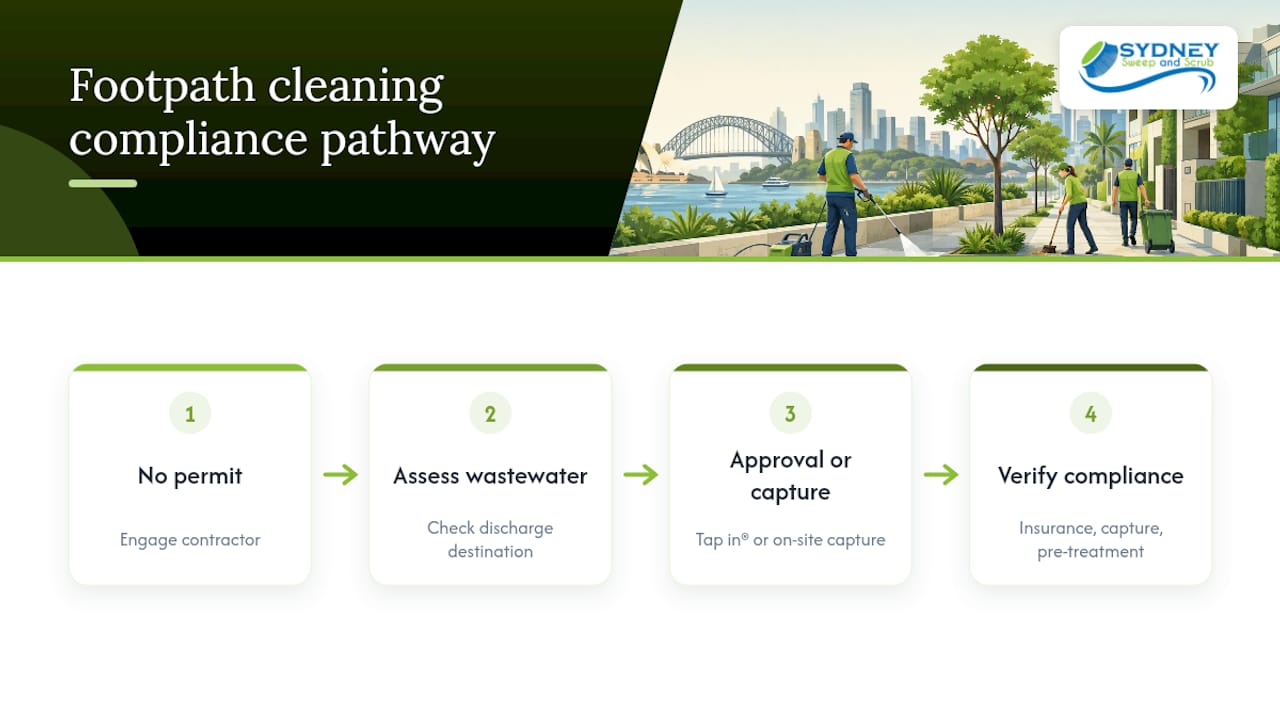
For a property or facility manager booking commercial footpath cleaning in Sydney, there is no separate government “cleaning permit” to apply for in the way you might apply for a road occupancy licence. Cleaning a footpath as a commercial service is a matter of engaging a qualified contractor and making sure the work meets existing environmental and safety rules, not a standalone approvals process.
The practical requirements sit with two bodies. Where a job might discharge wash water into the sewer system rather than the stormwater drain, Sydney Water’s trade wastewater requirements may apply, and some commercial customers need to install pre-treatment equipment or apply through Sydney Water’s online Tap in® portal. Whether that applies to a given footpath clean depends on the volume and nature of the wastewater, and your contractor should be able to tell you if the job falls into that category.
Beyond that, your responsibility as the person booking the work is to confirm the contractor operates lawfully: current public liability insurance, a documented method for keeping wash water out of stormwater drains, and, where relevant, evidence of pre-treatment compliance. Councils publish general guidance on footpath cleaning practice, such as the brochure from the City of Newcastle, which recommends minimal detergent use and wastewater capture as standard practice for anyone cleaning a public footpath commercially.
In short, the “application” most property managers need to complete is a proper contractor brief and compliance check, not a council form.
Relevant Sydney local council regulations and contact information for permits
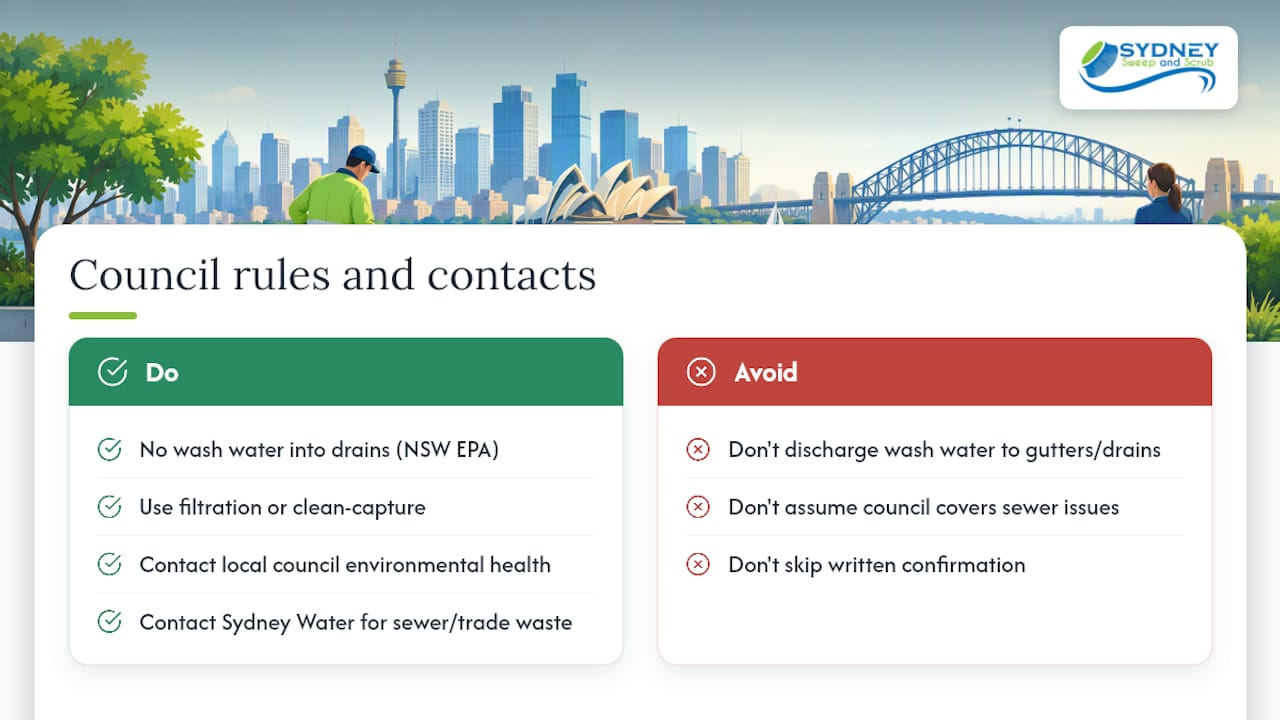
Each Sydney council sets its own local rules for activity on public footpaths, and these mostly concern things like footpath dining, signage or construction hoarding rather than routine commercial cleaning. Where cleaning intersects with council rules, it is usually about environmental protection under NSW-wide legislation rather than a council-specific cleaning licence.
Councils across Sydney generally point businesses back to the same core principle found in NSW EPA stormwater guidance: wash water must not enter the drain. Some councils, including the City of Newcastle in its published footpath cleaning brochure, go further and set out preferred methods, such as recommending contractors use filtration or clean-capture equipment and dispose of wastewater to sewer rather than the gutter.
If your site sits within the City of Sydney, Inner West, Northern Beaches or another Sydney council area, the most direct path is to contact that council’s environmental health or compliance team to confirm whether any local notification is expected for the type of cleaning you are planning, particularly for larger or recurring jobs in busy retail precincts. For anything touching the sewer network or trade waste, Sydney Water remains the primary point of contact rather than the local council.
Because these requirements sit across a few different bodies, the simplest approach is to ask your chosen contractor to confirm, in writing, which rules apply to your specific site and job.
Timeline: how long the permit approval process typically takes
There is no fixed “permit approval” timeline for routine footpath cleaning in Sydney, because most jobs do not require a formal permit at all. Timeframes only become relevant when a site’s wastewater needs to go through Sydney Water’s trade wastewater approval process rather than being handled entirely on site through capture and removal.
For jobs that do not trigger a Sydney Water approval, which covers the large majority of standard footpath sweeping and pressure washing work, the practical timeline is simply how quickly you can book a contractor and confirm the work order. Many commercial cleaning bookings can be arranged within days once a scope, access arrangement and pedestrian management plan are agreed.
Where trade wastewater approval is genuinely needed, for example a large or recurring commercial site connecting to the sewer network for wastewater disposal, that process runs through Sydney Water separately from the cleaning booking itself and should be started well ahead of the planned clean, since pre-treatment installation and approval can take longer than the cleaning job itself. The best way to avoid delays is to raise the wastewater question with your contractor and, if needed, Sydney Water at the same time you first scope the job, rather than after you have already picked a date.
Conditions and restrictions commonly imposed by Sydney councils on footpath cleaning permits
Because most footpath cleaning in Sydney does not require a specific permit, the “conditions” that matter in practice come from environmental and safety obligations rather than a council approval letter. The consistent condition across every source is the same: wash water and cleaning runoff must not enter the stormwater system.
Typical expectations that apply to commercial footpath cleaning across Sydney include using bunding, portable tanks or clean-capture equipment to stop wash water reaching gutters and drains, keeping detergent use to a minimum, and disposing of collected wastewater to sewer or an authorised facility rather than the street. Council guidance, such as the City of Newcastle’s footpath cleaning brochure, frames these as best practice recommendations for any business or contractor cleaning a public footpath, and Sydney councils generally expect the same standard even where they have not published their own brochure.
Where a site sits near a waterway, in a heritage precinct or in a busy pedestrian zone, expect extra practical restrictions layered on by the property manager or event organiser rather than the council: fixed working hours to avoid peak foot traffic, signage and cones for pedestrian safety, and sign-off from building management before the crew leaves. These are sensible operational conditions rather than legal permit conditions, but they matter just as much for a smooth job.
Penalties and enforcement actions for cleaning without a proper permit in Sydney
Since routine commercial footpath cleaning generally does not require a specific permit, there is no separate “unpermitted cleaning” offence to worry about in most cases. The real enforcement risk sits with environmental pollution, not paperwork.
Letting wash water, detergent or debris run into a stormwater drain is a pollution incident under NSW environmental law, and the NSW EPA’s guidance is explicit that the drain is only for rain. A business, property manager or contractor responsible for that discharge can face enforcement action from the EPA or the local council, separate from any Sydney Water trade wastewater breach if pre-treatment or approval requirements were ignored.
The safest position for a property or facility manager is to treat compliance as the contractor’s job to demonstrate, not yours to guess at. Requiring a method statement and proof of wastewater capture before work begins is the simplest way to avoid ever being on the wrong side of an enforcement conversation.
How Sydney Sweep and Scrub can help and how to request a quote
A family-owned business covering mechanical sweeping, pressure washing and clean-capture cleaning for footpaths, car parks, warehouses and public spaces across Sydney. That combination matters for footpath work specifically: sweeping clears solids first, pressure washing lifts ground-in grime, and capture systems keep the wastewater out of the drain.
The business runs on cutting-edge equipment and eco-friendly, carbon-neutral operations, with flexible online booking and pricing as part of its positioning.
- Mechanical sweeping and scrubbing to clear loose debris before any water is used.
- Pressure washing, including hot water options, for grease and ground-in stains.
- Clean-capture systems that keep wash water out of stormwater drains.
- Line-marking prep and de-flooding for sites that need more than a standard clean.
Before booking, ask for a method statement, confirmation of the wastewater capture method, insurance details and available scheduling windows. Visit the carpark and footpath cleaning page to see the service in detail or request a quote directly through the site.
Sources
- Slips, trips and falls | Safe Work Australia
- Commercial trade wastewater | Sydney Water
- Guidance for stormwater management: the drain is just for rain | EPA NSW
- Footpath cleaning – City of Newcastle
FAQ
Do I need a permit to have a footpath cleaned in Sydney?
No separate government permit is generally required for commercial footpath cleaning in Sydney. The main requirement is choosing a contractor who prevents wash water from entering stormwater drains and, where relevant, meets Sydney Water’s trade wastewater rules.
Who is responsible if cleaning wastewater pollutes a drain?
The property manager or business that engaged the cleaning can be held responsible alongside the contractor, since NSW EPA guidance makes clear that stormwater drains are only for rain. That is why confirming a contractor’s wastewater capture method before booking matters so much.
What should I ask a footpath cleaning contractor before booking?
Ask how they capture and dispose of wash water, whether they can supply a method statement and safe work method statement, and what their public liability insurance covers. A contractor unable to answer these clearly is a risk regardless of their quoted price.
Can footpath cleaning happen during business hours?
Yes, when a contractor uses clean-capture or filtration equipment that avoids misting, overspray and pooling, as recommended in council guidance such as the City of Newcastle’s footpath cleaning brochure. This lets cleaning happen without shutting a site down for hours.
Does Sydney Sweep and Scrub offer footpath cleaning services?
Yes, mechanical sweeping, pressure washing and clean-capture cleaning services are available suited to footpaths, car parks and public spaces across Sydney. Quotes and scheduling are available through its carpark cleaning page.