
Dry sweeping and compressed-air blowing are not acceptable on Australian construction sites where respirable crystalline silica may be present. Compliant methods are wet sweeping with water carts or surfactant, low-pressure hosing, and M-class or H-class vacuums fitted with HEPA filtration. Every principal contractor must fold these controls into a safe work method statement, apply traffic controls around powered sweepers, and keep maintenance and air-monitoring records when the risk profile is uncertain.
TL;DR:
- Wet sweeping with water or surfactant, along with HEPA-filtered vacuums, is the only compliant method for dust control on Australian construction sites.
- Mechanical sweepers require built-in suppression and controlled speeds to avoid increasing airborne silica dust, especially without functioning dust suppression systems.
- Air monitoring is mandatory when control effectiveness is uncertain, and exposures near or above 0.05 mg/m³ require health review and control adjustments.
- Sweeping activities must be documented in SWMS, traffic managed as powered mobile plant, and included in environmental management plans where necessary.
- Regular, weather-dependent cleaning at high-traffic zones and exit points with proper recordkeeping reduces track-out and contamination risks.
Table of Contents
- Quick compliance checklist site managers can apply today
- Acceptable sweeping and dust-control methods: wet sweeping, mechanical sweepers and H/M vacs
- Managing respirable crystalline silica: exposure standard and controls
- Integrating sweeping into SWMS, traffic management and the CEMP
- Practical sweeping routines: frequency, zones, and preventing track-out
- Equipment selection, maintenance and operator controls
- Recordkeeping, air monitoring and verifying your controls
- Enforcement, common breaches and immediate remediation steps
- How a compliant cleaning service handles sweeping on-site
- Primary Australian regulator and guidance links to retain
- Get compliant site sweeping without adding to your own workload
- Sources
- FAQ
Quick compliance checklist site managers can apply today
The principal contractor, as the PCBU, carries the primary duty to control dust and sweeping tasks, but day-to-day execution is usually delegated to site supervisors, leading hands, and the workers actually running the sweeper or vacuum. That delegation needs to be explicit: someone has to own the daily cleaning schedule, and someone has to sign off that the safe work method statement actually reflects what happens on the ground.
A toolbox talk or induction is the right place to run through what is banned and what is required before work starts.
- Avoid: dry sweeping, general-purpose domestic or shop vacuums, and compressed air for clearing dust or debris.
- Do: name the sweeping method in the SWMS, run a daily or shift-based cleaning schedule, install wheel-wash points at site exits, and log equipment maintenance and operator training.
- Check: wind conditions and visible dust plumes before starting earthworks or demolition sweeping.
- Escalate: trigger air monitoring when a new task, plant type, or material introduces uncertainty about whether exposure sits below the workplace exposure standard.
Air monitoring is not something every site needs constantly, but it becomes necessary whenever a control’s effectiveness cannot be confirmed by observation alone, for instance after introducing a new dry-cutting process or when workers report dust despite suppression measures. If monitoring shows exposures near or above the standard, or if a worker has used respiratory protective equipment for more than 30 days in a year, health monitoring obligations follow. Regulators do not need to be notified for routine dust management, but a notifiable incident, such as a significant uncontrolled release affecting neighbouring properties, should be escalated to the relevant state WHS regulator or EPA without delay.
This checklist works best as a laminated one-pager next to the site diary, not as a document buried in a folder. Auditors and inspectors tend to ask supervisors to explain the checklist from memory before asking to see the paperwork, so treat it as a working tool rather than a compliance formality.
Acceptable sweeping and dust-control methods: wet sweeping, mechanical sweepers and H/M vacs
Three method families cover almost every sweeping task on an Australian construction site: wet sweeping, mechanical sweeping with dust suppression, and vacuum collection through M-class or H-class units. Choosing between them depends on the material, the surface, and how much water the site can spare.
Wet sweeping works by wetting the dust before it becomes airborne, either through a fine spray from a water cart or a hand-held hose at low pressure. Adding a surfactant improves how well fine particles clump together, which reduces re-suspension once the water evaporates. This method suits open areas, stockpile perimeters, and general housekeeping where dust is fine and widespread. It is the cheapest control to deploy but depends on a reliable water supply, which is not always available on remote or drought-affected sites.
Mechanical sweepers, the ride-on or towed units used on larger pads and access roads, need their own dust suppression built in, usually a water spray at the brush head or a shrouded pickup point. Operators should run at a controlled speed, because a sweeper moving too fast simply throws dust into the air rather than collecting it. National Safe Work Australia guidance is explicit that dry sweeping and compressed air disturb settled silica dust and increase exposure, which is why any mechanical sweeper without functioning suppression should be taken out of service rather than run dry “just for today.”
M-class and H-class vacuums are the third pillar, and the distinction matters more than most site teams realise. M-class units filter down to a medium hazard level and suit general construction dust; H-class units use HEPA filtration rated for the highest hazard materials, including silica-containing dust from cutting, grinding, or drilling. A domestic or general-purpose shop vacuum does neither job properly: its filtration is not rated to capture respirable particles, so it can pass fine silica dust straight through the exhaust and back into the breathing zone. Guidance from Queensland WorkSafe and the model Code of Practice’s Appendix 4 controls table prioritise H-class vacuums where practicable, precisely because of this filtration gap.
- Wet sweeping suits open ground, stockpile edges, and areas without heavy machinery traffic.
- Mechanical sweepers with suppression suit access roads, hardstands, and large paved areas.
- M-class vacuums suit general construction dust from routine cleanup.
- H-class vacuums suit any task involving cutting, grinding, drilling, or other silica-generating work.
Water supply is the practical constraint that trips up a lot of otherwise well-planned sites. Remote sites, drought-affected regions, or projects with strict water-use conditions in their development consent may need to lean more heavily on vacuum collection or scheduled deliveries of water by tanker. Where surfactant use is restricted, for example near waterways with runoff conditions, a mechanical sweeper with a sealed collection hopper and H-class filtration becomes the practical fallback rather than an optional upgrade.
Pro Tip: Match the method to the material before the shift starts, not halfway through it. A site running dry-cut concrete in the morning and general housekeeping in the afternoon needs an H-class vacuum for the first task and can usually switch to wet sweeping for the second.
Managing respirable crystalline silica: exposure standard and controls
Respirable crystalline silica is the hazard that sets the bar for every sweeping decision on a construction site, and the workplace exposure standard is the number every control has to beat.
The workplace exposure standard for respirable crystalline silica is 0.05 mg/m³ as an 8-hour time-weighted average, and Safe Work Australia’s guidance requires exposure to be reduced as low as reasonably practicable rather than treating the standard as a target to sit just under. That distinction matters on-site: a control that keeps exposure at 0.04 mg/m³ is not automatically “good enough” if a cheaper or more reliable control could push it lower again.
The hierarchy of controls applies here the same way it does to any other WHS hazard, and sweeping tasks map onto it cleanly.
- Elimination or substitution: using pre-cut or pre-fabricated materials to avoid on-site cutting and grinding where possible.
- Engineering controls: water suppression at the point of dust generation, on-tool extraction for cutting and grinding equipment, and H-class vacuum collection for cleanup.
- Administrative controls: scheduling dust-generating tasks away from other trades, rotating workers to limit exposure duration, and enforcing the daily cleaning schedule.
- Respiratory protective equipment: fit-tested RPE as the last line of defence, never the primary control.
Tasks that generate significant respirable dust, increasing risk during housekeeping, include cutting or grinding of concrete, masonry, tiles, demolition activities, and handling of dry sand, cement, or aggregate stockpiles in windy conditions. Sweeping up after these tasks with the wrong method, dry sweeping or a domestic vacuum, effectively re-creates the exposure the original task caused.
Air monitoring earns its place when a site cannot be confident, just by looking, that controls are working. Safe Work Australia’s national guide calls for statistically valid sampling, meaning enough samples, correctly timed against the task being monitored, and collected with calibrated pumps, so the resulting report will actually stand up if a regulator asks for it. A single sample taken on a quiet day tells you very little; task-based sampling across a representative shift is what gives a defensible result.
Health monitoring becomes a separate obligation once a worker needs to rely on respiratory protective equipment for an extended period over the year, as specified by regulation, a threshold worth tracking in training and PPE-issue records rather than estimating after the fact.
Integrating sweeping into SWMS, traffic management and the CEMP
Sweeping stops being a housekeeping afterthought and becomes a documented, high-risk activity the moment it involves powered mobile plant, silica-generating cleanup, or operation near public roads or pedestrians. At that point it needs a place in the SWMS, and on larger projects, a mention in the construction environmental management plan.
- Confirm the risk trigger. A site running a ride-on sweeper on a public-facing access road, or a vacuum collecting dry-cut concrete dust, meets the threshold for a documented SWMS entry rather than a verbal instruction.
- Write the sweeping method into the SWMS. Name the specific method (wet sweeping, mechanical sweeper with suppression, H-class vacuum), the hazard it controls, and the operator competency required.
- Apply traffic controls to powered sweepers. Safe Work Australia’s traffic management guidance treats sweepers as powered mobile plant, which means exclusion zones, separated travel routes, spotters, and signage apply just as they would to an excavator or a delivery truck. Sites commonly miss this because a sweeper looks like a maintenance tool rather than mobile plant, and that gap is one of the more frequent findings in site audits.
- Add an air-quality sub-plan to the CEMP where triggered. EPA NSW’s local government air quality toolkit recommends that projects with significant potential for off-site air impacts include a dedicated air-quality sub-plan covering suppression methods, wheel-wash operation, and cleaning schedules, and many local councils make this a condition of development consent rather than a voluntary extra.
- Record operator competency checks. Whoever runs the mechanical sweeper or the H-class vacuum should have documented training against the SWMS, not just informal on-the-job instruction, so the competency check itself becomes part of the audit trail.
The CEMP sub-plan and the SWMS should reference the same cleaning schedule and the same suppression methods rather than describing them differently in two documents, which is a small detail that saves a lot of confusion when an auditor cross-checks paperwork against what is happening on-site. Traffic management plans that treat sweepers as an afterthought are one of the easier gaps to close, and closing it before an inspection is far cheaper than explaining it during one.
Practical sweeping routines: frequency, zones, and preventing track-out
“Clean as you go” is the operating principle behind every workable sweeping schedule, and it works because it treats dust and debris control as continuous rather than something dealt with at the end of a shift once material has already spread.
Site exits, stockpile areas, loading zones, and any high-traffic corridor between plant and public roads deserve the most frequent attention, because these are the points where material leaves the controlled site and becomes a council or EPA problem rather than an internal housekeeping one.
- Daily sweeping of access roads and hardstands, more often during extended dry spells or high wind.
- Post-earthworks sweeping immediately after excavation, demolition, or bulk material handling, before the next trade moves through the area.
- Wheel-wash checks at every site exit, logged against a simple pass or fail note in the site diary.
- Stockpile perimeter sweeping after any delivery or handling activity that disturbs the pile.
Frequency should scale with weather rather than sit on a fixed calendar. A wet week might only need alternate-day sweeping of access roads, while a run of hot, windy days can justify twice-daily attention to stockpile areas and exits. Logging this against actual conditions, not just a generic roster, is what turns a cleaning schedule into evidence rather than a guess.
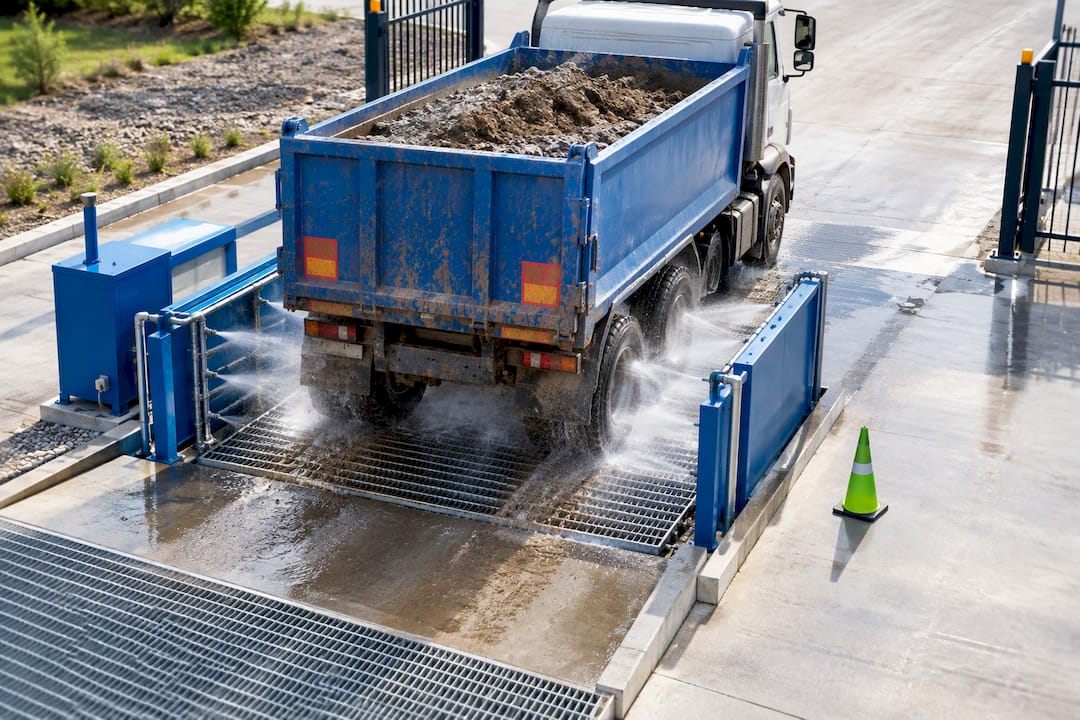
Rumble grids and wheel-wash bays are the physical controls that stop sediment leaving on tyres before sweeping even becomes necessary. A rumble grid dislodges loose material through vibration as a vehicle drives over it, while a wheel-wash bay uses a water spray or bath to strip mud and dust from tyres before the vehicle reaches a public road. Both are cheaper to run than repeatedly cleaning up track-out on the street outside the site, and both reduce the chance of a complaint reaching the local council in the first place.
Stockpiles benefit from more than sweeping around their base. Temporary screens or hoardings on the windward side cut wind-driven dust significantly on exposed sites, and where a stockpile is going to sit for weeks rather than days, short-term revegetation or a light mulch cover can hold the surface down between deliveries. None of this replaces sweeping, but it reduces how much material reaches the sweeping zone in the first place, which is the cheaper problem to solve.
Prevention consistently beats after-the-fact removal: a site that keeps exits clean avoids the far more expensive and reputationally damaging scenario of a council officer photographing tracked mud on a public road outside the gate.
Equipment selection, maintenance and operator controls
Procurement or hire specifications should lock in the equipment standard before a machine ever arrives on-site, because arguing about filtration class after a unit is already rented is a conversation nobody wins.
Minimum specifications worth writing into a hire agreement or purchase order include an M-class or H-class rating matched to the material being handled, sealed collection systems that do not leak dust from hopper joints or hose connections, and HEPA-grade filtration on any H-class unit used for silica-generating tasks. A supplier who cannot confirm the class rating in writing is not the right supplier for a construction site handling concrete, masonry, or tile dust.
Maintenance is where equipment quietly stops doing its job if nobody is checking.
- Filter change intervals should follow the manufacturer’s schedule, not “when it looks full.”
- Sealed bagging of collected dust at hopper-emptying time prevents re-suspension during disposal.
- Leak inspections should check hose joints, seals, and hopper lids for dust escape, not just filter condition.
- Hopper emptying should happen downwind of workers and public areas, into sealed containers, away from busy periods.
Pro Tip: Keep a laminated copy of the manufacturer’s filter-change schedule inside the equipment cage. It stops “we’ll do it next week” becoming the default answer when a filter is overdue.
Operational controls matter as much as the machine’s rating. A mechanical sweeper run at excessive speed throws dust rather than collecting it, so operators need a documented safe operating speed in the SWMS, not just a general instruction to “be careful.” Brush settings that sit too high skim over debris instead of lifting it, which means a poorly adjusted sweeper can pass a site as “swept” while leaving material behind for the next gust of wind to disturb.
Vendor declarations, the manufacturer’s manual, and any independent filtration certification should sit in the same maintenance log as the filter-change records and inspection checklist. That single file becomes the first thing an auditor or WHS inspector asks to see, and a site that can produce it in under a minute makes a very different impression than one still searching through email attachments.
Recordkeeping, air monitoring and verifying your controls
Regulators and auditors expect a specific set of documents, not a general assurance that “we sweep regularly.”
- SWMS entries naming the sweeping method, equipment class, and operator competency requirement.
- Cleaning schedules showing frequency, zones covered, and who signed off each shift.
- Maintenance logs covering filter changes, seal inspections, and hopper-emptying procedures.
- Training records confirming operators have been briefed against the current SWMS, not an outdated version.
- Air-monitoring reports where sampling has been triggered, including the sampling method and comparison against the 0.05 mg/m³ standard.
- CEMP sections covering the air-quality sub-plan where a project has triggered that requirement.
Interpreting air-monitoring results is straightforward in principle: a result below the standard confirms the current control is adequate for that task on that day, while a result at or above it means the control needs to change before the task is repeated, not just noted for future reference. A single reading close to the standard is worth a second, statistically valid sampling round rather than either dismissal or panic.
Audit-ready sites tend to share a few habits: they consolidate records into one folder or system rather than spreading them across supervisors’ phones and site diaries, they keep filter-change receipts as physical proof rather than relying on memory, and they take dated photos of wheel-wash bays in operation, not just of the bay sitting empty. These small habits are the difference between a five-minute audit and a half-day one.
Enforcement, common breaches and immediate remediation steps
Inspectors and council officers tend to focus on the same handful of failings, because they are the easiest to spot and the most common to occur.
- Dry sweeping or compressed air still in use despite the SWMS specifying a wet or vacuum method.
- Missing SWMS entries for sweeping tasks that clearly involve powered plant or silica-generating cleanup.
- Uncontrolled track-out from site exits onto public roads, visible as mud or dust trails.
- Inadequate or non-functioning wheel-wash systems, often broken or bypassed rather than genuinely absent.
Who enforces which breach depends on scale and where the impact lands. Local councils typically act on nuisance dust and track-out affecting public roads or neighbouring properties, state EPAs step in for off-site air quality impacts and licence conditions on larger sites, and state WHS regulators handle worker exposure and safety breaches, including silica exposure above the workplace standard. EPA materials note that enforcement can extend to penalty notices or fines where dust spreads off-site in breach of licence conditions.
Immediate remediation is usually simple once a breach is identified: switch the offending equipment out of service, deploy a water cart or wet-sweeping crew to the affected area, and fix or reinstate the wheel-wash before the next vehicle movement. Where the breach has already affected a public road or a neighbouring property, notifying the local council or EPA proactively, rather than waiting for a complaint to arrive first, tends to result in a far more cooperative conversation than reactive enforcement does.
How a compliant cleaning service handles sweeping on-site
Contracting a service that already runs to these standards removes a layer of risk for the PCBU without removing the underlying duty. On a well-managed site, a compliant provider works from a cleaning schedule aligned to the SWMS, runs M-class or H-class vacuums and mechanical sweepers fitted with dust suppression rather than dry equipment, and maintains a wheel-wash program at site exits as a matter of course rather than as an afterthought.
Some cleaning providers apply this approach across construction sites, warehouses, car parks, and public spaces, using industrial-grade equipment suited to each surface and material type. Its commitment to eco-friendly, carbon-neutral operations gives clients an additional way to fold sustainability commitments into a construction environmental management plan, and its construction site cleaning services are booked directly online rather than through a lengthy procurement process.
For a principal contractor, engaging a provider that already documents maintenance, training, and cleaning frequency shifts a meaningful share of the audit burden off internal site staff, while the WHS duty itself stays with the PCBU regardless of who holds the broom or the vacuum hose.
Primary Australian regulator and guidance links to retain
Keep these documents on file as the evidence base for your controls. Safe Work Australia’s national silica guide and the model Code of Practice controls table via Queensland WorkSafe cover exposure controls, while the EPA NSW construction air quality toolkit sets out CEMP and council expectations. For broader contractor obligations, a commercial contractor licensing checklist rounds out the compliance picture.
Get compliant site sweeping without adding to your own workload
Reading the regulator guidance is one thing, running it correctly on a live construction site, shift after shift, is another. Sydney Sweep and Scrub takes that operational load off your team by handling mechanical sweeping, wet suppression, and wheel-wash operation with equipment already matched to the material and surface in front of it.
That matters most for principal contractors juggling a dozen other WHS priorities: rather than training internal staff on filtration classes and hopper-emptying procedures, you get a provider whose cleaning schedule, maintenance records, and eco-friendly operating approach are already built to sit inside your SWMS and CEMP. Flexible booking and competitive pricing keep this straightforward for construction companies, strata managers, and facility operators, with clients able to add optional waste offset participation to support their sustainability commitments.
Visit Sweep and Scrub’s construction site cleaning page to check availability and book a site sweep.
Sources
- Working with crystalline silica and silica-containing products (Safe Work guidance via Qld WorkSafe)
- National guide: working with crystalline silica and silica-containing products (Safe Work Australia)
- Local government air quality toolkit: construction sites (EPA NSW)
FAQ
Do you need a licence to clean in Australia?
Most commercial cleaning and sweeping work in Australia does not require a specific trade licence, though businesses generally need an Australian Business Number and relevant public liability insurance to operate legitimately. Specific tasks, such as handling hazardous waste or certain demolition-related cleanup, can trigger additional state-based licensing or permit requirements, so it is worth checking the relevant state WHS regulator or EPA for the task at hand.
What is the Australian standard for construction dust and silica exposure?
The workplace exposure standard for respirable crystalline silica is 0.05 mg/m³ as an 8-hour time-weighted average, set out in Safe Work Australia’s guidance and the model Code of Practice. Sites must reduce exposure as low as reasonably practicable rather than treating that figure as an acceptable target to sit just beneath.
How often should a construction site be swept for compliance?
Frequency should follow the cleaning schedule set out in the SWMS or CEMP, typically daily for access roads and high-traffic zones, and immediately after earthworks, demolition, or bulk material handling. Windy or extended dry conditions usually call for more frequent sweeping of stockpile areas and site exits, logged against actual weather rather than a fixed roster.
What PPE is required for workers doing sweeping and dust control tasks?
Respiratory protective equipment is required only where engineering and administrative controls cannot bring exposure below the workplace exposure standard, and it should be fit-tested rather than issued generically. Depending on the task, workers may also need eye protection and high-visibility clothing when operating or working near powered sweeping plant.
How should collected dust and debris be disposed of safely?
Collected dust should be bagged and sealed at the point of hopper emptying to prevent it becoming airborne again, then disposed of through a licensed waste facility appropriate to the material collected. Hoppers should be emptied downwind of workers and public areas, and away from busy periods, to avoid re-suspension during the emptying process.