
Floor cleaning automation pays off fastest in large facilities with repeatable hard-floor layouts and multi-shift operations, where robots consistently improve productivity and coverage quality. The two outcomes that matter most are consistency and labour reallocation. The trade-offs are real too: upfront cost, an ongoing service budget, and a genuine need for operational discipline before you scale past a pilot.
TL;DR:
- Large facilities with consistent, predictable floor layouts and multi-shift operations see the fastest ROI, especially when automation is paired with operational discipline.
- Autonomous scrubbers typically cost $15,000 to $85,000 depending on size and capacity, with annual servicing adding 10 to 15% of the purchase price.
- Using programmed routes and sensors ensures consistent cleaning quality, reduces water and chemical use, and minimizes variability caused by staff fatigue or turnover.
- A successful pilot involves precise mapping, clear success metrics, dedicated ownership, and monitoring intervention rates to ensure the host program is effective.
- Managed service options can lower capital risk, accelerate deployment, and include maintenance, making automation accessible without upfront equipment ownership.
Table of Contents
- What floor cleaning automation actually delivers
- How autonomous floor cleaning works: sensors and machine types
- Where automation works best: matching sites to machines
- Cost bands, running costs and building a realistic ROI model
- Running a pilot: the deployment checklist that actually matters
- Maintenance, servicing and the real causes of downtime
- Proof of clean: reports, dashboards and audits
- How Sydney Sweep and Scrub makes automation practical for your site
- Sources
- FAQ
What floor cleaning automation actually delivers
Autonomous scrubbers don’t just replace a person pushing a machine. They change how cleaning gets scheduled, verified, and staffed across a facility that runs long hours.
The biggest shift is labour reallocation with professional office cleaning. Instead of rostering staff to push scrubbers up and down the same aisles every night, you move them onto detail work, spot response, and the jobs a robot can’t do (edges, stairwells, spills that need immediate attention). A Tennant Company case study on large campus sites found autonomous scrubbers integrate into existing teams without displacing them, once the schedule and roles are rebuilt around the machine rather than bolted on top of it.
Consistency comes from the mapped route itself. A programmed path covers the same square metres, at the same pressure and detergent mix, every single run. No missed corners because someone was rushing to clock off.
Key benefits stack up like this:
- Off-peak and overnight cleaning cuts occupant disruption and reduces slip hazards during trading hours.
- Mapped routes remove the variability that comes with fatigue, rushed shifts, or staff turnover.
- Water and chemical use typically drops because dosing is programmed rather than judged by eye.
Pro Tip: Run your first automated shift during the quietest overnight window you have, then compare water use against your last three manual runs. The gap usually shows up faster than the labour savings do.
How autonomous floor cleaning works: sensors and machine types
Every autonomous scrubber navigates using some combination of LiDAR and Simultaneous Localisation and Mapping (SLAM), often backed by camera fusion for obstacle detection. LiDAR builds the spatial map; SLAM lets the machine update its position in real time as pallets move or a forklift cuts across its path. Camera-based sensors add the depth that matters most when you’re running machines through occupied hours, where a static map isn’t enough to dodge a person stepping out from behind a shelf.
Machines fall into three broad classes:
- Compact units suit tight retail floors, small warehouses, and sites with narrow aisles or frequent obstacles.
- Mid-range scrubbers cover mid-size distribution centres and car parks with wider, more predictable floor plans.
- Industrial autonomous mobile robots (AMRs) handle large-format warehouses and logistics hubs where swathe width and battery endurance matter more than manoeuvrability.
Battery chemistry affects lifecycle cost as much as sticker price. Lithium-ion packs cost more upfront but hold charge longer and degrade slower than older lead-acid alternatives, which matters when you’re running two or three shifts and can’t afford a midday charge gap.
Where automation works best: matching sites to machines
Not every floor is a good candidate, and pretending otherwise is how pilots fail. Facilities that get the strongest return share a few traits.
- Large, repeatable hard-floor areas — think polished concrete, epoxy, or sealed tile that stays in the same configuration week to week.
- Multi-shift or extended-hours operations where a robot can run overnight without competing for floor space with staff or forklifts.
- Predictable traffic patterns — warehouses, airport concourses, retail malls, and large building lobbies all fit this profile well.
- Minimal layout churn — racking, signage, and furniture that don’t move around every week, so the map stays accurate.
Sites to avoid or modify before deploying: frequent layout changes, heavy debris or construction-grade dirt, uneven thresholds or ramps, and areas with unpredictable pedestrian surges. None of these rule automation out permanently, but they usually mean a smaller pilot zone or a modified route before you commit fleet-wide.
Cost bands, running costs and building a realistic ROI model
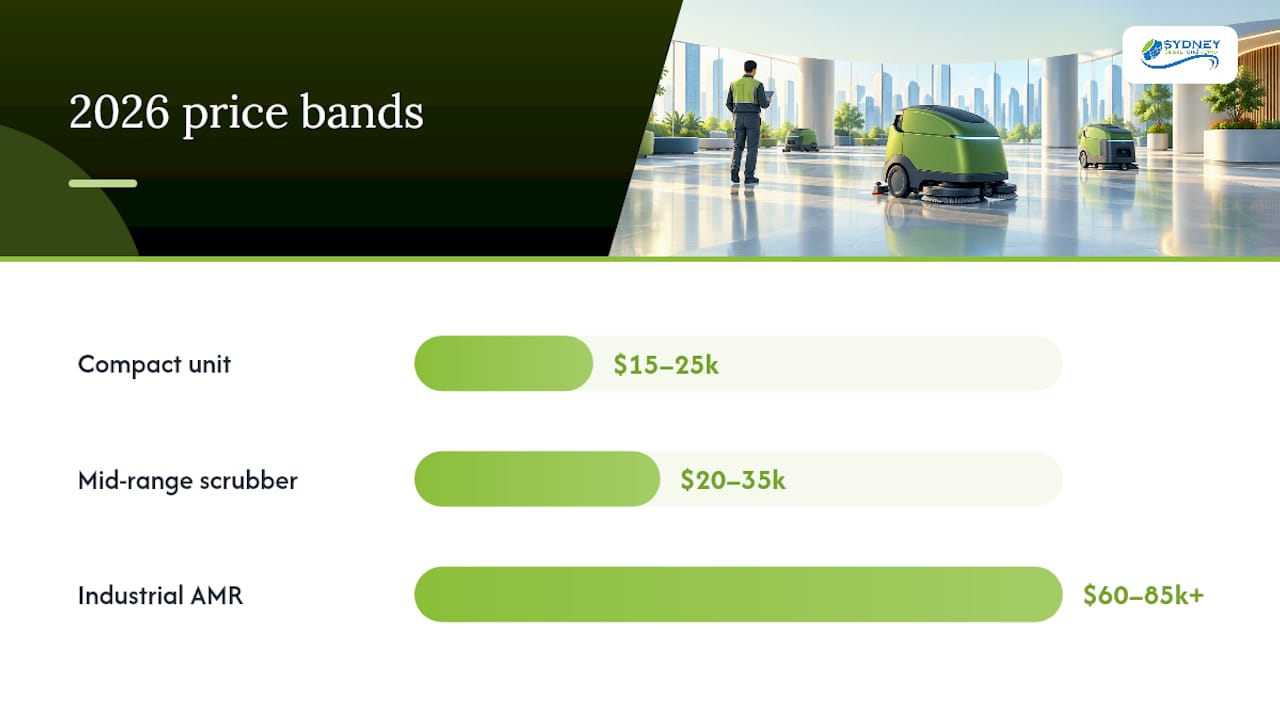
Indicative 2026 pricing splits into three bands, and the driver in each case is sensor stack and cleaning swathe width rather than brand.
| Machine class | Indicative price band | Typical fit |
|---|---|---|
| Compact unit | $15,000–$25,000 | Retail floors, small warehouses |
| Mid-range scrubber | $20,000–$35,000 | Distribution centres, car parks |
| Industrial AMR | $60,000–$85,000+ | Large-format warehouses, logistics hubs |
Those figures come from IndustrySearch’s 2026 pricing guide, which also flags annual servicing at roughly 10 to 15% of purchase price as a standing budget line, not an occasional surprise.
Beyond servicing, budget for brushes and squeegees, detergent, filters, and eventual battery replacement, all of which erode a naive ROI calculation built purely on machine price versus labour saved.
The realistic way to model payback: use practical coverage, not spec-sheet coverage. Combine that adjusted figure with your loaded labour rate (wages plus super, leave, and overheads) and payback windows of 9 to 18 months are typical at good-fit sites. Poor-fit sites stretch well beyond that or never pay back at all.
Running a pilot: the deployment checklist that actually matters
The rest is what ISSA calls the host programme: the staff training, mapping discipline, and exception handling that surrounds the robot every shift.
A workable pilot sequence looks like this:
- Map the pilot zone and pressure-test your cleaning protocols against what the robot can actually do, because assumptions about coverage and dwell time rarely survive contact with a real floor.
- Set success metrics up front — route completion rate, intervention frequency (how often a human has to step in), and cleaning quality checks against your existing standard.
- Assign clear ownership: one person owns uptime and charging schedules, another owns exception handling when the robot stops for an obstacle or a spill it can’t identify.
- Run pre-shift readiness checks and post-run inspections, and escalate recurring faults rather than working around them.
Pro Tip: Track intervention frequency from day one of the pilot, not just at the end. A robot that needs rescuing three times an hour in week one and once a week by week four tells you the host programme is working. Flat or rising numbers tell you it isn’t.
Maintenance, servicing and the real causes of downtime
Budget 10 to 15% of purchase price annually for servicing, and treat that figure as a floor for compact units and closer to the top of the range for industrial AMRs running two or three shifts a day.
Consumables have their own lifecycle. Brushes, squeegees, and filters wear on a schedule tied to run hours rather than calendar time, and battery packs typically need replacement well before the machine itself is retired.
The main uptime risks aren’t mechanical failure. They’re routing errors from an outdated map, poor dock or charging-bay planning that leaves a machine stranded mid-shift, and slow fault response when there’s no clear service-level agreement with the supplier. Remote diagnostics and a defined SLA close most of that gap before it becomes a pattern.
- Service budget: 10 to 15% of purchase price per year, non-negotiable.
- Consumables: brushes, squeegees, filters on a run-hour schedule.
- Battery: plan replacement cost into year two or three, not as a surprise.
- Routing and docking: the most common source of avoidable downtime.
Proof of clean: reports, dashboards and audits
Buyers should expect three report types as standard: coverage maps showing exactly what floor area was cleaned, run logs recording time and duration per shift, and exception reports flagging every stop, obstacle, or skipped section.
- Coverage maps let you verify a contract or internal SLA against what was actually cleaned, not what was scheduled.
- Run logs and exception data feed straight into route tuning, so week four’s run is measurably tighter than week one’s.
- Most platforms offer a dashboard and data export; confirm what’s stored, for how long, and who can access it before you sign anything.
How Sydney Sweep and Scrub makes automation practical for your site
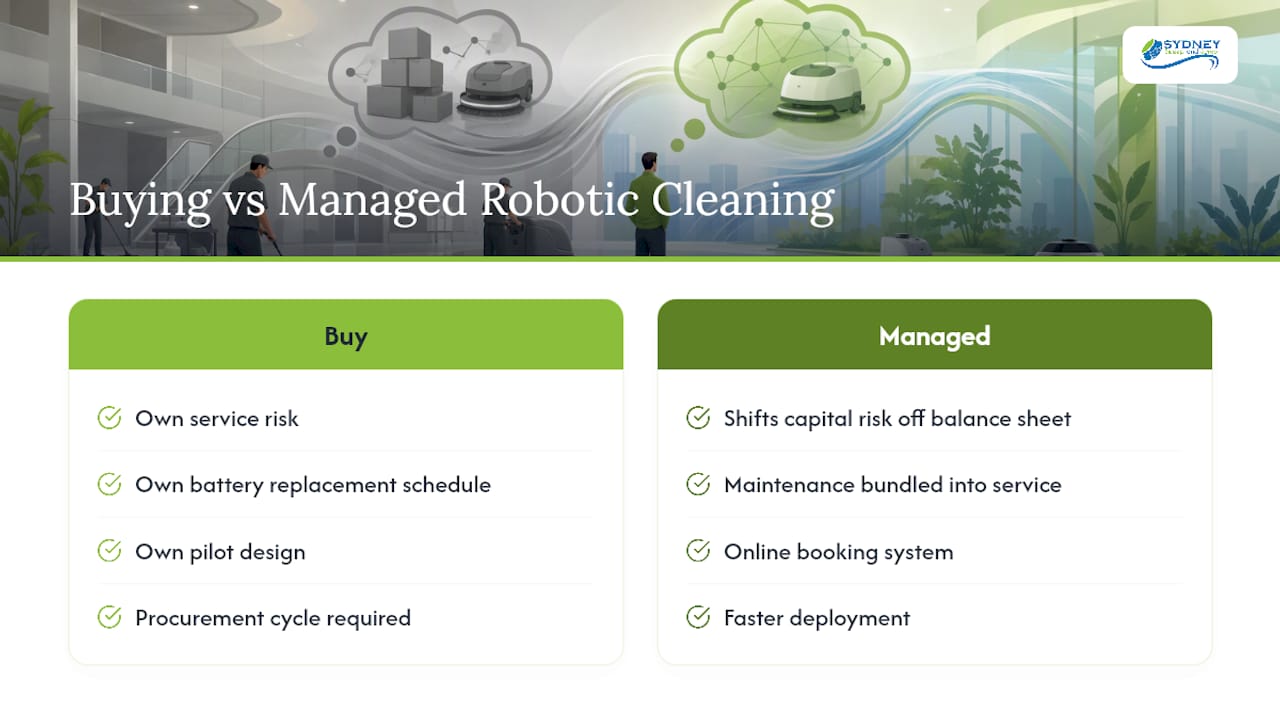
Buying a machine outright means owning the service risk, the battery replacement schedule, and the pilot design yourself. Sweepandscrub offers a different route to the same result: automated robotic cleaning for carparks and warehouses as a managed service, with eco-friendly, carbon-neutral operations and an online booking system that skips the procurement cycle most equipment purchases require.
A managed service shifts the capital risk off your balance sheet and bundles maintenance into the arrangement, so uptime becomes someone else’s problem to solve rather than yours to escalate. It also gets you cleaning faster than sourcing, testing, and training a fleet in-house. If you’re weighing that decision against buying equipment, it’s worth reading why hiring a contractor instead of buying a machine often works out cheaper over a three-year horizon.
To get a quote or a pilot running, have your floor area, current shift pattern, and existing labour hours ready. Sweepandscrub also covers warehouse cleaning and carpark cleaning contracts for sites that want a blended manual-and-automated program rather than a full robotic rollout.
Sources
- Autonomous Cleaning Robots: A Facility Manager’s Guide – Facility Management Insights
- Robotic floor cleaning robot cost in Australia 2026: full price guide — IndustrySearch
- Autonomous cleaning needs more than autonomous machines — ISSA
- Getting cleaning robotics right — pilots, people and partners — Facilities Management Advisor
FAQ
How much does a floor cleaning robot cost?
Indicative 2026 prices run from $15,000–$25,000 for compact units, $20,000–$35,000 for mid-range scrubbers, and $60,000–$85,000 or more for industrial AMRs. Annual servicing typically adds another 10 to 15% of the purchase price on top.
Are robotic floor cleaners worth it?
They’re worth it at large, repeatable hard-floor sites running multi-shift operations, where coverage consistency and productivity gains are strongest. Sites with frequent layout changes or heavy debris tend to see a weaker return.
How much are automatic floor cleaners to run day-to-day?
Beyond the purchase price, budget for annual servicing at 10 to 15%, plus brushes, squeegees, filters, detergent, and eventual battery replacement. Realistic payback at a good-fit site typically lands between 9 and 18 months once you model coverage at 50 to 70% of the spec sheet figure.
What is the best automated floor cleaner for my facility?
The right class depends on floor size and layout: compact units for tight retail spaces, mid-range scrubbers for distribution centres and car parks, and industrial AMRs for large-format warehouses. If you’d rather skip equipment ownership entirely, Sweepandscrub’s automated robotic cleaning service covers carparks and warehouses as a managed program.
Do I need a pilot before a full rollout?
Yes. A short pilot with clear metrics, mapped zones, and pressure-tested protocols is what determines whether the host programme around the robot is actually ready, and skipping it is the most common reason full rollouts underperform.