
NABERS rates how a building performs once people are actually using it; Green Star rates the design and construction intent before anyone moves in. Use Green Star to set the targets during design and procurement, then use NABERS after 12 months of operation to prove you hit them. Most commercial buildings in Australia need both at different points, not one instead of the other.
TL;DR:
- Both schemes should be used in sequence, with Green Star setting design targets before construction and NABERS verifying performance after 12 months of operation.
- A NABERS rating requires a full year of verified utility data and becomes mandatory for leasing or selling office space above disclosure thresholds.
- Green Star assessments are voluntary and focus on design intent, while NABERS measures actual energy, water, and IEQ performance based on metering data.
- Maintaining continuous, validated metering and proper documentation is critical to prevent rating drift and ensure compliance with legal disclosure requirements.
- Coordinating assessment timelines with the building handover and fixing metering gaps early can save time and money during certification processes.
Table of Contents
- NABERS vs Green Star: how the two schemes actually differ
- When to use NABERS, when to use Green Star
- BEEC, CBD and the legal side building professionals can’t skip
- Protecting your rating: what facility managers should do this quarter
- Timelines and costs to budget for
- The verdict: run both schemes, in the right order
- Where routine cleaning fits into your ratings evidence
- Where to check the official detail
- Sources
- FAQ
NABERS vs Green Star: how the two schemes actually differ
NABERS measures operational performance: energy, water, waste, and indoor environment quality (IEQ), scored on a 1 to 6 star scale built from 12 months of real utility data. There’s no design review, no credit checklist. It’s a straight measurement of what a building consumed and how it performed against similar buildings, drawn directly from your metering records.
Green Star, run by the Green Building Council of Australia (GBCA), is a voluntary certification covering design, construction, and (through Green Star Performance) operation. It works on a credit system across categories like energy, water, materials, indoor environment, and innovation. High-scoring Green Star projects report 10 to 40% less energy use and 10 to 75% less water use compared with average buildings, but that’s a design intent figure, not a guarantee of in-use performance.
The two schemes overlap most obviously on IEQ, energy, and water, but they measure them differently:
- Evidence type: Green Star relies on documents, drawings, and credit submissions; NABERS relies on 12 months of verified utility data.
- Timing: Green Star can be assessed before a building opens; NABERS can only be assessed after it has operated for a full year.
- Owner focus: Green Star suits developers and design teams chasing market positioning; NABERS suits owners and facility managers proving ongoing performance.
- Overlap point: Green Star Performance and NABERS both track operational energy and water, and the two are designed to complement rather than compete.
If your brief asks for “a Green Star building that performs,” you’re really asking for both schemes working in sequence, not a choice between them.
When to use NABERS, when to use Green Star
Sequence matters more than picking a favourite. Here’s the order that avoids rework:
- Concept and design stage: Use Green Star to set ambition and de-risk procurement decisions on glazing, HVAC systems, and materials before contracts are signed.
- Construction and handover: Pursue Green Star As Built certification to lock in what was actually delivered against the design credits.
- First 12 months of occupation: Let the building run. This is the mandatory data window before any NABERS rating can be booked.
- Post-occupancy verification: Commission a NABERS rating once you have a continuous 12-month dataset to confirm the building performs as designed.
Ownership shifts along that sequence. The developer and design team own Green Star at concept and As Built stage. The building owner and facility manager own the NABERS outcome, because it depends entirely on how the asset is run day to day, not how it was drawn.
BEEC, CBD and the legal side building professionals can’t skip
A NABERS energy rating becomes mandatory, not optional, once you’re selling or leasing office space above the common disclosure thresholds. Before you can advertise that space, you need a Building Energy Efficiency Certificate (BEEC) registered under the Commercial Building Disclosure (CBD) program.
Statistic callout: A BEEC is valid for 12 months from issue. Miss the renewal window during a transaction and you’re back to square one on data collection, not just paperwork.
Registering a BEEC on the CBD portal involves:
- Confirming your rating scope (whole building, base building, or tenancy).
- Submitting a NABERS energy assessment completed by an accredited assessor.
- Uploading the certificate to the CBD portal before marketing the space.
- Keeping the certificate current for every advertised listing period.
Non compliance carries real transaction risk. Agents can’t legally advertise a covered office space without a current BEEC, and deals have stalled at exchange when a certificate lapsed mid negotiation. A commercial property document checklist is worth building into your due diligence pack alongside the BEEC, because gaps here surface exactly when a buyer’s lawyer starts asking questions. None of it works without a clean audit trail: metering records, maintenance logs, and assessor sign-off all need to trace back to source data.
Protecting your rating: what facility managers should do this quarter
Ratings drift when data collection is patchy, not usually because a building’s fundamentals changed. Deferred HVAC maintenance is one of the most common causes of rating decline, because plant running outside spec quietly inflates energy use long before anyone notices on a bill.
Five priorities protect both your NABERS number and your Green Star Performance standing:
- Fix manual meter reading gaps. Continuous, validated metering is non negotiable for a clean 12-month NABERS dataset.
- Run preventive HVAC maintenance on a schedule tied to an asset register, not on a reactive call-out basis.
- Centralise service history, warranties, and meter logs in one place so an assessor query doesn’t turn into a week-long document hunt.
- Use a CMMS alongside energy monitoring to flag consumption anomalies and log the fix, not just the fault.
- Chase quick wins: retune BMS setpoints, trim after-hours HVAC and lighting run time, and correct scheduling drift.
Pro Tip: Book your NABERS assessment window into the facilities calendar the day your 12 month data period starts, not the day it ends. Fixing a metering gap with three weeks left in the cycle can push certification out by another full year.
Routine hard surface cleaning and carpark upkeep feed directly into this evidence base too, particularly for IEQ and site condition records, a point worth reading up on in this guide to sustainability for Sydney commercial cleaning.
Timelines and costs to budget for
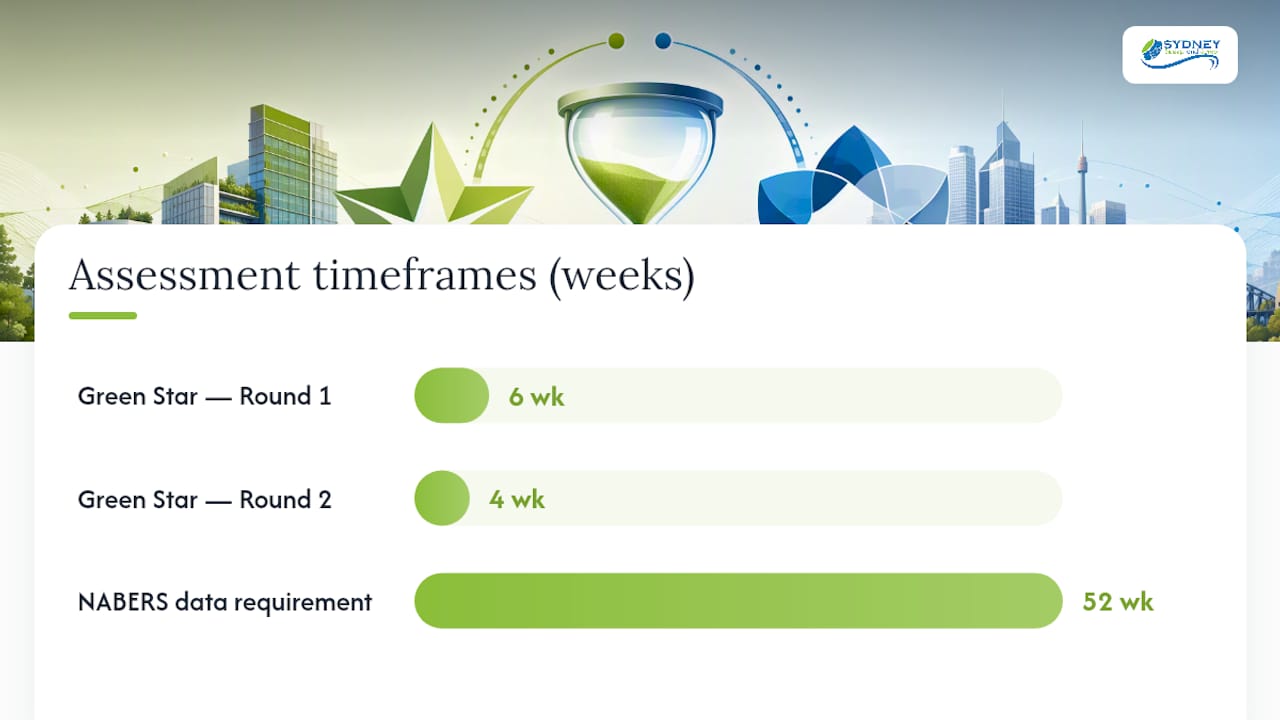
Green Star assessments typically run in two rounds: Round 1 takes around six weeks, Round 2 around four, though peak submission periods stretch that. Fees vary by tool and project scale, so confirm current pricing directly with the GBCA rather than relying on older quotes.
NABERS works on a different clock entirely. You need a continuous 12-month period of verified data before you can even book an assessor, so:
- Budget for assessor fees on both schemes, plus pre-assessment consultancy if your data or documentation has gaps.
- Factor in remedial works costs if a metering audit turns up faults partway through the 12-month window.
- Align your building handover date with the start of a clean metering period. Handing over mid quarter often means a longer wait for a usable NABERS dataset than teams expect.
The verdict: run both schemes, in the right order
Green Star and NABERS aren’t rivals. One sets the target, the other proves you hit it, and maintenance is the bridge between the two. A single star improvement in NABERS commonly cuts energy consumption by 15 to 30% and lifts asset value, and that gain comes from operations, not from redesigning the building.
Over the next 30 to 90 days:
- Confirm your rating scope and which scheme actually applies to your transaction or asset.
- Audit metering continuity and close any gaps before they cost you a quarter.
- Appoint an accredited NABERS assessor or Green Star Accredited Professional (GSAP) early.
- Lock in preventive maintenance schedules against your asset register.
- Collect outstanding service records, warranties, and BEEC documentation now, not at audit time.
Track progress against a NABERS star target, kWh/m² trend, and maintenance completion rate. Those three numbers tell you faster than any credit checklist whether the building is on track.
Where routine cleaning fits into your ratings evidence
Assessors ask for more than energy bills. Clean loading docks, well maintained carparks, and documented surface treatment all feed into IEQ credits and the general condition evidence that supports both a BEEC application and an ongoing Green Star Performance rating. It’s an easy category to overlook because it doesn’t sit on an energy meter, yet it shows up in every site inspection.
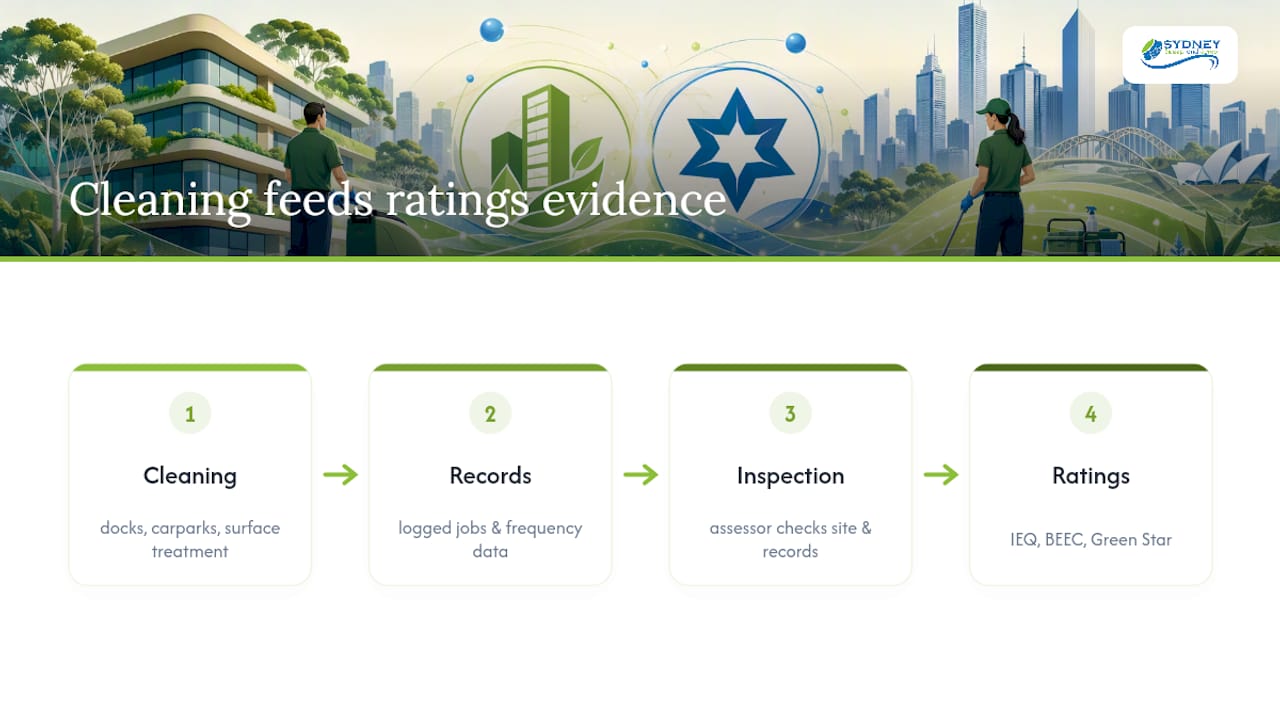
Mechanical sweeping, scrubbing, and pressure washing services can be conducted using carbon-neutral operations, which means the cleaning line item in your evidence pack comes with its own sustainability credentials attached rather than adding a gap you have to explain away. Every job is logged, so service records and cleaning frequency data are ready to drop straight into a BEEC or Green Star evidence file instead of being reconstructed from memory at audit time. If your facility handles high foot or vehicle traffic, eco-friendly pressure washing documentation is worth specifying in your maintenance contract now.
Book a hard surface cleaning assessment for your site and get service records structured the way an assessor expects to see them, before your next NABERS or Green Star review lands.
Where to check the official detail
For thresholds, forms, and assessor lists, go direct to the source: the GBCA’s Green Star performance pages, the NATSPEC technical note on environmental rating schemes, and the CBD portal for BEEC registration. Fees and rules change, so verify against these before you commit a budget.
Sources
- Green Star — GBCA (performance rating overview)
- Environmental rating schemes for buildings — NATSPEC technical note
- Green Star vs NABERS — Certified Energy
- NABERS & Green Star: Australia building rating compliance — OxMaint
- Green building certification in Australia — Duplex Building Design
FAQ
Is NABERS or Green Star mandatory?
NABERS becomes mandatory (via a BEEC) for office sale or lease transactions above the standard disclosure thresholds; Green Star is voluntary certification.
Can a building hold both ratings at once?
Yes. Most well-run commercial buildings carry a Green Star As Built certification from construction and a separate NABERS rating verifying ongoing operational performance.
How long does a NABERS rating take to get?
You need a continuous 12-month period of verified utility data before booking an assessment, so the process is scheduling-driven rather than assessor-driven.
Does better cleaning actually affect a NABERS or Green Star score?
Documented cleaning and maintenance records support IEQ credits and site condition evidence in both schemes; a service like Sweepandscrub’s hard surface cleaning helps keep that evidence audit-ready.
What happens if a BEEC lapses during a sale?
A lapsed Building Energy Efficiency Certificate stops you legally advertising the space until a new NABERS assessment and CBD registration are completed, which can delay a transaction.